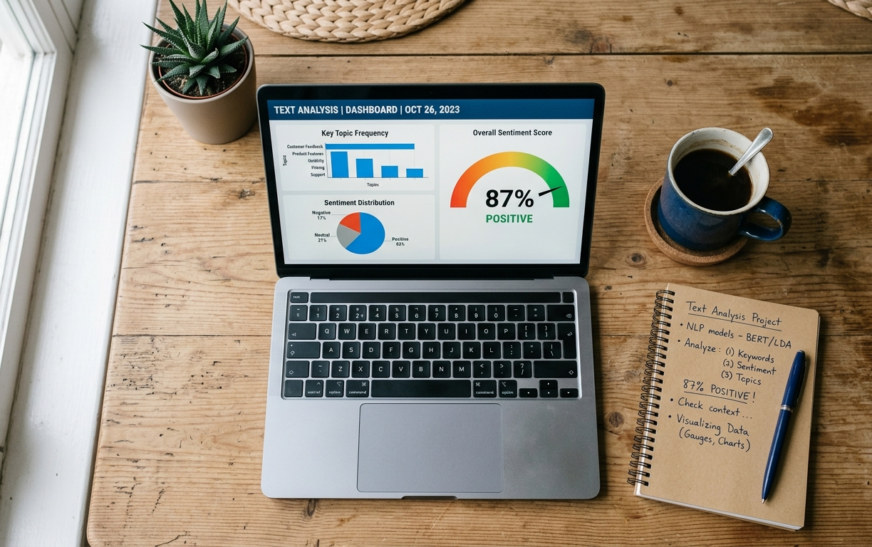
Grammarly says its AI checker is the most accurate on the market. Independent testers say it missed most of the AI text they threw at it. Both are technically telling the truth ,and if that sounds impossible, that’s exactly why this article exists.
I’ve spent time with the Grammarly AI checker, dug through independent benchmark data, and tracked the biggest news to hit this tool in years: in June 2026, Grammarly’s parent company (now called Superhuman) bought GPTZero, one of the most trusted AI detectors in the world. That deal changes what this tool is ,and what it’s about to become.
Here’s everything you need to know before you trust a Grammarly AI score, whether you’re a student sweating a submission or a writer checking your own drafts.
What Is the Grammarly AI Checker?
The Grammarly AI checker (officially “AI Detector”) is a free tool that scans text and estimates what percentage appears to be AI-generated by tools like ChatGPT, Gemini, or Claude. You paste up to roughly 1,000 words, and it returns a single AI-likelihood score in seconds — no signup required.
Grammarly launched the detector in August 2024, which raised a few eyebrows at the time because the company had previously called AI detection tools unreliable. Since then, it’s become one of the most-searched AI checkers online, mostly because millions of people already use Grammarly for grammar and spelling, so it’s the first detector they bump into.
One thing worth clearing up right away: the AI checker is not the same as Grammarly’s plagiarism checker. Plagiarism detection asks “was this copied from an existing source?” The AI detector asks “does this read like a machine wrote it?” Two different questions, two different tools, and confusing them causes a lot of panic.
How Does the Grammarly AI Checker Work?
Like most AI detectors, Grammarly’s tool analyzes statistical patterns in text ,sentence predictability, structural uniformity, and phrasing habits typical of large language models. It doesn’t “know” who wrote something; it estimates how closely the writing resembles known AI output based on its training data.
That distinction matters more than any accuracy number. AI detectors don’t have access to your writing history. They can’t see you typing at 2 a.m. All they can do is compare your finished text against patterns learned from millions of human and AI writing samples. If your writing happens to resemble those AI patterns — very consistent sentence lengths, safe word choices, textbook structure — you can get flagged even if you wrote every word yourself.
This is also why the same text can score differently on different tools, or even on the same tool on different days. The models behind detectors get updated constantly, because the AI models they’re trying to catch keep improving too. It’s a genuine arms race — the same hardware race driving better chatbots is covered in our breakdown of what’s actually happening in AI chips in 2026, and detection tools are permanently chasing that curve.
Free vs. Pro: What You Actually Get
The free Grammarly AI checker gives you one overall percentage score for up to ~1,000 words, with no signup. The Pro version (from around $12/month, as of mid-2026) adds an “AI Detector agent” that highlights which specific sentences look AI-generated, explains why, and offers one-click rewrites and citation suggestions for longer documents.
| Feature | Free | Pro |
|---|---|---|
| Word limit per scan | ~1,000 words | Up to ~5,000 words |
| Overall AI % score | Yes | Yes |
| Sentence-level highlights | No | Yes |
| Explanations for flags | No | Yes |
| One-click AI Rewriter | No | Yes |
| Citation suggestions | No | Yes |
| Signup required | No | Yes |
The free tier’s biggest weakness comes up constantly in user complaints: you get a number with zero context. If it says “34% AI,” you have no idea which 34%. For a student trying to figure out what to revise before submission, that’s close to useless — and it’s clearly designed to nudge you toward Pro.
Honest take: the sentence-level highlighting in Pro genuinely is the more useful product. Whether it’s worth $12/month depends on how often you’re being judged by AI detectors. For most casual users, the free score plus a second free tool (more on that below) covers the same ground.
How Accurate Is the Grammarly AI Checker, Really?
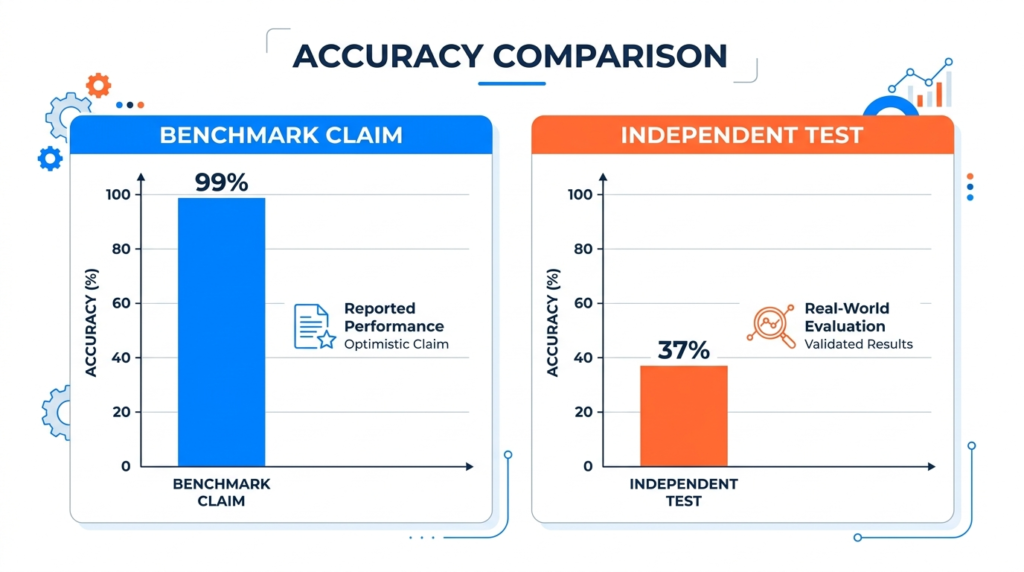
Grammarly claims 99% accuracy and a #1 ranking on the independent RAID benchmark. But multiple independent tests paint a rougher picture: PCWorld found it gave fully AI-generated text a score of just 37%, and Originality.ai’s RAID-based testing measured an F1 score of only 0.364, meaning it missed most AI content. The honest answer: it’s decent on raw, unedited AI text and weak on anything modified.
Let’s unpack the contradiction, because both sides are citing real data.
Grammarly’s side: The RAID (Robust AI Detection) benchmark is a legitimate, large-scale independent evaluation covering hundreds of thousands of text samples. Grammarly’s detector has ranked at the top of RAID’s quality leaderboard with a reported 99% accuracy figure under that benchmark’s specific settings. That’s not marketing fluff, it’s a real result under standardized conditions.
The skeptics’ side: Under different test conditions, results collapse:
- PCWorld ran a fully AI-fabricated story (written by Google Gemini) through the tool twice and got a 37% AI score both times — consistent, but consistently wrong.
- Originality.ai’s evaluation using the RAID dataset with adversarial samples reported an F1 of 0.364 and recall of 0.222 ,in plain English, it failed to catch most of the AI text, especially anything paraphrased or reformatted.
- ZDNET’s testing landed around 40% overall accuracy across mixed content types.
- Community reports (including a well-known Reddit thread in r/Grammarly) describe the same document scoring wildly differently days apart, with no edits in between.
How can both be true? Benchmark settings. Detectors have a sensitivity dial: crank it up and you catch more AI but falsely accuse more humans; turn it down and you protect humans but let AI slip through. Grammarly has deliberately tuned its detector to be conservative — it would rather miss AI text than wrongly flag a human. Under benchmark configurations that reward that tradeoff, it scores brilliantly. Under real-world conditions with paraphrased or “humanized” AI text, it lets a lot through.
For students, that conservative design is actually a feature: Grammarly is less likely than aggressive detectors to falsely accuse your genuine writing. For teachers or editors trying to catch AI use, it’s a serious limitation.
Where it consistently struggles
- Paraphrased AI text. Run ChatGPT output through any rewriting tool and Grammarly’s detection rate drops sharply — independent tests suggest it catches only a fraction of “humanized” AI content.
- Non-English and translated text. The detector is built primarily around English. Translated writing often comes out unnaturally smooth, which can confuse the scoring in both directions.
- Formal human writing. Highly structured, technical, or academic prose — especially from non-native English speakers who learned “textbook” English — occasionally trips false positives. This is a documented industry-wide problem, not unique to Grammarly, but it’s the failure mode with the highest human cost.
- Newer AI models. Detection models are trained on yesterday’s AI output. Text from the newest models tends to slip through until detectors catch up.
Grammarly vs. GPTZero, Turnitin, and Originality.ai
Grammarly’s AI checker is the most convenient option and the gentlest on human writing, but dedicated detectors are more sensitive. GPTZero catches more paraphrased AI, Originality.ai is tuned for publishers and SEO content, and Turnitin remains the de facto standard inside universities — and it’s usually the one that actually decides a student’s fate.
| Tool | Best for | Strength | Weakness |
|---|---|---|---|
| Grammarly | Quick free first check | Low false-positive rate, no signup | Misses edited/paraphrased AI |
| GPTZero | Students, educators | Sentence-level analysis, <1% claimed false-positive rate across 20 languages | Free tier has scan limits |
| Turnitin | Universities | Integrated into school systems | Not available to individuals |
| Originality.ai | Publishers, SEO teams | Aggressive detection of AI content | More false positives on human text |
A practical workflow that costs nothing: draft, run Grammarly’s free check, then cross-check anything suspicious with GPTZero’s free tier. If two independently trained detectors agree, the signal is far more meaningful than either score alone. If they disagree — which happens constantly — that disagreement itself tells you how unreliable a single number is.
AI writing tools , AI “humanizing” rewrites, and AI detection. Superhuman is effectively selling both the poison and the antidote. That’s a fair criticism — and also a reason the education market (roughly a third of Grammarly’s $700M+ annual revenue, according to reporting on the deal) is exactly who this acquisition is designed to reassure.
One caution for students: a clean Grammarly score tells you nothing about what Turnitin will say. Your university’s system uses a completely different model trained on different data. Treat Grammarly as a rough pre-check, never as clearance.
The Superhuman–GPTZero Deal: Why 2026 Changed Everything
In June 2026, Superhuman — the company formerly known as Grammarly — announced it was acquiring GPTZero, the AI detection startup with over 19 million registered users. The plan: run two independently trained detectors side by side, combine detection with process-tracking tools like Authorship and Replay, and build what both companies call an “authenticity layer” for the internet.
Some quick background, because the naming gets confusing. Grammarly acquired the Superhuman email app in 2025, then rebranded the whole parent company as Superhuman. Grammarly still exists as the writing product; Superhuman is the company behind it. Then on June 23, 2026, Superhuman announced the GPTZero acquisition (financial terms undisclosed; PitchBook had valued GPTZero above $88 million).
Why does this matter for anyone typing text into a free checker?
Two detectors beat one. Grammarly’s detector and GPTZero’s were trained on different data and make different mistakes. The companies’ stated logic is that combining them catches more AI while cross-checking false positives. If they execute well, the Grammarly AI checker of 2027 could be substantially more reliable than today’s version.
The focus is shifting from detection to proof. Both companies are pushing tools that track how a document was written rather than just scoring the finished text ,Grammarly’s Authorship records what was typed versus pasted versus AI-generated, and GPTZero’s Replay does something similar. That’s a smarter answer to the false-positive problem than any percentage score will ever be.
There’s an irony worth naming. The same company sells AI writing tools, AI “humanizing” rewrites, and AI detection. Superhuman is effectively selling both the poison and the antidote. That’s a fair criticism — and also a reason the education market (roughly a third of Grammarly’s $700M+ annual revenue, according to reporting on the deal) is exactly who this acquisition is designed to reassure.
GPTZero continues operating as a standalone product for now, so the two-tool cross-check workflow above still works.
Falsely Flagged as AI? Here’s What to Actually Do
If your genuine writing gets flagged, don’t panic and don’t just rewrite blindly. Gather process evidence first: version history, drafts, and notes. Turn on Grammarly Authorship (or Google Docs version history) for future work, run the text through a second detector to document disagreement, and remember that no detector’s output is definitive proof ,even Grammarly says so.
This scenario is common enough that a niche legal industry has grown around defending students in academic misconduct cases. If it happens to you:
- Preserve your process evidence immediately. Google Docs version history, Word AutoSave versions, handwritten notes, research bookmarks, earlier drafts. This is the single strongest defense that exists.
- Run the flagged text through 2–3 other detectors and screenshot the results. When GPTZero says 5% and another tool says 80%, that contradiction is evidence that detection scores aren’t reliable verdicts.
- Cite the tools’ own disclaimers. Grammarly states plainly that no AI detector can conclusively determine whether AI produced a text. A score is a probability estimate, not a finding of fact.
- For future assignments, write with tracking on. Grammarly’s Authorship feature (free with an account) generates a report showing what was typed, pasted, or AI-generated. It flips the burden of proof in your favor before an accusation ever happens.
- Know your school’s actual policy. Many U.S. universities have already restricted using detector scores as sole evidence, precisely because of documented false-positive rates against non-native English speakers.

The uncomfortable truth for honest writers: clean, careful, grammatically perfect writing looks more AI-like to these tools, not less. Varied sentence lengths, personal anecdotes, and a distinct voice are your best insurance,and they also happen to make your writing better.
So Should You Use the Grammarly AI Checker?
Yes ,for what it’s actually good at. It’s a fast, free, zero-friction first look, and its conservative tuning means it rarely accuses humans falsely. That makes it one of the safer tools for checking your own work before submission.
No, if you need a verdict. It misses heavily edited AI text, its free tier gives you a context-free number, and its score will never match what Turnitin or an employer’s tool says. Anyone using it to catch AI writing (teachers, editors, hiring managers) will be disappointed and occasionally misled.
The bigger picture: single-score AI detection is a transitional technology. The Superhuman–GPTZero merger signals where this is heading ,toward process verification, where proving your work matters more than beating a probability score. Until then, treat every AI percentage the way you’d treat a weather forecast: useful signal, terrible gospel.
If you’re experimenting with AI tools yourself, the smartest move is transparency plus skill — learn to use them well rather than hide them. Our tested roundup of the best AI productivity tools we actually use in 2026 covers where AI assistance genuinely helps, and if you’re creating visual content, our guides to AI image prompts that actually work and the best free AI video generators of 2026 show how far generation tools have come — which, not coincidentally, is exactly why detection keeps getting harder.
FAQ Section
Is the Grammarly AI checker free?
Yes. The basic AI detector is free and requires no signup, with a limit of roughly 1,000 words per scan. It returns only an overall AI-likelihood percentage. Sentence-level highlights, explanations, and rewriting tools require Grammarly Pro, which starts at about $12/month as of mid-2026.
How accurate is the Grammarly AI detector?
It depends on the text. It performs well on raw, unedited AI output and ranked #1 on the independent RAID benchmark with a reported 99% accuracy. But independent tests (PCWorld, ZDNET, Originality.ai) found it scored fully AI-generated text as low as 37–40% and missed most paraphrased AI content. It’s a useful first check, not a definitive verdict.
Can Grammarly’s AI checker be wrong about human writing?
Yes. Like all detectors, it can produce false positives — especially on formal, technical, or highly structured writing, and on text by non-native English speakers. Grammarly tunes its detector conservatively to minimize this, making it less likely than aggressive detectors to falsely flag humans, but no tool is immune.
Does using Grammarly’s grammar suggestions make my writing get flagged as AI?
Standard grammar and spelling corrections generally don’t make human writing read as AI-generated. However, heavier features — full-sentence rewrites, tone adjustments, and generative suggestions — can shift your text toward AI-typical patterns that detectors (including Turnitin) may flag. If detection risk matters, use suggestions selectively and keep version history on.
What happened with Grammarly and GPTZero in 2026?
Superhuman,Grammarly’s parent company after its 2025 rebrand — announced on June 23, 2026 that it was acquiring GPTZero, an AI detection platform with 19+ million registered users. GPTZero continues as a standalone product for now, and the companies plan to combine their independently trained detectors with process-verification tools like Authorship.
Is Grammarly’s AI checker the same as Turnitin?
No. Turnitin is a separate system used by universities, trained on different data, including student submissions. A low Grammarly score does not predict a low Turnitin score. Students should treat Grammarly as a rough pre-check only ,the tool your institution uses is the one that counts.

Continue Reading on CripsyWire
For more practical AI coverage for US buyers, see our full AI tools and agents library. When you are deciding between competing tools, the reviews and comparisons section breaks down head-to-head matchups. AI features that live inside your phone are tracked in smartphones, and AI on your wrist or finger in wearables. All of this is part of CripsyWire's broader Tech coverage — start at the homepage for what is newest.