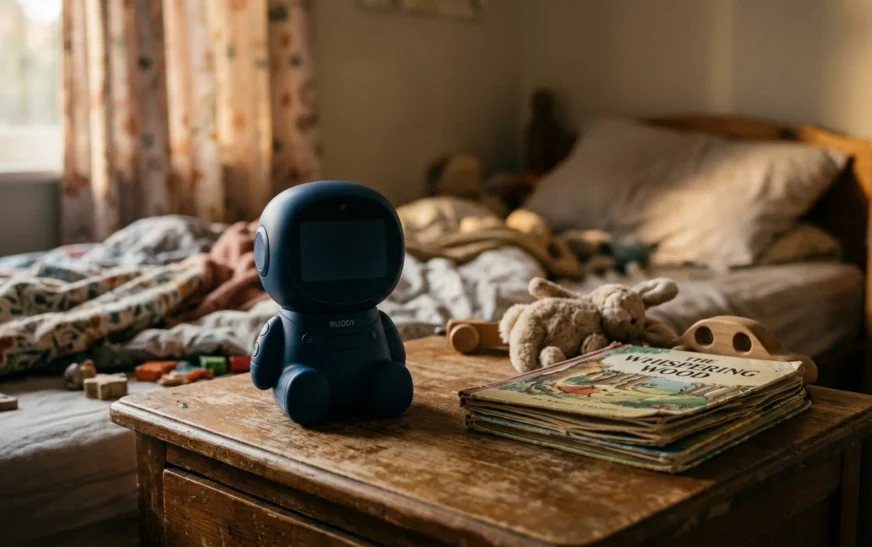
The Moxie robot is one of the saddest cautionary tales in modern consumer AI, and in 2026 it is also one of the most important. In late November 2024, the Pasadena-based startup Embodied told its customers that the company was shutting down and that every Moxie robot a $799 AI-powered companion designed for children aged 5 to 10, with a particular focus on neurodivergent kids — would stop working within days.
What followed was a wave of TikTok videos of parents trying to explain to crying children that their robot friend was, essentially, dying. It was, as one family put it, “like a sad Pixar movie.” More than 18 months later, the story of Moxie is no longer just about a single failed product. It is about what happens when AI companies treat hardware and software like they are separable and they are not.
What Moxie Actually Was
Moxie was a small, blue, expressive AI robot with a Pixar-style animated face. It launched in 2020, initially at $1,500, before settling at $799 as Embodied scaled production. The robot was marketed as a “supportive robot friend” designed to help children develop social and emotional skills through storytelling, conversation, educational games, and structured daily activities like a meditation routine called Moxie Mornings.
The robot’s appeal was that it actually worked. Reviews from speech-language pathologists, occupational therapists, and families of autistic children were genuinely positive. Moxie could hold eye contact, respond to emotional cues, and adapt its conversations to a child’s developmental level. For families who had spent years searching for tools that worked for their kids, Moxie was the rare AI product that delivered on its marketing.
The catch, which almost nobody understood at the time of purchase, was that Moxie was not really a robot. It was a remote control for a robot that lived in the cloud.
The Shutdown: What Happened in November 2024
On the morning of November 26, 2024, Embodied CEO Paolo Pirjanian sent customers an email and posted a public statement explaining that the company was closing. The cause was simple and brutal: a critical funding round had collapsed at the last minute when a lead investor pulled out, and the company had been unable to find a replacement.
Pirjanian was direct about what this meant. Moxie’s “brains” the large language models that handled conversation, the speech recognition, the emotional inference layer — all ran on Embodied’s cloud servers. Once those servers were shut down, the robot on a child’s desk would become an expensive paperweight. The exact timeline was uncertain, but the company said it could happen within days.
There would be no refunds, except for customers who had purchased within the last 30 days. There would be no warranties honored. There would be no transition plan. Embodied included tips from a fictional in-universe research organization called Global Robotics Lab to help parents explain the news to their children in an age-appropriate way.
The tone of those tips, in retrospect, was the most painful part. A startup that built its brand on emotional intelligence had to provide its customers with a script for telling their kids that their friend was dying.
Why Moxie Stopped Working: The Cloud Dependency Problem
Moxie cost $799 because it had a high-quality animated face, a robust microphone array, and a charming industrial design. But the actual intelligence the part that made Moxie feel alive was almost entirely cloud-based. The robot’s on-device processing handled lip-sync, facial animation, and basic input parsing. Everything else, including the conversations that made the product valuable, ran on Embodied’s servers using paid large language model API calls.
This is not unusual for AI products. It is the same architecture that powers Alexa, Google Home, and most smart speakers. The difference is that Amazon and Google have business models that fund the cloud cost for the device’s lifetime. Embodied did not. The math behind a $799 one-time purchase that has to fund cloud LLM costs for years was always tight, and it broke the moment funding became uncertain.
The story is a clear reminder of a principle that consumer AI products keep relearning: if the intelligence lives in the cloud, your device lives or dies with the company’s balance sheet.
The Open-Source Rescue Attempt
Within days of the Embodied announcement, a community of robotics hobbyists and former Embodied engineers started working on an open-source server that could replace the company’s shut-down cloud backend. The goal was modest: keep Moxies functional, even at reduced capability, so families would not lose them entirely.
By late December 2024, AppleInsider and other outlets reported that the open-source effort was progressing. Embodied itself released some server-side software to help. The result, more than a year later, is that some Moxie robots are running again on community-built servers. The replacement is not at full feature parity with the original the conversational nuance, the daily routines, the emotional inference layer were all proprietary and have not been fully replicated but the robot will at least talk, play simple games, and animate its face.
For families whose children had bonded deeply with Moxie, this partial recovery has been meaningful. For families who lost interest after the initial shutdown and put the robot in a closet, the open-source path requires too much technical setup to be worth the effort.
If you own a Moxie and want to explore restoring it, the relevant community is active on GitHub and on hobbyist forums. Search for “Moxie open source server” there are now multiple forks, with the most active maintained by former Embodied engineers and independent contributors.
What Moxie Teaches Us About AI Hardware in 2026
Eighteen months after the shutdown, the lesson from Moxie is shaping how I evaluate any consumer AI hardware. The questions I now ask before recommending a device:
- Does the device function offline? If the answer is no, you are renting, not buying.
- What happens if the company shuts down? A serious company should have a stated plan, not vague reassurance.
- Is the intelligence local or cloud-based? Local-first AI is more expensive in hardware but actually durable.
- Is the data exportable? If your child has built a relationship with this device, can their interaction history be preserved if the service ends?
These questions matter most for emotionally significant products companion robots, AI pets, kids’ educational toys, mental health apps. The same questions also apply to smart speakers, smart appliances, and many wearables. We have written about how to think about cloud-dependent AI tools in our roundup of the best AI productivity tools we actually use, and the same evaluation framework applies here.
Where the Moxie Robot Stands in 2026
As of mid-2026, the official Embodied company is gone. The moxierobot.com website still hosts the closing FAQ, but no products are being sold and no support is being provided. The trademark and intellectual property situation is murky there have been rumors of acquisition discussions, but no public announcement of a successor company has been made as of this writing.
The Moxie hardware itself is now a collector’s curiosity, occasionally appearing on eBay for $200 to $400. Buyers should understand they are purchasing a device that requires community-built software to function and that is not officially supported by anyone.
For families considering similar AI companion products today, the market has shifted noticeably since 2024. Companies launching new emotional-support robots are now more careful about advertising local processing capability, longer warranty commitments, and lower-cost subscription models that align with sustainable unit economics. The Moxie story is, in that sense, a turning point: the consumer AI market is finally taking durability seriously.
FAQ: Moxie Robot
Is the Moxie robot still working in 2026? The official Embodied servers shut down in late 2024 and have not been restored. Some Moxie robots are running on community-built open-source servers with reduced functionality. Without that workaround, a Moxie purchased before November 2024 is non-functional.
Why did Embodied shut down? A critical funding round collapsed when the lead investor withdrew at the last minute, leaving the company unable to sustain operations. Embodied could not find a replacement investor in time.
Will Moxie come back? Embodied has not announced any acquisition or relaunch as of mid-2026. Community-led open-source efforts are keeping some robots functional but cannot replicate the full original product.
Did Embodied refund Moxie customers? Embodied offered refunds only to customers who purchased within 30 days of the shutdown announcement. Everyone else received nothing.
Can I buy a Moxie robot in 2026? You can find used Moxie robots on resale marketplaces for $200 to $400, but you should only buy one if you are comfortable setting up community-built server software. The robot will not work out of the box.
What is the lesson from the Moxie shutdown? Any consumer AI device that relies on cloud servers for its core functionality is only as reliable as the company running those servers. Before buying AI hardware, check whether the device can function offline and what happens if the company fails.
Final Thoughts
The Moxie robot story is not really about a single failed startup. It is about a category of consumer AI products that we are still figuring out how to do responsibly. Embodied built a genuinely valuable product, employed people who cared deeply about the families they served, and ran out of money. The result was that thousands of children lost a friend, and an entire industry got a hard lesson in what cloud dependency really costs.
If you are considering an AI companion device in 2026 for a child, a parent with dementia, or yourself ask the question Moxie taught us to ask. What happens to this thing if the company disappears tomorrow? If the answer is “it dies,” you are not actually buying a robot. You are renting one.

Continue Reading on CripsyWire
For more practical AI coverage for US buyers, see our full AI tools and agents library. When you are deciding between competing tools, the reviews and comparisons section breaks down head-to-head matchups. AI features that live inside your phone are tracked in smartphones, and AI on your wrist or finger in wearables. All of this is part of CripsyWire's broader Tech coverage — start at the homepage for what is newest.