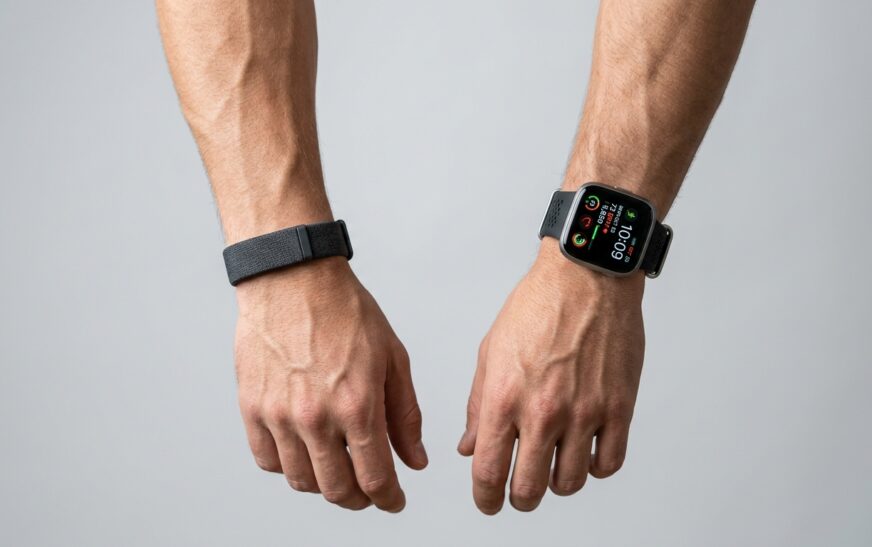
Search whoop vs apple watch and you’ll find a hundred guides that treat them like the same product with different logos. They’re not. One is a screenless coach you rent by the year; the other is a tiny computer you buy once and strap to your wrist. After living with both, I think most “comparisons” miss the only question that actually matters: do you want a recovery tool, or do you want a smartwatch? Because these two devices answer completely different needs, and picking the wrong one is an expensive mistake you’ll regret for years.
This isn’t a spec-sheet beauty contest. It’s an honest, real-world look at what each device does well, where each one quietly fails, and exactly who should buy which in 2026.
The Core Difference Nobody Explains First
Before a single price or feature, understand the philosophy gap, because everything else flows from it.
Whoop has no screen. You can’t check the time, read a text, or tap a workout. It’s a fabric band that sits on your wrist (or bicep) and does one thing obsessively: measures your body 24/7 and turns that into recovery, strain, and sleep scores. It exists to answer one question every morning — should I push hard today, or back off?
Apple Watch is a full wrist computer. It tracks your health too, but it also handles calls, texts, Apple Pay, maps, music, alarms, and thousands of apps. Fitness is one feature among dozens.
So the real comparison isn’t “which is the better tracker.” It’s “do I want a focused recovery instrument, or a do-everything device that happens to track fitness?” Hold that thought, because it decides everything below.
Pricing: Where the Math Gets Sneaky
This is where buyers get burned, so let’s be blunt.
Apple Watch is a one-time purchase. You pay once and own it. The 2026 lineup:
- Apple Watch SE 3 — $249
- Apple Watch Series 11 — $399 (42mm) / $429 (46mm); cellular adds $100
- Apple Watch Ultra 3 — $799
There’s no mandatory subscription. Every core health feature — heart rate, sleep, blood oxygen, ECG, the new sleep score — works for free, forever. (Apple Fitness+ is optional and separate.)
Whoop is subscription-only. The band itself is “free,” but it’s useless without an active membership, and you cannot buy the hardware outright. The 2026 tiers:
- Whoop One — $199/year (the Whoop 5.0 band, core sleep/strain/recovery)
- Whoop Peak — $239/year (adds Healthspan with Whoop Age, stress monitoring, wireless charger)
- Whoop Life — $359/year (the medical-grade Whoop MG band with ECG, on-demand AFib detection, blood pressure insights in beta)
Here’s the part nobody warns you about: cancel your Whoop subscription and the band stops working. No offline mode. Your historical data locks after 30 days, and the hardware has to go back. You are renting, not owning.
The 3-year cost reality
| Device | Up front | Year 1 | 3-year total |
|---|---|---|---|
| Apple Watch SE 3 | $249 | $249 | ~$249 |
| Apple Watch Series 11 | $399 | $399 | ~$399 |
| Apple Watch Ultra 3 | $799 | $799 | ~$799 |
| Whoop One | $0 | $199 | ~$597 |
| Whoop Peak | $0 | $239 | ~$717 |
| Whoop Life (MG) | $0 | $359 | ~$1,077 |
A Series 11 you keep for three years costs less than a single year-plus of Whoop Peak. Over a typical 3–4 year ownership window, Apple is dramatically cheaper. Whoop only makes financial sense if its recovery data genuinely changes how you train — and for a lot of people, it doesn’t.
Health & Recovery Tracking: The Real Battleground
This is the heart of the whoop vs apple watch debate, so let’s break it into the things that actually matter.
Sleep tracking
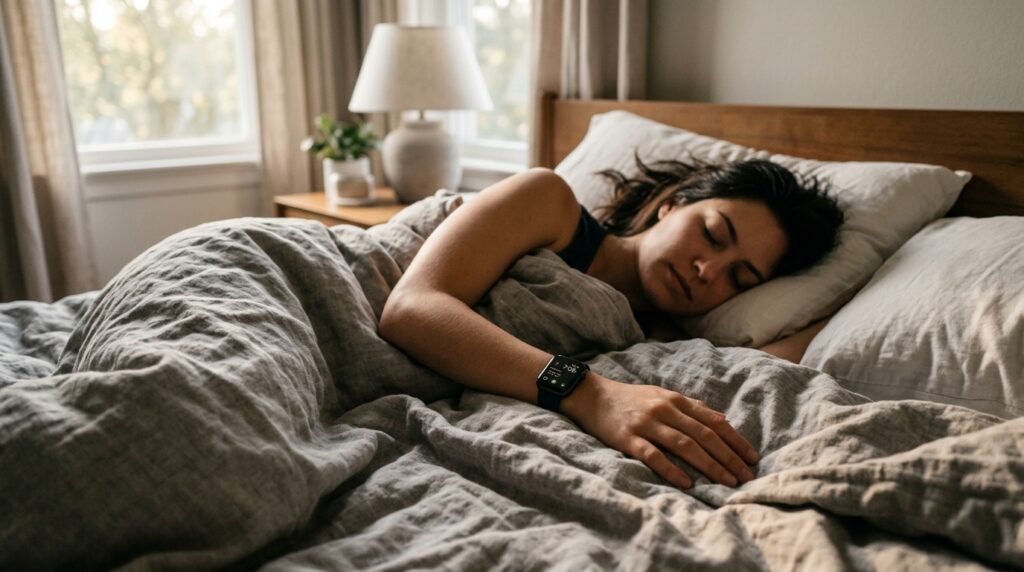
Both are strong here, with different flavors. Apple Watch Series 11 added a proper sleep score out of 100 that factors total duration, bedtime consistency, how often you wake, and time in each stage. It’s clear and motivating.
Whoop has tracked sleep deeply for years and arguably presents it more usefully for athletes — it tells you exactly how much sleep you need tonight based on yesterday’s strain, and nudges you toward a consistent schedule. If sleep optimization is your obsession, Whoop’s coaching edges ahead. If you just want a reliable nightly readout, the Apple Watch is plenty. If rings are more your style, I’ve also broken down how the top sleep-focused smart rings stack up for overnight tracking.
Recovery & strain (Whoop’s home turf)
This is the one area where Whoop is clearly the specialist. Its entire system is built around a daily recovery score (driven heavily by heart-rate variability) and a strain score that escalates as your day gets harder. Wear it for a few weeks and it starts to feel like a coach reading your nervous system. The Apple Watch tracks workouts and now surfaces more trends, but it doesn’t package the “are you recovered enough to train hard?” verdict the way Whoop does out of the box.
If recovery-led training is your whole reason for buying, Whoop wins this round. For deeper metabolic and recovery context, it’s worth seeing how other recovery-focused wearables approach the same data.
Heart health & medical-grade features
Here Apple is more accessible and Whoop is more clinical at the top tier.
- Apple Watch Series 11 & Ultra 3: ECG, blood oxygen, irregular-rhythm notifications, and new hypertension awareness that flags possible high blood pressure over a 30-day window (pending FDA clearance at launch). All standard, no subscription.
- Whoop MG (Life tier only): FDA-cleared ECG, on-demand AFib detection, and blood pressure insights in beta — but you only get these on the $359/year plan.
For most people, the Apple Watch delivers serious heart-health tools at no recurring cost. You only need Whoop’s medical features if you specifically want continuous, athlete-grade physiological monitoring and are willing to pay annually for it. As always, neither device is a medical diagnosis — Apple is clear that these are wellness features, which you can read more about on the official Apple Watch health page.
Battery, Comfort & Daily Wear
This is closer than the spec sheets suggest, and it cuts both ways.
Whoop wins on battery and wearability. The Whoop 5.0 lasts up to 14 days per charge, and you charge it with a slide-on battery pack without taking it off — so it never leaves your wrist. Because it’s a soft screenless band, it disappears under sleeves, gym grips, and while you sleep. Athletes love that you basically forget it’s there.
Apple Watch wins on speed and screen. Series 11 runs up to 24 hours (Ultra 3 stretches to about 42), but fast charging hits 80% in roughly 30 minutes — a quick top-up while you shower covers a night of sleep tracking. You do, however, have to charge it daily-ish and deal with a hard case on your wrist.
If you hate charging routines and want a device you never notice, Whoop is more pleasant to live with. If you want a screen that tells you the time and your texts, that’s obviously not Whoop’s game.
The Smartwatch Stuff (Where It’s Not Even Close)
Let’s be honest about the gap: Whoop does none of this.
The Apple Watch handles calls and texts from your wrist, Apple Pay, turn-by-turn maps, music control, Siri, alarms, timers, live translation, fall and crash detection, Emergency SOS (satellite on the Ultra 3), and a deep app ecosystem. It’s an extension of your iPhone — which is exactly why it pairs so neatly with the rest of Apple’s hardware, including the hidden iPhone features most people never enable.
Whoop intentionally strips all of that away to stay distraction-free. That’s a feature for some people and a dealbreaker for others. Just know what you’re choosing.
Full Comparison Table
| Feature | Whoop 5.0 / MG | Apple Watch Series 11 |
|---|---|---|
| Cost model | Subscription only ($199–$359/yr) | One-time ($399; $429 for 46mm) |
| Owns the hardware? | No — rent it | Yes |
| Screen | None | Always-on LTPO OLED |
| Battery | ~14 days | ~24 hours (fast charge) |
| Sleep tracking | Excellent, coaching-led | Excellent, sleep score |
| Recovery/strain score | Best in class | Basic trends |
| ECG / AFib | Yes (MG / Life tier) | Yes (standard) |
| Blood pressure | Insights beta (MG) | Hypertension awareness |
| Blood oxygen | Yes | Yes |
| Calls/texts/apps | No | Yes (full smartwatch) |
| Payments / GPS / maps | No | Yes |
| Works without phone | Yes (app sync) | Yes (cellular models) |
| Best for | Recovery-obsessed athletes | Everyone wanting one device |
Who Should Buy Which
Skip the hype. Here’s the straight answer.
Buy Whoop if:
- You train seriously and genuinely act on recovery and strain data.
- You want zero screen distraction and a band you never have to take off.
- You don’t mind paying every year and don’t want smartwatch features.
Buy an Apple Watch if:
- You want one device that does fitness and everything else.
- You’d rather pay once and own it than rent forever.
- You use an iPhone (Apple Watch requires one) and want notifications, payments, and apps on your wrist.
- You want strong heart-health tools without a recurring fee — in which case the SE 3 at $249 or Series 11 at $399 is the value sweet spot.
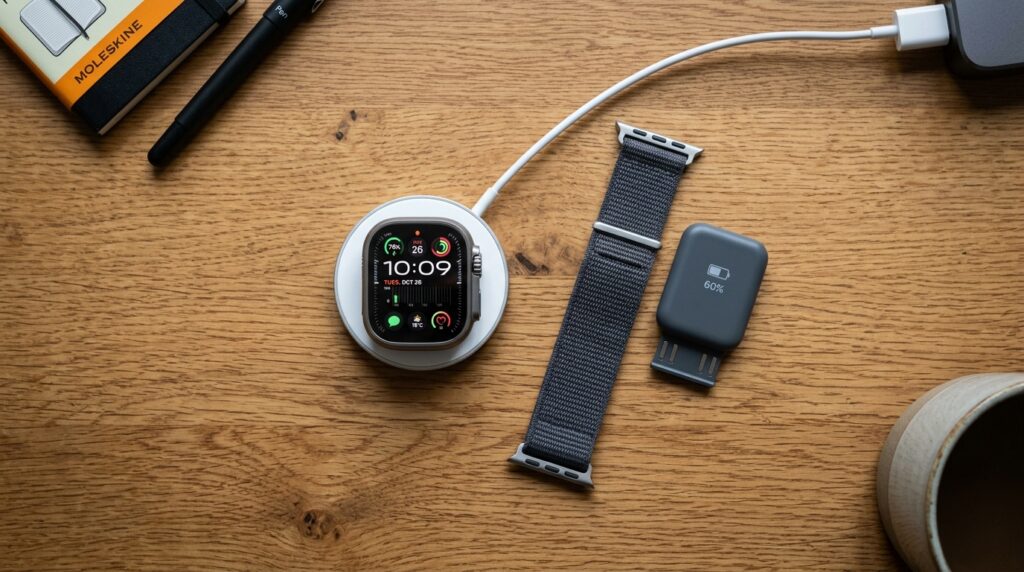
For most people reading this, the Apple Watch is the smarter buy: lower lifetime cost, far more capability, and health tracking that’s now genuinely excellent. Whoop is the specialist’s tool — brilliant if recovery is your whole world, overkill (and pricey) if it isn’t.
FAQ
Is Whoop more accurate than the Apple Watch? For heart-rate variability and recovery, Whoop’s approach is more refined because that’s its entire focus. For everyday heart rate, sleep stages, and workouts, the two are broadly comparable in 2026. Accuracy alone shouldn’t decide your purchase — fit and use case matter more.
Do I have to pay a subscription for the Apple Watch? No. Every core health and fitness feature works for free. Apple Fitness+ is an optional add-on, not a requirement, which is a major contrast with Whoop’s mandatory annual fee.
What happens to my Whoop if I stop paying? The band stops recording and syncing — there’s no offline mode. Your historical data stays accessible for about 30 days after cancellation, then locks, and the hardware must be returned. You don’t own the device.
Can the Apple Watch track recovery like Whoop? It tracks the underlying data (HRV, resting heart rate, sleep) and shows trends, but it doesn’t deliver a single daily “are you recovered?” verdict the way Whoop does by default. Third-party apps can close some of that gap.
Which is better for sleep tracking? Both are strong. Whoop leans into coaching and tells you how much sleep you need based on the previous day’s strain; the Series 11 gives a clean nightly sleep score. Heavy sleep-optimizers may prefer Whoop; most users will be happy with Apple.
Does Whoop work without a phone? Yes, it records continuously and syncs to the app later, so you can leave your phone behind on a run. The Apple Watch needs an iPhone for setup, and cellular models can run independently once configured.
Is the Whoop MG worth it over the Apple Watch for heart health? Only if you specifically want continuous medical-grade monitoring and will use the ECG/AFib/blood-pressure features regularly. For most people, the Apple Watch’s built-in heart tools cover the bases without a $359/year commitment.
The Bottom Line
The whoop vs apple watch question really comes down to one honest decision: rent a focused recovery coach, or own a do-everything smartwatch.
Whoop is the better recovery instrument — screenless, comfortable, two-week battery, and the best strain-and-recovery coaching out there. But it’s a yearly bill, you never own it, and it does nothing beyond health.
The Apple Watch is the better overall device and the better value — pay once, own it, get excellent health tracking plus the full smartwatch experience. For the vast majority of buyers in 2026, that’s the one I’d recommend. Save the Whoop for the athletes who’ll actually live by its scores.
Whichever way you lean, do it for the right reason — not the marketing. For more no-hype breakdowns of the gear you’re actually thinking about buying, that’s exactly what we do at CripsyWire.

Continue Reading on CripsyWire
For more honest tech matchups, browse our full reviews and comparisons library. AI tool reviews live in AI tools and agents, phone reviews in smartphones, and wearable reviews in wearables. Before you buy, our step-by-step guides may help with setup decisions. The CripsyWire homepage highlights what is newest, all under our Tech coverage.