15 min read
In this guide
- What the Phonemax P1 Is
- Phonemax P1 Specs at a Glance
- Durability: IP68 and MIL-STD-810G Explained
- Display, Performance and Everyday Use
- Battery Life: The 6100mAh Cell
- Cameras for Worksite Documentation
- Phonemax P1 Price and Where to Buy
- Who Should Buy It — and Who Should Skip It
- Phonemax P1 vs the Rest of the Phonemax Range
- A Warning: Two Different Phones Share the P1 Name
- Buying Checklist Before You Order
- Frequently Asked Questions
Most rugged phones ask flagship money for a tough shell. The P1 takes the opposite route: a budget 4G handset from Shenzhen Phonemax Technology with one pitch — a big battery in a body that can take a knock. Every fact below comes from Phonemax’s own range page, the GoRugged listing, wholesale listings or the manufacturer’s spec sheet. Where sources disagree, this guide says so.
What the Phonemax P1 Is
A battery-first rugged handset
Phonemax lists the P1 in its rugged-phone range as the battery-focused option, alongside the P2, which carries the same 6,100mAh cell. The company’s own comparison page puts it plainly: the P1 is the model to pick when battery life is the priority, while other models cover 5G, thermal imaging, night vision and compact designs.
The phone is a 4G LTE device with no 5G radio — a deliberate trade-off, not an oversight. A 4G-only chip costs less, draws less power and still handles calls, messaging, maps and work apps. If your job needs a phone that is still alive at 6pm, the trade makes sense.
Who Phonemax built it for
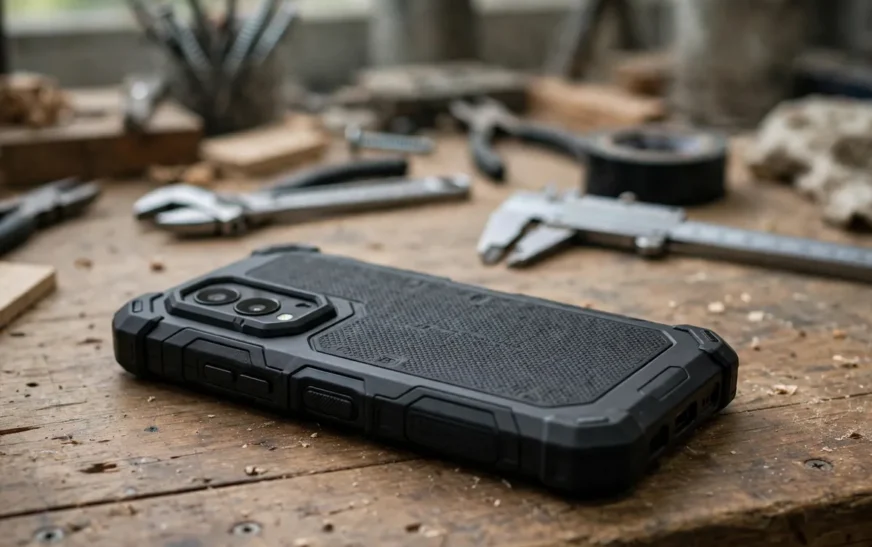
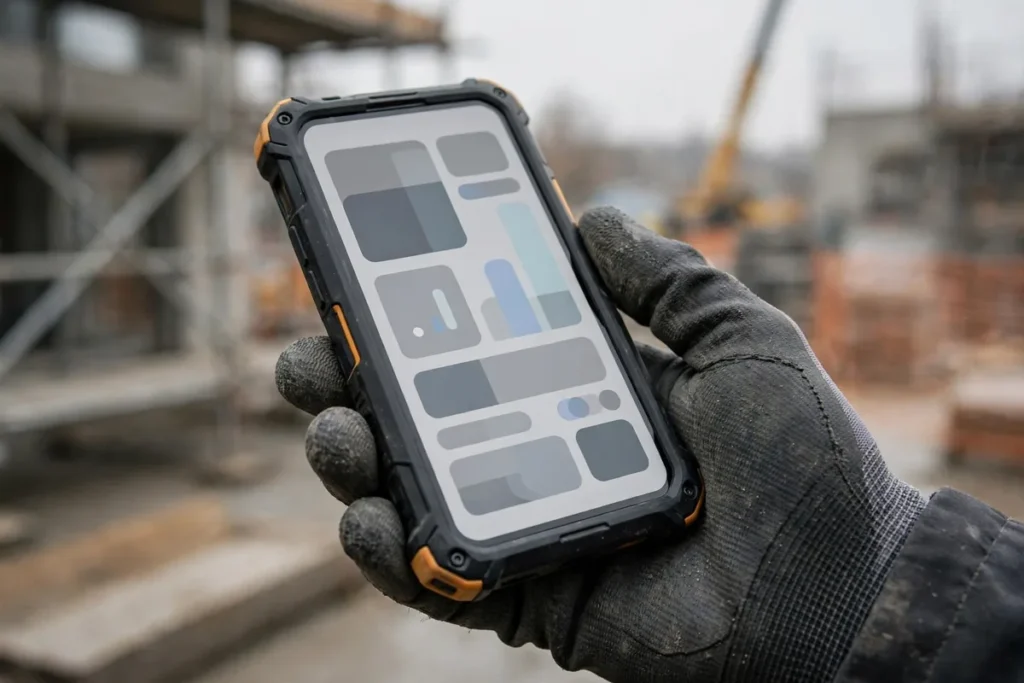
The GoRugged listing describes the P1 as ideal for outdoor adventures, construction sites and other demanding environments, built to withstand shocks, drops and harsh weather. That matches Phonemax’s positioning: field work and outdoor use, not office use or gaming.
Three spec-sheet details underline the worksite focus: a programmable PTT (push-to-talk) button, a smart key for the torch, camera or outdoor tools, and an optional Honeywell or Zebra barcode scanner for stock work.
Phonemax P1 Specs at a Glance
| Feature | Phonemax P1 |
|---|---|
| Display | 6.35-inch HD+ IPS, 720 x 1560 |
| Processor | MediaTek Helio P22 (MTK6762), octa-core at 2.0GHz |
| RAM / storage | 4GB RAM / 128GB storage, microSD up to 256GB |
| Battery | 6,100mAh |
| Rear camera | 21MP main + 0.3MP secondary sensor |
| Front camera | 8MP |
| Operating system | Android 10 |
| Network | 4G LTE (no 5G), dual SIM (nano + nano) |
| Protection | IP68, MIL-STD-810G tested |
| Extras | NFC, fingerprint sensor, PTT button, smart key |
| Size | 166.9 x 81 x 13.9 mm |
| Weight | About 275 g |
| Colours | Grey / Orange |
Two discrepancies are worth knowing. GoRugged’s feature list prints the battery as 6,050mAh, while its specification table, the spec sheet and Phonemax’s range page all say 6,100mAh — treat that as the headline figure. Weight is listed as 275 g in one listing and about 279 g in the spec sheet.
Storage is a strong point: 128GB built in, plus a microSD slot for cards up to 256GB. Before you load it up, check how much storage you actually need to judge whether 128GB covers you or a card is worth adding.
Durability: IP68 and MIL-STD-810G Explained
What IP68 actually means
The P1 carries an IP68 rating, and the two digits each mean something specific. The first, 6, is the highest solid-particle rating: the phone is dust-tight. The second, 8, means immersion in water deeper than one metre, under conditions the manufacturer specifies.
That last part matters. The “8” does not name a depth or a time on its own — the manufacturer sets the test depth and duration. Phonemax’s P1 materials do not publish either figure for this model, so no immersion figure is claimed here. Treat the rating as strong protection against rain, splashes, mud and an accidental dunk, not as a licence to take the phone swimming.
What MIL-STD-810G testing covers
MIL-STD-810G is a US military test standard covering drops and shocks, rain, vibration, altitude, sand and dust, humidity, temperature extremes and temperature shock — 29 test methods that describe how testing is done, not a single pass mark.
That creates a gap buyers should understand: a maker can claim compliance after testing against only some of those methods, and results are rarely published. The badge says the phone went through lab testing, not which tests were run. No drop height was published for the P1 itself, so none is stated here. The separate P1 Pro sheet does state a 1.5-metre drop test — but that is a different model.
Display, Performance and Everyday Use
The 6.35-inch HD+ screen
The P1 has a 6.35-inch IPS display at 720 x 1560 — HD+ rather than Full HD, so text and images are less sharp than on a 1080p panel, especially in small text and fine detail.
For the jobs this phone is built for, that is a fair trade: maps, messages, work apps and photos all read clearly, and video looks acceptable rather than crisp. No brightness figure was published for the P1.
If you compare phones by screen size, it helps to see how phone sizes compare across models: a 6.35-inch rugged body feels much larger in the hand than a 6.35-inch slim phone.
The Helio P22 chip and 4GB of RAM
The MediaTek Helio P22 is an octa-core chip at 2.0GHz, built for budget phones. It handles calls, messaging, email, maps, music and light apps without fuss — not heavy gaming, 4K editing or a dozen demanding apps at once. The 4GB of RAM is enough for everyday use, though switching quickly between maps, camera and messaging will feel slower than on a phone with 8GB.
The P1 is a 4G-only phone, so data speeds depend on local 4G coverage — see how mobile data actually works.
Android 10: older software, real consequences
The P1 ships with Android 10, several generations old. Most everyday apps still run on it, so the phone stays usable for its intended jobs. The downside: no newer features, and no update commitment was found — assume the software stays as shipped, with no newer privacy controls and no guarantee of security patches.
For a second phone or a work handset, many buyers accept that. For a primary phone holding banking apps and personal data, it is a real drawback — and a sharp contrast with a modern flagship, as the guide to hidden features on a flagship iPhone shows.
Battery Life: The 6100mAh Cell
Why the battery is the headline feature
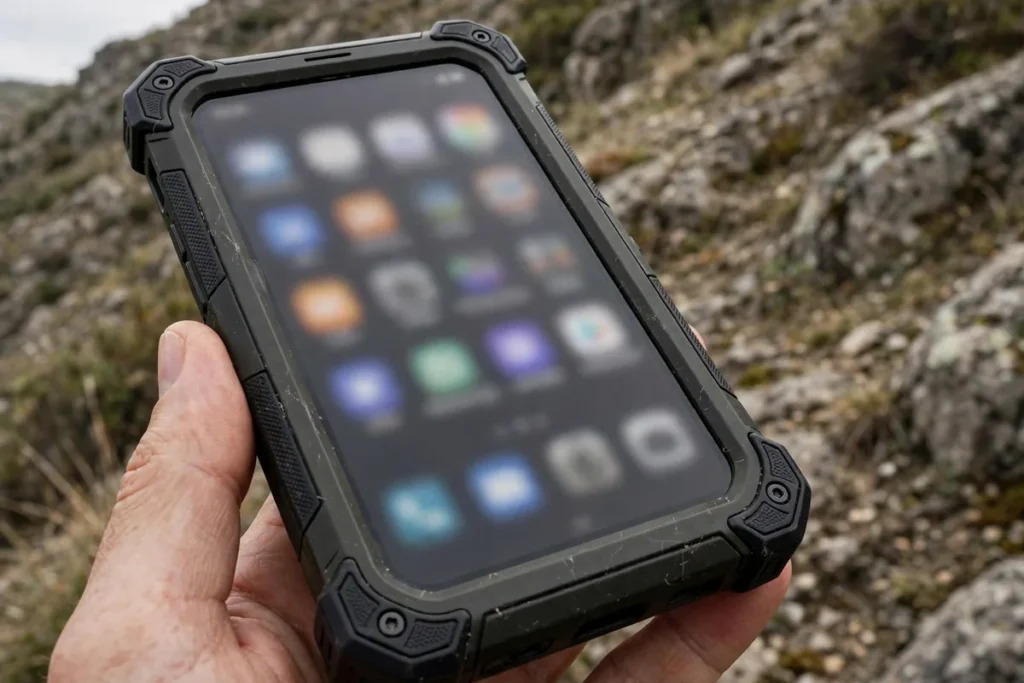
Phonemax’s own range page singles out the P1 for its battery: the P1 and its sibling, the P2, are the two models listed with 6,100mAh cells, while the compact X5 has a 5,000mAh battery. In a market where most phones ship with cells around 5,000mAh, the extra capacity is the P1’s clearest advantage.
A bigger battery does not mean a fixed number of hours — screen time, signal, temperature and app use all change the result. What it does mean is margin: a phone that starts the day full is far more likely to still be working at the end of a long shift. It ships with a 5V/2A charger, a standard 10W unit, so charging is steady rather than fast.
Manufacturer-stated usage figures
The spec sheet gives three usage figures: about 20 days of 4G standby, about 14 hours of video watching, and about 49 hours of calls — lab figures, not independent test results. Standby time depends heavily on signal strength, since a phone hunting for a weak signal drains far faster than one on a strong one.
Even so, the figures point one way: days between charges with light use, and a heavy day of calls, maps and photos without trouble. For a crew, a field team or a hiker, that is the difference between carrying a power bank and leaving it at home.
Using the phone as a hotspot drains the battery much faster than normal use — check whether a hotspot burns through data first.
Also check how much data your phone uses before a long day off Wi-Fi, so a hotspot session does not eat through your plan unnoticed.
Cameras for Worksite Documentation
The P1 has a 21MP rear camera with a 0.3MP secondary sensor, and an 8MP front camera. Megapixels alone say little about photo quality — sensor size, lens and processing matter more, and none are detailed in the sources checked. The camera is a documentation tool: site progress, damage, serial numbers and delivery notes, shot in daylight. Low-light photos will show the limits of budget hardware.
Photos from a 21MP camera take up real space, and a work phone fills its storage with site photos fast. The guide to freeing up space on your phone covers the quickest wins when the gallery feels crowded.
For a deeper clean-up, clearing storage on your phone walks through the steps that reclaim the most space without losing anything important.
The front camera handles video calls at 8MP, fine for site check-ins. If your site videos come back muffled, the guide to fixing a phone microphone covers the common causes, from a blocked mic hole to a software setting.
Phonemax P1 Price and Where to Buy
There is no single verified US retail price for the P1, so this section reports the prices actually found. Phonemax’s own store lists P1 variants at $169.00. Wholesale listings on GlobalSources show $126 to $164 on one listing and $149 to $179 on another, while a separate wholesale page lists $149 to $154 for a single unit. In South Africa, GoRugged sells the 4GB/128GB model for R3,599, marked down from R5,899, with free shipping.
The honest summary: the P1 is a sub-$200 phone in most listings, often closer to $150. Import costs, taxes and shipping change the final figure, so check the listing before you order — and treat any deal far below this range with suspicion.
Phonemax sells through its own store, distributors and wholesale platforms. Before you pay, confirm the exact model (Phonemax P1, 4GB RAM, 128GB, Android 10), the network bands against your carrier, the warranty (12 months, spare parts for at least two years) and the return policy. Against a normal budget phone, the P1 wins on battery and toughness and loses on software age, screen sharpness and camera quality. Against a premium rugged phone costing three or four times as much, it wins on price and loses on nearly everything else.
Who Should Buy It — and Who Should Skip It
Who should buy it
- Construction, farm and warehouse workers. Built for dust, drops and long shifts, with a battery that survives the working day.
- Hikers, campers and outdoor workers. Lasts days on standby, survives rain and mud, and carries offline maps.
- Fleet and field teams buying in bulk — wholesale prices from about $126, with a PTT button and optional barcode scanner.
- Anyone who wants a cheap second phone. A rugged backup that lives in a toolbox or a glove box.
Who should skip it
- Anyone who wants 5G. The P1 is 4G-only, and that will not change.
- Mobile gamers and heavy multitaskers. The Helio P22 and 4GB of RAM handle everyday apps, not demanding games.
- Photography enthusiasts. The 21MP camera is a documentation tool, and low-light results will disappoint.
- Buyers who want the newest Android. It ships with Android 10 and no update commitment was found.
- People who want a light, slim phone. At around 275 g and nearly 14 mm thick, the P1 is a brick in the pocket.
Phonemax P1 vs the Rest of the Phonemax Range
Phonemax’s current range has ten models; the P1 sits at the battery-first, budget end.
| Model | Network | Standout feature | Battery |
|---|---|---|---|
| P1 | 4G | Battery-focused rugged use | 6,100mAh |
| P2 | 4G | Battery-focused rugged use | 6,100mAh |
| P20 | 5G | 5G rugged smartphone | Not listed |
| P20 Pro | 5G | Thermal imaging | Not listed |
| R4 GT | 4G | Thermal imaging + night vision, compact | Not listed |
| X5 | 4G | Android 16, compact design | 5,000mAh |
If battery life is the priority, the P1 and P2 are the picks. If you need 5G, the P20 and P20 Pro are the only options; for thermal imaging, the P20 Pro and R4 GT cover it. For most buyers, the real choice is between the P1 and a mainstream budget phone: the P1 wins when the phone will be dropped, soaked or run flat, and a normal budget phone wins when it lives in a pocket.
If you are weighing a rugged phone against a wearable, the comparison of the Oura Ring vs Galaxy Ring shows what finger-worn trackers can and cannot do in the field.
Our look at the Galaxy Watch 8 Classic covers the wrist-worn alternative.
A Warning: Two Different Phones Share the P1 Name
The name “P1” belongs to two different phones from two different makers, and their specifications do not match. The phone in this guide is the Phonemax P1 from Shenzhen Phonemax Technology: Android 10, MediaTek Helio P22, 6.35-inch display, 6,100mAh battery, 4GB of RAM with 128GB of storage, and a 21MP rear camera. It is the model listed on phonemax.com and sold by GoRugged.
The other P1 is the ONERugged P1 from Emdoor, a different company: Android 14, Helio G99, 6.56-inch display, 5,800mAh battery with 33W charging, 8GB of RAM, a 48MP rear camera and a 32MP front camera, at about 311 g. The two phones share a name, an IP68 rating and a rugged brief, and almost nothing else. Check the brand first: Phonemax versus ONERugged, Helio P22 versus Helio G99, and Android 10 versus Android 14 are the three quickest tells.
The same care applies to the P1 Pro, a Phonemax model but not the P1. It adds an IP69K rating and a stated 1.5-metre drop test, and its figures belong to that model alone. When a listing does not name the exact model, ask the seller before you pay.
Buying Checklist Before You Order
- Confirm the brand is Phonemax, not ONERugged, and the model is the P1, not the P1 Pro.
- Confirm 4GB of RAM with 128GB of storage, running Android 10.
- Check the network bands against your carrier.
- Confirm price, shipping, taxes and delivery time in writing.
- Ask what the warranty covers and who handles a claim in your country.
- Check the return policy, and confirm the phone is new, not refurbished.
- Check what is in the box: charger, cable, strap and accessories.
- Keep a spare USB-C cable in the truck; if your other devices charge wirelessly, our roundup of the best wireless chargers covers the rest of your kit.
- On arrival, test the fingerprint sensor, NFC, cameras, speakers and charging on day one.
Frequently Asked Questions
Is the Phonemax P1 waterproof?
The P1 carries an IP68 rating: dust-tight, and rated for immersion deeper than one metre under conditions the manufacturer specifies. Treat it as strongly water-resistant — rain, splashes, mud and an accidental dunk are fine, but swimming and diving are not.
How big is the battery, and how long does it last?
The battery is 6,100mAh, the largest in Phonemax’s current range alongside the P2. The spec sheet states about 20 days of 4G standby, about 14 hours of video and about 49 hours of calls — lab figures, so real life will differ with signal, screen use and temperature.
Does the Phonemax P1 have 5G?
No. The P1 is a 4G LTE phone with no 5G radio. Phonemax’s own range page lists the P1 and P2 as 4G models, and the P20 and P20 Pro as the 5G options.
What Android version does the Phonemax P1 run?
It ships with Android 10, an older version of Android. No update commitment was found, so buyers should assume the software stays as shipped.
How much does the Phonemax P1 cost?
Prices vary by seller and region. Phonemax’s own store lists P1 variants at $169, wholesale listings show $126 to $179, and GoRugged in South Africa sells it for R3,599. No single verified US retail price exists.
Is the Phonemax P1 the same as the ONERugged P1?
No. They are different phones from different makers that share a name. The Phonemax P1 runs Android 10 on a Helio P22 chip with a 6,100mAh battery, while the ONERugged P1 runs Android 14 on a Helio G99 chip with a 5,800mAh battery and a 48MP camera.
Written by Saad Dharejah, Founder & Editor at CripsyWire, covering smartphones, AI tools and wearables. View All Articles
Facts checked on 10 November 2026. This guide was made from Phonemax’s own rugged-phone range page, the GoRugged P1 product listing, GlobalSources wholesale listings and the manufacturer’s P1 spec sheet, with IP68 and MIL-STD-810G explained from independent standards guides.

Continue Reading on CripsyWire
For more honest tech matchups, browse our full reviews and comparisons library. AI tool reviews live in AI tools and agents, phone reviews in smartphones, and wearable reviews in wearables. Before you buy, our step-by-step guides may help with setup decisions. The CripsyWire homepage highlights what is newest, all under our Tech coverage.