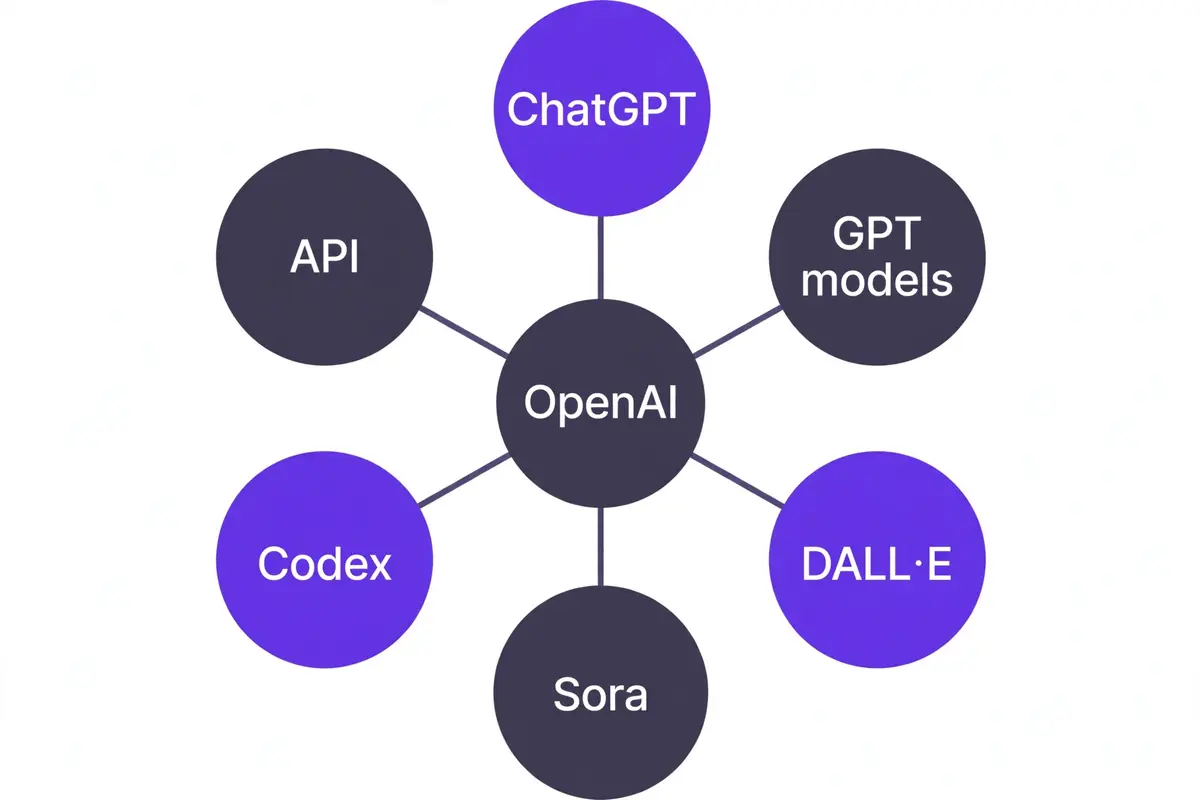
Quick answer: OpenAI is the artificial intelligence company behind ChatGPT. Founded in December 2015, it builds the GPT family of AI models and turns them into products: ChatGPT for chatting, DALL-E for images, Sora for video, Whisper for speech, Codex for coding, and an API that lets other apps use its models. ChatGPT is free to start, with paid plans from $8 to $500 a month. OpenAI is the company; ChatGPT is one of its products.
Almost everyone has heard of ChatGPT. Fewer people know what OpenAI is, what else it makes, or how its products fit together. The confusion is understandable: OpenAI is a company, ChatGPT is a product, GPT is a family of models, and all three names get used as if they meant the same thing. They do not.
This guide sorts it out in plain English. It explains what OpenAI is and how it is organised, what each of its products does, what they cost, how to start using them, what they are genuinely good at, where they fall short, and what the alternatives are. No technical background is needed.
What is OpenAI?
OpenAI is an American artificial intelligence research and deployment company, founded in December 2015 by Sam Altman, Greg Brockman, Ilya Sutskever, and Elon Musk. It began as a nonprofit research lab with a stated mission: to ensure that artificial general intelligence — AI that can learn and do most things a human can — benefits all of humanity.
That mission still shapes the company, but the structure has changed several times. In 2019 it added a capped-profit arm so it could raise the enormous sums needed to train large models. In October 2025 it restructured again: the nonprofit OpenAI Foundation now controls OpenAI Group PBC, a public benefit corporation that runs the business. Microsoft is a major partner and holds about 27% of OpenAI Group. Sam Altman is the chief executive.
The scale of the company is hard to overstate. OpenAI’s models run inside ChatGPT, inside Microsoft’s products, inside thousands of apps built on its API, and inside businesses that use its tools every day. It is one of the most influential technology companies in the world, and it is also one of the most argued about — over safety, over how it trains its models, and over what its technology means for jobs.
A short history of OpenAI
OpenAI’s story is short but crowded. It began in December 2015 as a nonprofit research lab, founded by Sam Altman, Greg Brockman, Ilya Sutskever, and Elon Musk, with the goal of building safe artificial general intelligence. For its first years it published research and built models that few people outside the field had heard of. The GPT models arrived in stages — GPT-1 in 2018, GPT-2 in 2019, GPT-3 in 2020 — each one noticeably more capable than the last, and each one drawing more attention. In 2019 the company added a capped-profit arm so it could raise the money needed to train models at ever-larger scale.
Everything changed in November 2022, when ChatGPT launched and reached 100 million users in two months. GPT-4 followed in 2023, and the company has shipped new models, products, and features at a relentless pace since: voice chat, image generation, web search, coding agents, and video generation. In October 2025 it restructured, putting the nonprofit OpenAI Foundation in control of the commercial public benefit corporation that runs the business. As of late 2026, the current models are the GPT-6 family, and the company that started as a small research lab is one of the most valuable private companies in the world.
OpenAI is not the same as ChatGPT
This is the single most useful distinction in the whole guide. OpenAI is the organisation. ChatGPT is one of its products — the chat interface most people use. GPT is the model family underneath, the technology that powers ChatGPT and much else besides.
| OpenAI | ChatGPT | GPT | |
|---|---|---|---|
| What it is | The company | A product you chat with | The model family |
| What it does | Researches and builds AI | Answers questions, writes, analyses, creates images | Understands and generates language |
| Who uses it | Everyone, indirectly | Hundreds of millions of people | Developers, and ChatGPT itself |
| You pay for | Nothing directly | Free tier, or $8–$500 a month | Through ChatGPT or the API |
Mixing the three up causes most of the confusion about AI news. When a headline says “OpenAI released a new model”, it usually means a new GPT model. When it says “ChatGPT can now do X”, it means the product gained a feature. When it says “OpenAI is worth $X”, it means the company — which is private, so you cannot buy its shares the way you can buy a public company’s stock.
ChatGPT: the product everyone knows
ChatGPT launched in November 2022 and reached 100 million monthly active users within two months, making it one of the fastest-growing consumer applications in history. It is a conversational AI: you type a question or a task, and it responds in natural language. It can draft emails, explain concepts, write and debug code, analyse documents, summarise long texts, brainstorm ideas, and create images.
ChatGPT is not a search engine, although it has grown closer to one. It launched a web search feature on 31 October 2024 and opened it to everyone, with no sign-up, in February 2025. The search answers questions with links to web pages, and it decides which pages it can read through crawlers that website owners can allow or block. For many everyday questions, people now ask ChatGPT first and a search engine second. That shift is why AI search has become a story of its own, with new startups trying to build search around AI answers rather than around links.
Under the surface, ChatGPT runs on OpenAI’s GPT models, and the version you get depends on your plan. The free tier gives access to lighter models with basic functionality. Paid plans unlock the newest and most capable models, longer conversations, file uploads, voice chat, image generation, deep research, and scheduled tasks. Microsoft’s Copilot is built on the same OpenAI models, so the two assistants share a lot of DNA — the Copilot vs ChatGPT comparison shows where they actually differ in practice.
GPT models: the engine underneath
GPT stands for Generative Pre-trained Transformer. It is the name of OpenAI’s family of large language models — systems trained on enormous amounts of text so they can predict, generate, and reason with language. Every OpenAI product that deals with words is built on a GPT model.
The models have moved fast. GPT-4o was the flagship general-purpose model through 2025: fast, multimodal, and good at complex reasoning. As of August 2026, the newest GPT generation is GPT-5.6, and the current ChatGPT plans run on the GPT-6 family of models, with different tiers — Astra, Sol, Terra, and Luna — designed around different trade-offs between capability, speed, and cost. The exact model names change every few months, which is normal for this field and is also why any guide that lists “the latest model” goes stale quickly. What matters is the pattern: each generation is more capable, handles more kinds of input (text, images, audio, video), and costs less per unit of work than the one before it.
Training these models takes enormous computing power, which is why the hardware behind AI matters as much as the software. The data centers full of specialised AI chips that train and run GPT models are one of the biggest infrastructure build-outs in technology history.
DALL-E and image generation
DALL-E is OpenAI’s text-to-image model: you describe an image in words, and it creates one. It lives inside ChatGPT, so you can ask for an illustration, a logo idea, a product mock-up, or a picture in a particular style without leaving the chat. The same idea powers a whole category of tools, and text-to-image AI has become one of the most popular uses of generative AI outside of chat.
The quality of the results depends heavily on the prompt. A vague prompt gives a generic image; a specific prompt — subject, style, lighting, composition, mood — gives something usable. Learning to write good image prompts is a skill in itself, and it transfers directly to every other image generator, not just DALL-E. DALL-E images are AI-generated, so they are best for illustration and brainstorming, not for anything that needs to show a real person, place, or product accurately.
Sora: video from words
Sora is OpenAI’s video generation model. Like DALL-E for images, it creates video clips from a text description — a scene, a camera move, a style. It is part of the same shift that has produced a wave of AI video tools, where short clips that once needed a camera, a crew, and editing software can now be drafted from a sentence. The results are impressive for creative and marketing work, and they are still easy to spot as AI-made on close inspection: hands, physics, and fine detail are the usual giveaways. For a business or a creator, Sora is a drafting tool and a source of b-roll, not a replacement for real footage.
Whisper: speech to text
Whisper is OpenAI’s automatic speech recognition system. It transcribes audio and translates speech into text, and it handles many languages. It powers the voice features in ChatGPT, where you can talk instead of typing, and it is used by developers who need transcription in their own apps. For most readers, Whisper is invisible — it is the reason voice chat with an AI feels natural — but it is one of OpenAI’s most widely used pieces of technology.
Codex: the coding agent
Codex is OpenAI’s AI model for software engineering. It understands and writes code, and it now works as an agent: you give it a task, and it works through the steps, running code, checking results, and fixing its own mistakes. Developers use it through the ChatGPT app, the command line, and their code editors. The paid ChatGPT plans include different Codex allowances, with higher tiers getting more usage. For non-developers, the important thing is what Codex represents: OpenAI’s move from a chatbot that answers questions to an agent that does work on your behalf. That shift — from answering to doing — is where much of the company’s current effort is going, and it is also why people are learning to build their own AI agents on top of these tools.
The OpenAI API: models for developers
The OpenAI API is how developers use OpenAI’s models inside their own apps. Instead of opening ChatGPT, a developer sends text to the API and gets a response back, which their app then shows to the user. Thousands of products work this way, from customer support chatbots to writing tools to research assistants. The API charges per token — a token is roughly three quarters of a word — separately for input and output. As an example, GPT-4o cost roughly $2.50 per million input tokens and $10 per million output tokens as of 2025, though prices change as new models arrive. If you are not a developer, you can ignore the API entirely: everything in it is also available through ChatGPT. If you are one, it is the reason OpenAI’s technology shows up in so many places you would not expect.
What OpenAI costs
ChatGPT’s plans changed during 2026, so treat every price as a snapshot from October to November 2026 and check the current pricing page before you pay. The personal plans are billed monthly only, with no annual discount.
| Plan | Price | Who it fits |
|---|---|---|
| Free | $0 | Trying it out, light use |
| Go | $8 a month | Regular use on a budget; may include ads |
| Plus | $20 a month | Daily personal use |
| Pro | $100, $200, or $500 a month | Heavy use, Pro reasoning, no five-hour limit |
| Business | $20 per user a month billed annually, or $25 billed monthly | Small teams |
| Enterprise | Custom quote | Large organisations |
Plus is the plan most people choose: $20 a month, the newest models, deep research, projects, scheduled tasks, and custom GPTs. Pro is for people who hit Plus limits every day — researchers, developers, and heavy users — and the three tiers differ mainly in how much usage they include. The $500 tier also includes Ultrafast mode for the newest models. Business and Enterprise add team controls, admin tools, and data protections. The free tier is genuinely usable for everyday questions, which is why most people should start there and only pay when they hit a limit they actually feel.
How to start using OpenAI
Starting takes about five minutes. Go to chatgpt.com, create a free account with an email address, and you can start chatting immediately. The free tier includes the lighter models, web search, and basic image generation. If you use it every day, try Plus for a month and see whether the newer models and higher limits are worth $20 to you — you can cancel at any time, since billing is monthly.
A few habits make the first weeks much better. Be specific in your prompts: say what you want, in what format, and for whom. Check important facts, because ChatGPT can sound confident about things that are wrong. Do not paste passwords, private documents, or anything you would not want stored on someone else’s server. And learn the tools one at a time — voice, images, file analysis, deep research — instead of trying to master everything in a day.
The same AI productivity tools that make people more productive at work are the ones worth learning first.
Some people go further and use them to make money with AI, from freelance writing to small automated services.
What OpenAI is genuinely good at — and what it is not
OpenAI’s tools are genuinely good at drafting, summarising, explaining, brainstorming, coding help, and turning rough ideas into polished text. They are good at research that starts from a question and ends with a structured answer, and at creative work where speed matters more than perfection. They are also good at the boring work: reformatting, translating, tidying up spreadsheets, and writing the first draft of almost anything.
They are not good at facts you cannot verify. ChatGPT can invent references, dates, and quotations that look real. It is not a search engine, and it should not be your only source for anything important. It is not good at anything that needs a real-world action it cannot take, or at judgement calls where the stakes are high and the context is personal. And it is not private by default: what you type can be used to improve the models unless you change the settings. The honest rule is to treat it as a very capable assistant with no common sense and no accountability — useful, fast, and wrong just often enough that you should always check.
OpenAI alternatives
OpenAI is the best-known AI company, but it is not the only one. Google’s Gemini, Anthropic’s Claude, Meta’s AI, and Microsoft’s Copilot all do similar things, and each has strengths: Claude is often preferred for long writing and analysis, Gemini is deeply built into Google’s products, and Copilot is the natural choice inside Microsoft 365. For chatbots specifically, the Character AI alternatives show how different the companion-chatbot world is from ChatGPT. The right choice depends on what you actually do: most people end up using two or three of these, not one, and switching costs are low because the interfaces are so similar.
Frequently asked questions
Is OpenAI the same as ChatGPT?
No. OpenAI is the company, and ChatGPT is one of its products. ChatGPT runs on OpenAI’s GPT models, and developers can also use those models through the OpenAI API without ever opening ChatGPT.
Who owns OpenAI?
OpenAI is controlled by the nonprofit OpenAI Foundation, which oversees OpenAI Group PBC, the public benefit corporation that runs the business. Microsoft is a major partner and holds about 27% of OpenAI Group. Sam Altman is the chief executive.
Is ChatGPT free?
Yes, ChatGPT has a free tier with access to lighter models and basic features. Paid plans start at $8 a month for Go and $20 a month for Plus, with Pro tiers at $100, $200, and $500 a month. Prices are from October to November 2026 and can change.
What is the newest OpenAI model?
As of August 2026, the newest GPT generation is GPT-5.6, and the current ChatGPT plans run on the GPT-6 family of models. Model names change every few months, so check OpenAI’s own pages for the latest version.
What is OpenAI used for?
Writing, coding, research, brainstorming, image and video generation, speech transcription, data analysis, customer support, and business automation. Most people use it through ChatGPT; developers use it through the API.
Is OpenAI safe?
OpenAI builds safety measures into its products, including content filters and usage policies, but its tools can still produce wrong or biased answers. It is safe to use for everyday work if you check important facts and do not share private information.
Can I use OpenAI for business?
Yes. ChatGPT Business and Enterprise plans add team controls and data protections, and the API lets companies build OpenAI’s models into their own products. Many small businesses use ChatGPT for drafting, support, and research.
What is the difference between OpenAI and Microsoft Copilot?
Copilot is Microsoft’s AI assistant, built largely on OpenAI’s models. ChatGPT is OpenAI’s own product. They share underlying technology but differ in where they live: Copilot is built into Microsoft 365, Windows, and Edge, while ChatGPT is a standalone product with its own apps and features.
Bottom line
OpenAI is the company behind ChatGPT, and ChatGPT is the product that made AI a part of everyday life. The company also makes the GPT models, DALL-E for images, Sora for video, Whisper for speech, Codex for coding, and the API that powers thousands of other apps. The free tier is enough for most people to start, Plus at $20 a month is the sweet spot for daily users, and the Pro tiers exist for people who genuinely hit the limits. Start free, be specific in what you ask, check anything important, and remember the distinction that matters most: OpenAI is the company, ChatGPT is the product, and GPT is the engine underneath.

Continue Reading on CripsyWire
For more practical AI coverage for US buyers, see our full AI tools and agents library. When you are deciding between competing tools, the reviews and comparisons section breaks down head-to-head matchups. AI features that live inside your phone are tracked in smartphones, and AI on your wrist or finger in wearables. All of this is part of CripsyWire's broader Tech coverage — start at the homepage for what is newest.