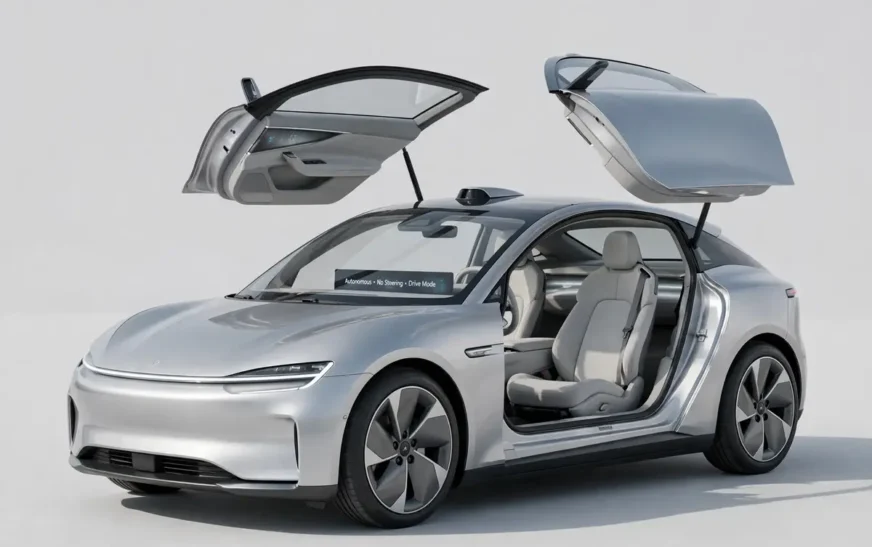
Quick answer: The Tesla Cybercab is a two-seat robotaxi with no steering wheel, no pedals, and no rear window. It costs $29,990 before tax, plus a mandatory $299 a month subscription without which it will not move. Paid robotaxi rides began in Austin in September 2026, and on 13 November 2026 Tesla invited select customers to order one for personal use, with estimated delivery in December 2026. You cannot just buy one yet — orders are by invitation only, for personal use, in a handful of Texas cities.
For two years, the Cybercab was a promise: a car with no steering wheel, built for a world where nobody drives. On 13 November 2026, it became something you could actually order — if you were invited. Tesla opened personal orders to select customers, at $29,990 before tax, with a $1,000 deposit and a $299 monthly fee that the car will not work without.
This guide explains what the Cybercab is, what it can and cannot do, where it runs, what it really costs, and whether you should want one. Every number is dated, because this story has moved fast in 2026 and will keep moving.
What is the Tesla Cybercab?
The Cybercab is Tesla’s purpose-built robotaxi: a vehicle designed from the ground up for autonomous ride-hailing, not for human driving. It was unveiled in October 2024 at Tesla’s “We, Robot” event, where Elon Musk promised a car for under $30,000. It is a compact two-seat coupe with butterfly doors that open upward, a 22-inch centre display, and — the part everyone notices — no steering wheel, no pedals, no mirrors, and no rear window. It stands about four feet tall, which makes it look lower and wider than an ordinary car. That screen is the whole dashboard — there is no instrument cluster and no buttons, a bigger break from the normal car dashboard than the phone-based systems most drivers use today.
The design follows from the job. A robotaxi does not need a driver’s seat, a steering column, or a rear window for a driver to look through. Removing them saves cost and weight, and it leaves a cabin built entirely around two passengers and a screen. The trade-off is obvious: there is no way for a human to take over. If the software cannot handle a situation, there is no wheel to grab. And if the screen itself stops responding, there is no backup at all — the same failure that leaves a phone screen unresponsive, except here you cannot just force-restart the phone. That is the central fact about the Cybercab, and everything else in this guide follows from it.
Cybercab specs
The specifications come from Tesla’s EPA filing of May 2026, which is the most reliable public source for the car’s hardware.
| Spec | Cybercab |
|---|---|
| Seats | 2 |
| Battery | 47.6 kWh usable |
| Motor | Single 163 kW front motor |
| Weight | 1,412 kg |
| Rated range | About 293 miles |
| Charging | Wireless induction (no plug) |
| Steering wheel | None |
| Pedals | None |
| Rear window | None |
| Display | 22-inch centre screen |
| Price | $29,990 before tax |
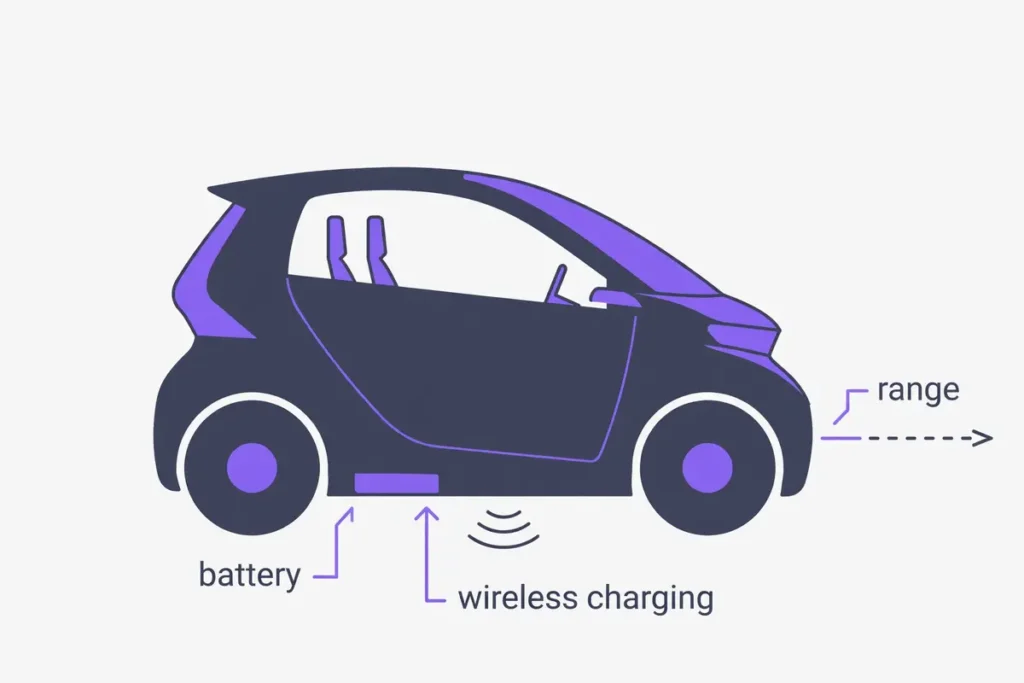
The 293-mile range is respectable for a city car, and the 47.6 kWh battery is small by electric car standards — which is the point. A robotaxi spends its day in a city, not crossing states, so a smaller battery keeps the weight and the cost down. The wireless charging is a bigger deal than it sounds: a robotaxi that has to plug itself in is a robotaxi that needs a human, so induction charging pads let the car recharge on its own between rides. It is the same principle as the wireless charger on your nightstand, scaled up to a whole car — and when wireless charging stops working on a phone, the fixes are familiar, but a car has no cable to fall back on.
How does it drive itself?
The Cybercab drives itself with cameras and a neural network — the same kind of large AI model that powers today’s chatbots, trained on millions of miles of driving video. Tesla’s approach is cameras only: no lidar, no radar in the usual sense, just vision and software. The car watches the road the way a driver does, and the software decides what to do.
That is also how a phone camera can identify objects and translate text in the real world — the same kind of computer vision, applied to driving instead of to a photo.
Tesla calls the capability Level 4 autonomy, which means the car handles all driving tasks within a defined area, with no human attention needed. The key phrase is “within a defined area”. The Cybercab does not drive anywhere; it drives inside geofenced zones that Tesla has mapped and approved, in daylight hours, in good conditions. Outside that zone, or in conditions it cannot handle, it does not go. The computer that runs all of this is one of the most powerful automotive computers ever built, and the hardware behind it — the specialised AI chips that train and run these models — is the same technology race that is reshaping the whole tech industry.
The car is also, in a real sense, an AI agent: software that perceives the world, makes decisions, and acts on them without a human in the loop. People are learning to build their own AI agents for desk work; the Cybercab is what the same idea looks like when the agent weighs 1,412 kilograms and moves at highway speed.
Where does the Cybercab run?
Paid robotaxi rides began in Austin, Texas, in September 2026, running from 6 am to 11 pm through the Tesla Robotaxi app. You hail the car from your phone, it arrives with no driver, and you ride. Dallas was announced for November 2026, and Las Vegas, Jacksonville, Phoenix, and San Antonio have been named as next. The service also runs in Houston, Fort Worth, and San Antonio in Texas, plus Miami, Orlando, and Tampa in Florida.
The rollout is deliberately slow and geofenced. Each new city needs mapping, regulatory approval, and a local fleet, and Tesla expands one zone at a time. That is the normal pattern for robotaxis: the technology works in a mapped area long before it works everywhere. If you do not live in one of these cities, the Cybercab is not something you can use yet, however much you read about it. Everything about a ride — hailing, unlocking, paying — runs through an app on your phone, which is why the phone in your pocket is part of the car’s controls in a way it never was for an ordinary car. The iPhone itself has plenty of hidden features that make that kind of app-first life easier, from Focus modes to the shortcuts that open your most-used apps faster.
What riding in a Cybercab is actually like
The ride itself is deliberately ordinary. You hail the car in the Tesla Robotaxi app, it pulls up with no one inside, the butterfly doors open, and you get in. The 22-inch screen shows the route, the speed, and what the car is seeing — the lanes, the traffic, the pedestrians it is tracking. There is no driver to greet, no small talk, and no one to ask to turn the music down. You can watch the road through the windscreen, or you can watch the screen’s version of the road, which is often more informative than the real one.
The first minute is the strange part. After that, the car accelerates smoothly, stops at lights, waits for pedestrians, and takes corners the way a careful driver would. The strangeness is not in how it drives but in what is missing: the empty space where a driver should be, and the knowledge that no one is watching the road except software. You may find that relaxing, or you may keep watching the road yourself out of habit for the whole trip. Both reactions are normal — the technology is new enough that nobody has a settled feeling about it yet, and the feeling matters as much as the engineering.
Cybercab timeline
| Date | What happened |
|---|---|
| October 2024 | Unveiled at Tesla’s “We, Robot” event; sub-$30,000 target announced |
| 17 February 2026 | First production Cybercab leaves the Giga Texas line |
| 23 April 2026 | Tesla confirms the Cybercab is in production at Giga Texas |
| September 2026 | Paid robotaxi rides begin in Austin, Texas |
| 10 September 2026 | NHTSA issues a Special Order as part of an audit into the car’s certification |
| 13 November 2026 | Tesla invites select customers to order a Cybercab for personal use |
| December 2026 (estimated) | First personal deliveries, in Austin and other Texas cities |
Production has ramped steadily: 245 cars were counted in a staging lot in July 2026, and the Texas registry shows 319 Cybercabs registered to Tesla Robotaxi LLC on 8 October 2026, alongside 420 Model Ys running in the same service. Tesla says the vast majority of Cybercabs will be owned by Tesla and run in its robotaxi service, not sold to the public — which makes the November order opening the exception, not the rule.
How much does a Cybercab cost?
The headline price is $29,990 before tax, which makes it the cheapest Tesla ever — $7,000 less than a Model 3. But the headline is not the cost. The order page terms, reported by Not a Tesla App and others, are:
| Item | Amount |
|---|---|
| Vehicle price | $29,990 before tax |
| Order deposit | $1,000, non-refundable |
| Autonomy Subscription | $299 a month, mandatory |
| First month of subscription | Included |
| Estimated delivery | December 2026, Austin, Texas |
The subscription is the catch. Tesla’s Autonomy Subscription Agreement says the Cybercab will not operate without an active paid plan — no subscription, no driving. At $299 a month, that is $3,588 a year, every year, for as long as you own the car. Over five years, the subscription alone costs $17,940, which is more than half the price of the car again. The real five-year cost is roughly $29,990 plus $17,940, or about $47,930 before tax, insurance, and charging — and the subscription never ends. Learning how to save money first makes the investing part less stressful, and the same discipline applies here: a cheap car with an expensive subscription is not a cheap car.
There is a second catch. The order terms limit the car to personal, non-commercial use. You cannot drive it for Uber, you cannot use it for deliveries, and you cannot join Tesla’s own Robotaxi network to earn the subscription back. Tesla’s AI chief, Ashok Elluswamy, has floated the second quarter of 2027 as the earliest date a customer’s car could join the network. Until then, the car costs you $299 a month and earns you nothing.
Can you buy a Cybercab?
Not unless Tesla invites you. Orders are open to select customers only, one vehicle per customer, with delivery in listed Texas cities — Austin, Dallas, Houston, Fort Worth, and San Antonio — and Florida cities joining the rollout. Tesla has not announced a date for sales to the general public, and it has not named a specific delivery day even for invited buyers: December 2026 is an estimate, and Tesla has missed autonomy targets before.
That is the honest answer to the most-asked question about this car. If you are not one of the invited customers, you cannot order one today, and there is no waiting list to join. The robotaxi service is the way most people will experience the Cybercab for now: hail one in Austin or another launch city, ride in it, and decide what you think. Buying one is a different question, and for most people it is not a question yet.
Safety and regulation
The Cybercab’s biggest open question is not technical but regulatory. The US National Highway Traffic Safety Administration (NHTSA) has an open audit into how a car with no brake pedal was certified, following a Special Order on 10 September 2026. A car with no steering wheel and no pedals does not fit the safety rules written for cars with drivers, and regulators are still working out what the rules should be. That is not a verdict against the car — it is the normal friction when a new kind of vehicle meets old rules — but it is a real uncertainty, and it could slow the rollout.
The safety case for robotaxis is that software does not get tired, drunk, or distracted, and the data so far from robotaxi services suggests they crash less often per mile than human drivers in the same areas. The case against is that when software fails, it can fail in ways a human never would, and there is no driver to catch the mistake. Both cases are true at the same time, and the honest position is that the evidence is still accumulating. The geofencing helps: by limiting where and when the cars run, Tesla limits what can go wrong.
Cybercab vs the competition
Tesla is not the only company running robotaxis. Waymo, owned by Alphabet, has been carrying paying passengers for longer and in more cities, with a different approach: its cars use lidar and radar as well as cameras, and they have a steering wheel and pedals even though nobody uses them. Waymo’s caution has bought it a wider service area and a cleaner regulatory record. Tesla’s bet is the opposite: a cheaper, simpler car with no driver controls at all, built at scale, which only works if the software is good enough.
The two approaches will be judged on the same things: safety per mile, cost per ride, and how fast each can expand to new cities. Tesla’s advantage is manufacturing — it can build Cybercabs by the thousand at Giga Texas, where the first car came off the line in February 2026 and production has run continuously since April. Waymo’s advantage is time on the road. For a rider, the difference that matters is simpler: which service is available in your city, and what a ride costs.
Should you buy a Cybercab?
For almost everyone, the answer right now is no — not because the car is bad, but because you probably cannot buy one, and the deal is not good yet. You would pay $29,990 plus a $1,000 deposit you cannot get back, plus $299 a month for as long as you own the car, for a two-seat vehicle that only works in a handful of Texas cities, that you cannot use commercially, and that cannot earn its keep until the second quarter of 2027 at the earliest. And remember that the car is two seats only — it cannot carry a family, move furniture, or do a school run for three children. That is a lot of money for a car that does less than an ordinary car in most places.
The people the Cybercab makes sense for are the invited few in Austin who want to be first, and who understand they are buying an experiment. For everyone else, the smart move is to ride in one first. Take a robotaxi in Austin or another launch city, see how it feels to sit in a car with no driver, and watch what happens over the next year: whether deliveries land in December as estimated, whether the NHTSA audit clears, and whether the service expands beyond Texas and Florida. If you want to earn money from AI instead, there are ways to make money with AI that work today and do not require a $29,990 invitation.
Frequently asked questions
How much does the Tesla Cybercab cost?
$29,990 before tax, plus a $1,000 non-refundable deposit and a mandatory $299 a month Autonomy Subscription. The subscription costs $3,588 a year and the car will not operate without it.
When is the Cybercab release date?
Tesla invited select customers to order on 13 November 2026, with estimated delivery in December 2026 in Austin, Texas. That date is an estimate, and there is no announced date for sales to the general public.
Can I buy a Cybercab?
Only if Tesla invites you. Orders are by invitation, one vehicle per customer, for personal use, with delivery in listed Texas cities. There is no public waiting list.
Where does the Cybercab run?
Paid robotaxi rides run in Austin, Texas, since September 2026, from 6 am to 11 pm through the Tesla Robotaxi app. Dallas was announced for November 2026, with Houston, Fort Worth, San Antonio, Miami, Orlando, and Tampa also in service or named next.
Does the Cybercab have a steering wheel?
No. It has no steering wheel, no pedals, no mirrors, and no rear window. It is designed for Level 4 autonomy inside geofenced areas, with no human driver.
What is the Cybercab’s range?
About 293 miles on a charge, from a 47.6 kWh usable battery pack, according to Tesla’s EPA filing of May 2026. It charges by wireless induction, with no plug.
Can I use a Cybercab to earn money?
No, not yet. The order terms limit personal Cybercabs to non-commercial use, so you cannot drive for rides or deliveries or join Tesla’s Robotaxi network. The earliest date mentioned for joining the network is the second quarter of 2027.
Is the Cybercab safe?
It operates in geofenced areas with no human driver, and robotaxi services so far report fewer crashes per mile than human drivers in the same areas. NHTSA has an open audit into how a car with no brake pedal was certified, so the regulatory picture is not yet settled.
Bottom line
The Cybercab is real, it is in production, and it is carrying paying riders in Austin — but buying one is still a velvet-rope affair. The car costs $29,990, yet the real price is the $299 a month subscription that never ends and the fact that you cannot earn with it until the second quarter of 2027 at the earliest. Its specs are honest — 293 miles of range, wireless charging, no steering wheel — and its limits are honest too: geofenced areas, a handful of cities, and an open regulatory audit. If you are invited and you want to be first, you know what you are buying. For everyone else, the Cybercab is worth watching and worth riding in, and worth buying only when the invitation, the price, and the map all line up.

Continue Reading on CripsyWire
For more US tech news, see our full news section. Many launches have detailed reviews in reviews and comparisons. AI launches live in AI tools and agents, phone launches in smartphones, and wearable launches in wearables. Step-by-step coverage of new product features lives in how-to guides. Start at the CripsyWire homepage, all part of our Tech coverage.