Quick answer: The Instamatch game is a memory matching game that turns Instagram photos into cards. Released in February 2012 by Tiny Hearts, it asks you to match two similar photos — not identical copies — from your own Instagram account, themed sets, or hashtag searches. The name is also used today by unrelated Indian betting platforms, which are a completely different thing. This guide explains the original game, how to play it, and the free alternatives you can play today.
Search for “instamatch game” and you will find two very different things sharing one name. The first is a clever little iPhone game from 2012 that turned Instagram photos into a memory matching game. The second is a set of Indian betting websites that use a similar name for sports betting and casino games. They have nothing to do with each other, and this guide exists to separate them — because the top search results mostly do not.
This guide covers the original game first: what it is, how to play it, and why it was interesting. Then it explains the name confusion honestly, including the risks of the betting sites. Finally, it gives you free matching games you can actually play today, since the original app is hard to find now.
What is the Instamatch game?
InstaMatch was a universal iOS app released in February 2012 by Tiny Hearts, a Toronto app studio best known for Pocket Zoo, a top-50 iOS app at the time. The idea was simple: take the classic memory matching game — known to many as Concentration — and replace the playing cards with real photos from Instagram.
The twist that made it interesting was that you did not match identical copies of the same image, the way most memory games work. You matched two similar photos of the same subject. If the theme was trees, you might need to pair two different trees, both photographed by different Instagram users. That made the game harder than it looked, and more interesting than a children’s matching game, because you had to remember what each photo actually showed, not just where a duplicate was hiding.
The app launched at $0.99 for a limited time, with a regular price of $1.99. It was covered by Engadget, TechCrunch, BrainStation, and Redmond Pie in the same week — a lot of attention for a small game, because Instagram itself was still new and exciting in early 2012, and the idea of playing a game with real photos from the internet felt fresh.
Where the memory matching game comes from
InstaMatch did not invent its game. The memory matching game — Concentration, as it is usually called — is far older than smartphones. The commercial version most people know, Ravensburger’s Memory, was first published in 1959, and the game itself is older still: children have been matching pairs of face-down cards for generations. The rules have barely changed in all that time, which is part of the point. A good game does not need new rules; it needs a new way to play.
What InstaMatch added was the photos. Instead of a fixed deck of illustrated cards, the deck was the internet — millions of real photographs, changing every day. That solved the oldest problem with memory games: once you have memorised a deck, the game is over. With Instagram photos, the deck was never the same twice. The themed sets and hashtag search were the real innovation, because they turned a children’s game into something that could surprise an adult.
Memory games are often sold as brain training, and the honest evidence is mixed. Playing them certainly exercises short-term memory and attention, and people do get better at the game itself with practice. Whether that improvement transfers to remembering other things in daily life is much less certain — the research on brain-training games is divided. What is not in doubt is that they are a genuinely social game: they work across ages, they need no language skill, and a child can beat an adult on a good day. That is why the format has survived for more than sixty years, and why it keeps reappearing on every new platform, from cardboard cards to phones.
How to play InstaMatch
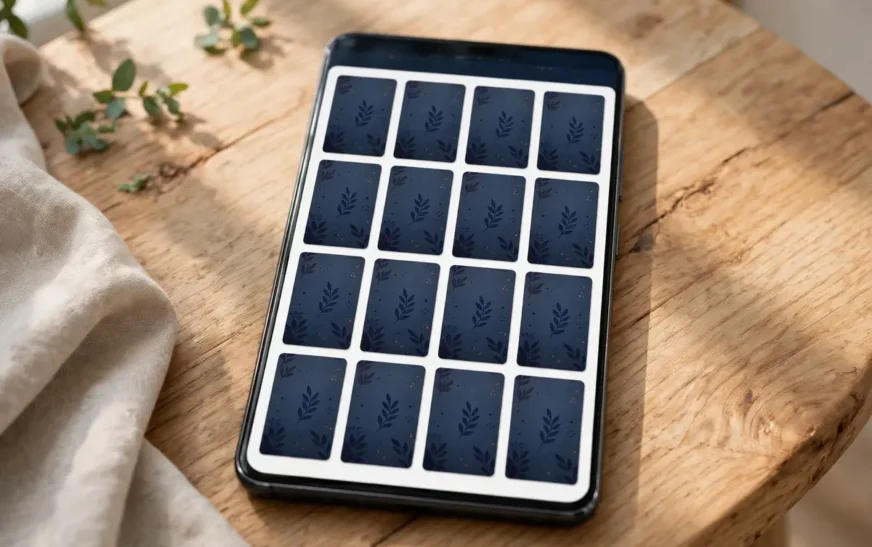
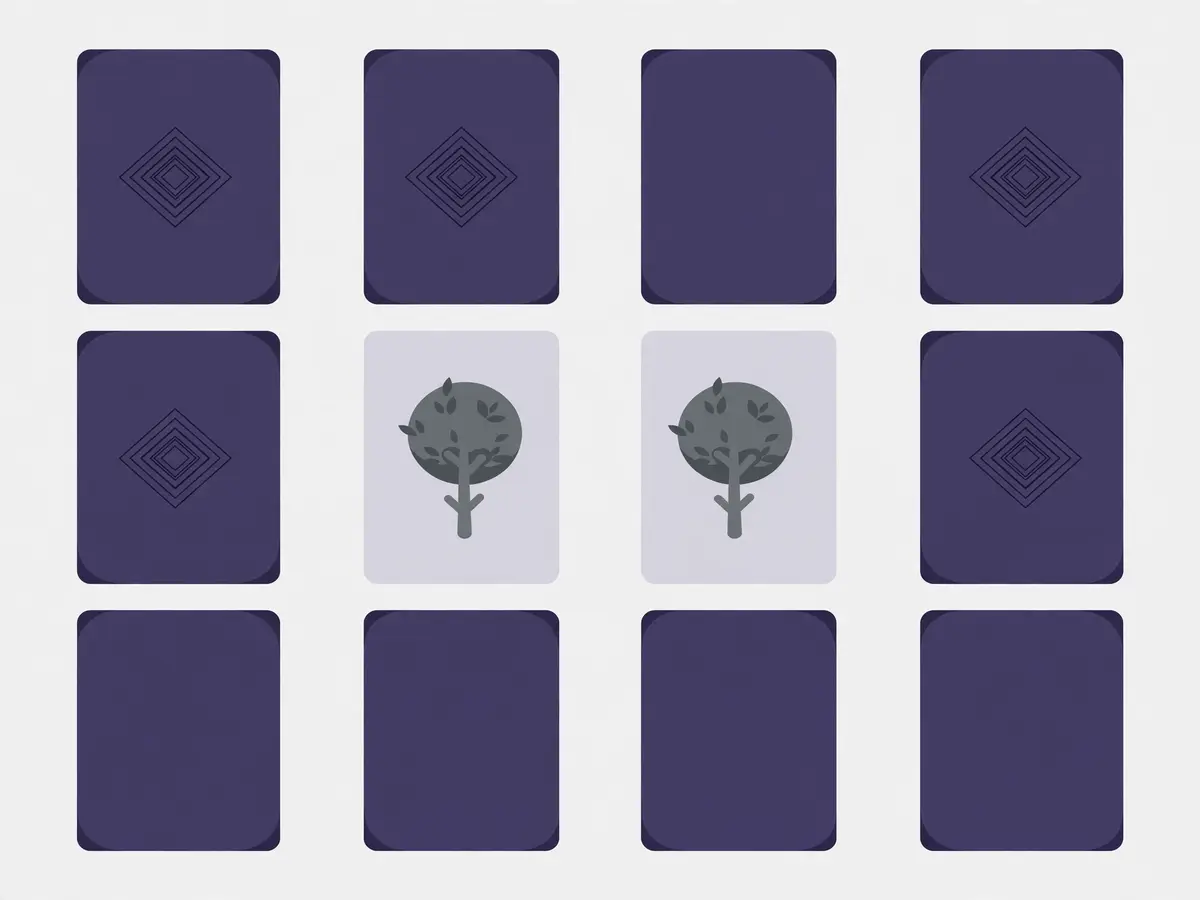
The game follows the rules of Concentration, the memory game most people learn as children. A set of cards is laid face down in a grid. You flip two cards. If they match, you keep the pair and score points. If they do not, they flip back over, and you try to remember where each photo was. The goal is to clear the whole board as quickly as possible.
There are three ways to choose the photos on the cards. First, you can play with your own Instagram photos, matching two identical copies until every photo is paired. Second, you can play with themed sets — Nature, Food, Animals, Cities, and World Wonders — where the photos are different pictures of the same kind of subject. Third, you can search for photos by hashtag, so you can match photos of almost any subject, from #leaf to #sunset. The themed and search modes are the ones that make the game genuinely challenging, because the two photos in a pair are similar but not the same.
There are three difficulty levels. Easy uses 12 photo cards, Normal uses 20, and Hard uses 20 moving cards — the cards slide around the screen, so remembering positions is much harder. On the iPad, the board grows: Normal and Hard jump to 30 cards, and up to four players can play together. On the iPhone, two players can take turns. The game also has a social side: you can double-tap a photo to like it on Instagram, and you can share your scorecard on social media. Scores are tracked through Game Center leaderboards, so you can compete with friends.
| Mode | What you match | Best for |
|---|---|---|
| Your own photos | Identical copies of your Instagram photos | Learning the game, playing with kids |
| Themed sets | Similar photos of the same subject | The real challenge |
| Hashtag search | Photos under any Instagram hashtag | Endless variety |
| Difficulty | Cards (iPhone) | Cards (iPad) | What changes |
|---|---|---|---|
| Easy | 12 | 12 | Gentle introduction |
| Normal | 20 | 30 | The standard game |
| Hard | 20 moving | 30 moving | Cards slide around the screen |
Scoring rewards speed and luck. Matching all the pairs quickly is the main goal, and the game gives extra points for combos — matching two photos without looking at them first. In multiplayer, players take turns, so a sharp-eyed player can watch the other person’s flips for clues and then use them on their own turn.
One practical note: the game needs an internet connection to fetch Instagram photos, so it does not work offline. If you are playing on mobile data rather than Wi-Fi, it is worth knowing how to check data usage on iPhone so a long session does not quietly eat your plan.
The name confusion: InstaMatch 365 and 360
Here is the part the search results do not make clear. The name “InstaMatch” is now also used by online betting platforms aimed at Indian players — sites calling themselves InstaMatch 365 and InstaMatch 360. They offer sports betting, including IPL cricket, live casino games, and crash-style games like Tower Rush and Chicken Rush, with deposits through UPI and promises of high returns.
These platforms have nothing to do with Tiny Hearts, Instagram, or the 2012 matching game. They are gambling websites, and their own pages say so: they are for users aged 18 and over, participation involves financial risk, and they do not guarantee winnings. Some of their pages also make claims about returns and “predictor” tips that no strategy can guarantee. This guide does not link to them, does not explain how to join them, and does not recommend them. If you searched for the game and landed on a betting site, you found the wrong InstaMatch.
The confusion is a good reminder of a wider pattern: when a name is not a registered trademark being actively defended, unrelated businesses can adopt it, and search results mix them together. The way to tell them apart is simple. The original InstaMatch is a 2012 iOS memory game about Instagram photos. The betting platforms are real-money gambling sites. If a page asks you to deposit money, it is not the game.
Is the original InstaMatch app still available?
Honestly, probably not — and you should not assume you can download it. The app was released in February 2012, and there is no current App Store listing for it that I could verify. Tiny Hearts has not promoted it in years, and the Instagram API it relied on has changed completely since 2012. Old apps that are not updated for new iOS versions eventually stop working or get removed from the store.
If you want to check for yourself, search the App Store for “InstaMatch” and look for the Tiny Hearts developer name. If it is not there, the app is gone, and any site offering you a download of it is not the App Store and should not be trusted.
Tiny Hearts, the studio behind the app, went on to build other apps, and Pocket Zoo — the game that made its name — is also a product of an earlier era of the App Store. Studios of that size rarely keep decade-old apps updated, because every iOS release can break old code and the cost of fixing it is rarely worth it for a $1.99 game. That is the most likely reason InstaMatch faded: not a scandal or a shutdown, just the ordinary economics of old apps. The good news is that the game itself — memory matching with photos — is easy to find elsewhere, and the next section has the best options.
Free alternatives you can play today
You do not need the original app to play a memory matching game. The best free option on a phone is already on many people’s phones: LinkedIn Games includes daily puzzle games that work the same memory and pattern skills, and they reset every day so there is always a fresh one to try.
On a computer, the same game is free in the browser with no download at all — search for “memory matching game online” and you will find versions that run in a tab, including some that let you upload your own photos. They are a good way to try the game before installing anything on your phone.
For the closest match to InstaMatch, look for a memory matching game on your app store — there are dozens, most of them free, and many let you play with your own photos. Search for “memory match” or “concentration game” and pick one with recent updates and a decent rating.
If you want the Instagram-photo twist specifically, you can make your own version. Print a set of your favourite photos in duplicate, or use a free card-making app, and play the physical game with family — it works exactly the same way, and it is a better game for children than a screen. If the photos you want are stuck on your phone, here is how to send photos from iPhone to PC so you can print them at full quality.
Before you download several games to try them, it is worth freeing up space on your phone, because games and photo libraries are two of the biggest storage hogs on most phones.
If clearing space is not enough, here is how to get more storage on your phone before downloading a batch of games to try.
There is also a creative option: you can generate your own matching-card images with text-to-image AI, printing pairs of pictures in whatever theme you like — animals, landmarks, food, or anything else. The trick is writing prompts that produce two similar but not identical images, which is a fun skill to learn.
If you want better results, learning to write good image prompts makes a real difference, and the same skill works for any image generator.
Playing on an iPhone has one more advantage: the phone itself has plenty of hidden features that make gaming smoother, from Focus modes that silence notifications to accessibility settings that help with tapping and swiping.
If you play with children, Guided Access is worth setting up — it locks the phone to a single app so a child cannot accidentally leave the game, open another app, or make a purchase.
Tips to get better at memory matching
Memory matching looks like luck, but it rewards method. The single best habit is to flip cards in a pattern instead of at random. Work through the grid row by row, so you always know which cards you have seen and which you have not. When you flip a card, say what it shows out loud or in your head — naming the photo helps you remember it better than just looking at it.
Watch your opponent’s flips in multiplayer. Every card they turn over is information you get for free, and a good player remembers the other person’s misses as carefully as their own. In the themed modes, where pairs are similar rather than identical, look for the details that distinguish one photo from another: the colour of a building, the shape of a tree, the angle of a shot. Two photos of the Golden Gate Bridge are only a match if the game says they are, so read the pair, not just the subject.
Finally, do not rush. Speed matters for the score, but a careless flip wastes the information you just gained. The fastest players are the ones who flip deliberately, remember everything, and only speed up when the board is nearly cleared. Long sessions can also heat your phone up, so take a break if the device feels warm — a hot phone is a sign to pause, not to push through.
Play the same board twice. Most matching games let you replay a layout, and the second run is always faster — not because you got smarter, but because you remember the board. That is the whole skill, and it is worth practising deliberately: after a game ends, try to recall where three specific cards were before you start the next one.
And play with someone better than you. In multiplayer, a stronger opponent shows you what you are missing — usually that they are remembering your flips, not just their own. A few games against a good player teach more than a dozen games alone.
Frequently asked questions
What is the Instamatch game?
The Instamatch game is a memory matching game released in February 2012 by Tiny Hearts for iPhone and iPad. It turns Instagram photos into cards and asks you to match two similar photos of the same subject. It is not the same thing as the InstaMatch 365 or 360 betting websites.
How do you play InstaMatch?
Cards are laid face down in a grid. You flip two at a time: if they match, you keep the pair and score points; if they do not, they flip back and you try to remember where each photo was. The goal is to clear the whole board as quickly as possible.
Is InstaMatch free?
The original app cost $1.99, with a launch price of $0.99. It is not clear that it is still available to download. The memory matching games you can play instead are mostly free.
Can I play InstaMatch on Android?
No. The original app was iOS only, for iPhone and iPad. Android users can play any of the free memory matching games on Google Play instead.
What is the difference between InstaMatch and InstaMatch 365?
InstaMatch is the 2012 iOS memory game about Instagram photos. InstaMatch 365 is an unrelated Indian betting platform offering sports betting and casino games. They share a similar name and nothing else.
Is InstaMatch 365 safe?
InstaMatch 365 is a real-money gambling platform for users aged 18 and over. Its own pages warn that participation involves financial risk and may be addictive, and that winnings are not guaranteed. This guide does not recommend it or link to it.
What are the best free memory matching games?
LinkedIn Games offers daily puzzles that train the same skills. Your app store has dozens of free memory matching games — search for “memory match” and choose one with recent updates. You can also make a physical set from your own printed photos.
How can I get better at memory matching games?
Flip cards in a set pattern, name each photo as you see it, remember your opponent’s flips in multiplayer, and slow down — a deliberate flip is worth more than a fast one.
Bottom line
The Instamatch game is a small piece of app history: a 2012 iPhone game from Tiny Hearts that turned Instagram photos into a memory matching game, with a clever twist — you matched similar photos, not identical copies. It had themed sets, hashtag search, three difficulty levels, and multiplayer through Game Center. The name has since been adopted by unrelated betting platforms, and that is the main thing to watch out for: if a page called InstaMatch asks you to deposit money, it is not the game. The original app appears to be gone from the App Store, but the game itself is not — free memory matching games are everywhere, LinkedIn Games trains the same skills daily, and you can even make your own set from your photos. The matching game was never really about the app. It was about paying attention, and that still works.

Continue Reading on CripsyWire
For more practical tutorials and hidden features, see our full how-to guides section. AI workflow guides feed into the broader AI tools and agents coverage, phone tricks live in smartphones, and wearable setup walkthroughs in wearables. When you are deciding what to buy, the reviews and comparisons section helps. All part of CripsyWire Tech, and the homepage shows what is newest.