Quick answer: A random UUID is a 128-bit identifier whose uniqueness comes from chance, not from a counter, a clock, or a machine address. In version 4, 122 bits are random and 6 bits are fixed to mark the version and variant. That leaves about 5.3 × 1036 possible values, so collisions are possible in theory and negligible in practice when the random source is sound. Use the random version when you need an unpredictable, decentralised ID. Use the time-ordered version, version 7, when you need IDs that sort by creation time and play well with database indexes.
Random UUID Explained: What Randomness Really Means
Most IDs tell a story. A database number tells you one row came after another. A timestamp tells you when something happened. A random UUID tells you none of that, and that silence is the point.
If you need one quickly, you can generate a UUID with CripsyWire’s free UUID tool and see the format for yourself. This article explains what sits behind that string, why the randomness matters, where the odds stand, and when randomness is the wrong choice.
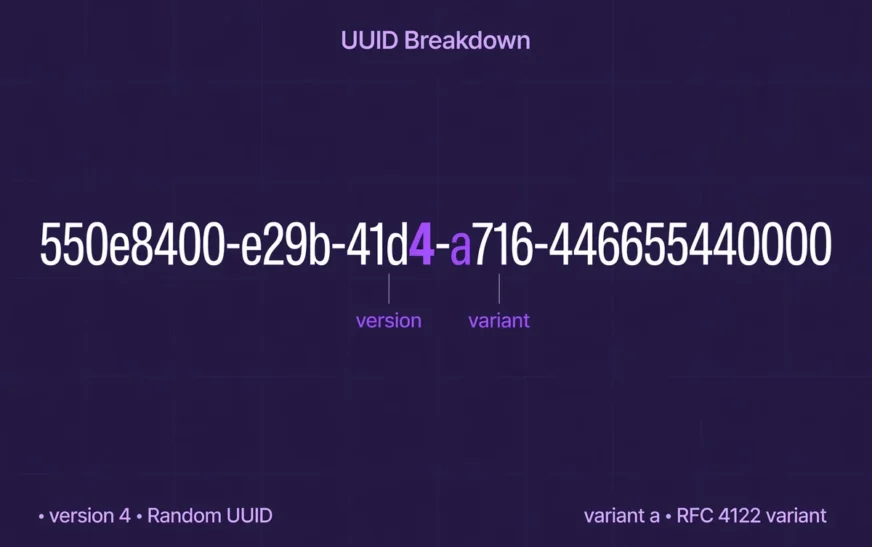
A UUID looks like this: 550e8400-e29b-41d4-a716-446655440000. It is 36 characters including four hyphens, and 32 hexadecimal characters without them. Each hexadecimal character carries 4 bits, so 32 × 4 gives 128 bits. That length is fixed across all versions. What changes is how those bits are filled.
What “random” means inside a UUID
In a UUID, random has a strict meaning: the bits should not be predictable from earlier UUIDs, from the time of day, from the machine that made them, or from any other observable fact. An attacker who sees one UUID should gain no useful help in guessing the next one.
That matters because identifiers often guard access. A file link, a password-reset token, or a private upload URL built on a UUID is only as private as the randomness behind it. If the sequence can be predicted, the ID stops being a secret and becomes a puzzle with a short solution.
The source matters more than the length. A cryptographic generator draws entropy from the operating system — timing jitter and hardware events that are hard for an outsider to reproduce. A simple seeded generator produces a fixed sequence once you know the seed. Its output can look random while being fully determined. Use the first kind for security-sensitive IDs, and leave the second kind for games and simulations.
The anatomy: 128 bits, 122 random, 6 fixed
Version 4 reserves 6 bits. Four encode the version, and two encode the variant. The version nibble at the start of the third group is always 4. The variant bits at the start of the fourth group, for the standard variant in RFC 9562, produce a first character of 8, 9, a, or b.
That leaves 122 bits free to vary. Two to the power of 122 is about 5.3 × 1036. The hyphens carry no information; they mark the 8-4-4-4-12 grouping and make the string readable.
RFC 9562, published in May 2024, is the current standard. It obsoletes RFC 4122. It formally adds version 7, the time-ordered version, and it tightens guidance on version 1, whose node field could expose a MAC address. The 122-bit count is not a marketing claim: 128 total bits minus 4 version bits minus 2 variant bits.
How version 4 randomness actually works
A correct implementation does three things. It asks the operating system or a vetted cryptographic library for 16 random bytes. It sets the version and variant bits to their fixed values, overwriting whatever random bits sat there. It formats the result as hexadecimal with hyphens in the standard places.
Skip the middle step and you do not have a version 4 UUID. You have 128 random bits in UUID clothing. Most parsers will still accept the string, but strict checks will flag it, and anyone reading the version nibble will draw the wrong conclusion about how the ID was made.
In Python, uuid.uuid4() handles this correctly. In modern browsers and Node.js, crypto.randomUUID() is the default choice. Random, note, does not mean unique by guarantee. It means unique by probability, with no central registry checking each new value. The statistics are overwhelmingly on your side when the source is sound.
Small utilities deserve the same check-before-you-commit habit. If you are sizing a phone before a transfer, the phone storage calculator gives a fast sense of capacity, just as checking the generator gives a fast sense of whether an ID can be trusted.

Collision odds: the birthday bound, without hype
The headline number invites a misunderstanding. It does not mean you can generate 5.3 × 1036 IDs before a collision becomes likely. Collisions become likely far earlier, because every new ID is effectively compared against every ID already made. This is the birthday paradox applied to identifiers.
The birthday bound for a 122-bit space is around 261, roughly 2.3 quintillion values. At that scale, the chance of at least one collision reaches about 50 percent. Below it, the chance falls fast. Generate a billion IDs and the collision chance is still vanishingly small — far below the chance of a hardware fault or a bug elsewhere in the system.
Put it concretely: at a billion UUIDs per second, you would need more than 70 years to reach the bound. No real application does that. The risk that dominates real incidents is not the mathematics. It is a broken generator, a duplicated seed, a virtual machine cloned with the same random state, or a sample value copied from documentation into production and reused as a constant. Never hard-code an ID that is supposed to be unique.
Storage choices can also create false collisions. Systems that normalise case differently, strip hyphens in one place but not another, or truncate a value to fit a short column can turn distinct values into identical strings. Keep one canonical form — lower case, hyphenated, full length — and that class of bug disappears.
Unpredictability and privacy
Sequential IDs leak information. If your newest order is number 104,821, a visitor knows roughly how many orders you have taken. If your next public link increments by one, anyone can walk the sequence and find neighbouring records. Random IDs close that leak by removing order and count from the identifier itself.
That suits shared files, invite links, unlisted pages, and keys that appear in URLs. An outsider who sees one ID learns nothing about how many others exist or what the next one will be. The ID still needs proper access control behind it — secrecy is not a substitute for authorisation — but unpredictability removes a cheap enumeration attack.
Random IDs also help when devices create records offline and merge them later. No coordination is needed, no central counter becomes a bottleneck, and no merge step has to renumber records.
If your work involves moving data between devices, the same verify-before-you-trust habit applies. A guide on how to back up an Android phone makes that point in a different domain: confirm the copy, then rely on it.
When random is right, and when version 7 is better
Random is right when the ID must be unpredictable, when creators cannot coordinate, or when leaking order or volume would be a problem. Public share links, reset tokens, offline device registrations, and records merged from many sources all fit. It is also right when the ID must not reveal timing for privacy reasons, such as a support ticket or a private upload.
Random is not free. Scattered IDs can fragment database indexes, because each new row lands in an unpredictable place rather than at the end. For small tables, the effect is negligible. For very large tables with heavy inserts, it becomes measurable.
Version 7 solves that cost. It fills the first 48 bits with a Unix timestamp in milliseconds, then fills the rest with random data. New rows append near the end of the index, inserts stay fast, and range queries by creation time become natural. The trade is that a version 7 ID reveals its creation time to the millisecond, and IDs made close together share a long prefix, making them easier to guess in a narrow window.
The practical rule is simple. Use the time-ordered version for internal keys in large, insert-heavy tables, where ordering helps and exposure is low. Use the random version for public-facing identifiers and anything where unpredictability is the priority. Many systems use both: a time-ordered key inside, and a random public token outside.
A guide to Wi-Fi 8 makes a similar point about standards: a new version fits a specific workload better, without making the older version worthless. Version 7 does not retire version 4. It gives large tables a better default, while version 4 keeps the crown for unpredictability.
The other versions, briefly
Version 1 combines a timestamp with a node identifier and a clock sequence. It sorts by time, but its node field created the privacy problem noted above. RFC 9562 keeps it for compatibility, not as a recommendation for new designs.
Version 3 hashes a namespace and a name with MD5. Version 5 does the same with SHA-1. Both are deterministic: the same namespace and name always produce the same UUID. That is useful for a stable ID derived from content, and useless as a secret, because anyone who knows the input can recompute the value. Neither should be used as a security token.
Nil is the all-zero UUID, and Max is the all-one UUID. Both are sentinels for “no value” or range boundaries. Neither should ever be issued as a real record ID. Version 6 reorders version 1 for better sorting, and version 8 is a custom format. For most teams, the choice that matters is between the random and time-ordered versions.
Mistakes that break randomness in practice
First, using a non-cryptographic generator for a security-sensitive ID. Keep test seeds in tests, where reproducibility is a virtue, and keep cryptographic sources in production, where unpredictability is the requirement.
Second, truncating a UUID to make it shorter. Cutting 122 bits down to 32 or 64 destroys the collision maths. If you need a short public code, design it as a short code with its own uniqueness check, rather than slicing a UUID and hoping.
Third, reusing a UUID across records, or copying a documentation example into production. Search the codebase for hard-coded values before launch. Fourth, storing UUIDs inconsistently — mixed case, mixed hyphenation, mixed text and binary — which creates phantom duplicates. Pick one canonical form and enforce it where data enters the system.
Fifth, assuming randomness removes the need for a uniqueness constraint. A unique index on the ID column costs almost nothing and catches the rare collision, the duplicated seed, and the copy-paste error alike. Sixth, exposing an internal ID where a public token belongs. Mint a separate random public token when the audience changes.
Unremarkable maintenance, done consistently, keeps systems honest. Clearing stale data on a phone is one example, which is why a walkthrough on how to clear the cache on Android sits naturally alongside more exciting topics.
Generating one safely, and choosing in five minutes
In Python, uuid.uuid4() is the standard call. In JavaScript, crypto.randomUUID() is the direct equivalent. Other languages provide the same through their standard or widely used libraries. The rule everywhere is the same: use the library, check you called the random variant, and test that a thousand values are distinct and carry the correct version digit.
For storage, prefer binary (16 bytes) where the database supports a native UUID type, such as PostgreSQL. Text is fine for smaller systems and JSON APIs, where readability matters more than a few bytes per row. What matters is consistency: one type, one case, one hyphenation rule.
To choose, ask first: will this ID ever appear in a URL or shared link? If yes, and unpredictability matters, choose the random version. If no, ask whether the table will grow large with heavy inserts. If yes, choose the time-ordered version. If both answers are no, pick the random version for simplicity. If the same input must always map to the same ID, use a name-based version and accept that it is computable. If you need an absolute guarantee against duplicates, add a uniqueness check at write time.
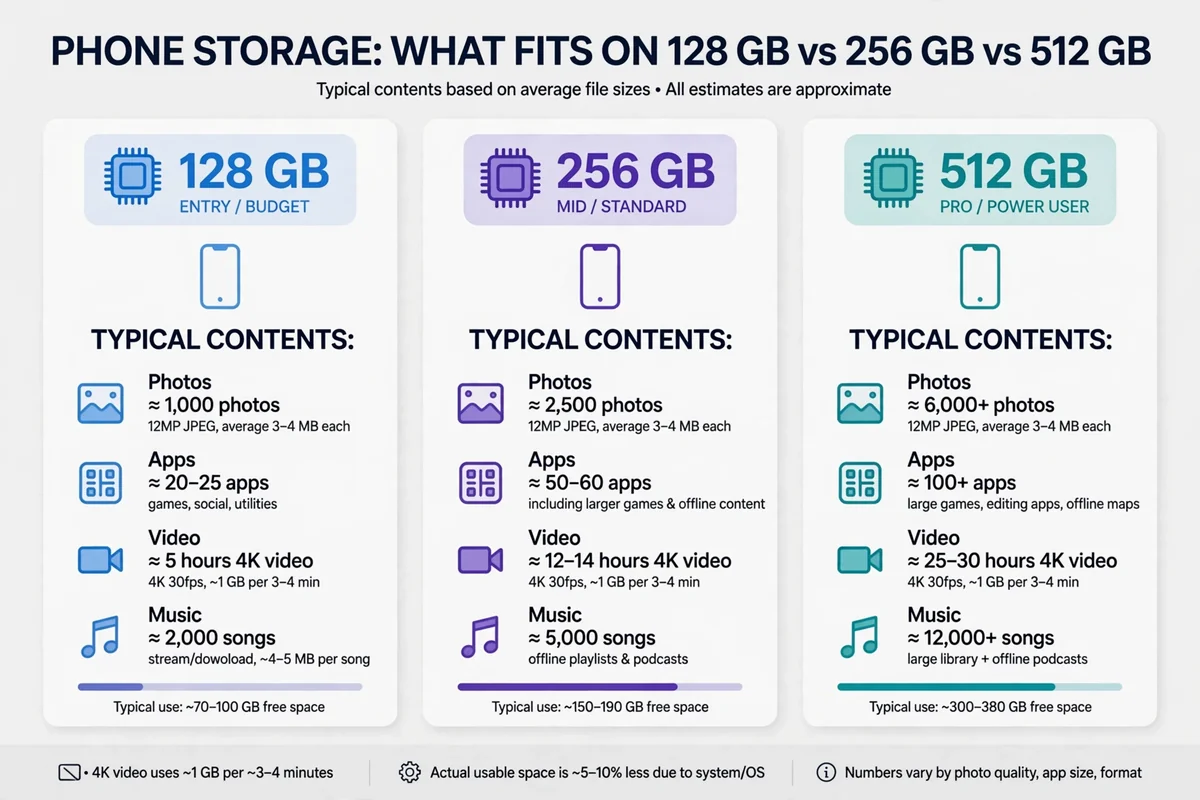
Checking capacity before you commit helps with hardware too. A guide on how many photos 128GB can hold prevents a storage surprise later, just as choosing an ID strategy early prevents a migration surprise.
What random does not do
Randomness does not make an ID secure on its own. A random UUID in a URL without access control is still accessible to anyone who obtains the link. Treat it as unlisted, not as locked. It does not make an ID meaningful either: it carries no creation time, owner, or category, so those facts must live in separate columns.
It does not make an ID short or memorable. Nobody should be asked to type one by hand. For human-facing codes — order numbers, invite codes, short links — use a separate code alongside the UUID. It also does not fix a broken data model: if two records should be one, distinct random IDs hide the duplication. Deduplication still needs a business key, such as an email or order reference.
If you are building a product, the same test applies elsewhere. A walkthrough on how to create an AI agent deals with a different building block, but asks the same question: what job is this piece actually doing, and what job should stay elsewhere?
A short history
UUIDs began as an answer to a distributed problem: how do independent systems create identifiers without asking a central authority? RFC 4122 defined versions 1 through 5, covering timestamp, name-based, and random strategies, and the format spread into databases, operating systems, and web APIs.
Each version traded one property for another. Version 1 leaked machine identity. Timestamp versions exposed time. Random versions solved privacy but scattered indexes. Name-based versions solved repeatability but were never secrets. RFC 9562, in May 2024, clarified privacy guidance, formalised version 7, and reserved version 8 for custom formats, without breaking existing version 4 values. That stability is part of the appeal: code from a decade ago still interoperates with code written today.
For a broader sense of how CripsyWire approaches new standards, the site’s blog collects explainers in the same vein, each focused on one technology and its practical trade-offs rather than on hype.
FAQ
What is a random UUID, in one sentence?
It is a 128-bit identifier in which 122 bits are drawn at random, with the rest fixed to mark it as version 4, so independent systems can create unique-looking IDs without coordinating with each other.
How many values can I generate before a collision becomes likely?
Around 261 values, roughly 2.3 quintillion, is where the chance of at least one collision reaches about 50 percent. Real systems generate far fewer, so the practical risk comes from broken generators or reused values, not from the mathematics.
Is a random UUID safe to use as a password or a secret key?
No, not by itself. A version 4 value has 122 bits of entropy, which is strong, but credentials have their own formats, rotation rules, and storage requirements. Use a dedicated secret generator and a proper secrets store for credentials, and use UUIDs for identification.
Can someone guess my next UUID from one I published?
Not when the generator uses a cryptographic source. Each value is independent, so seeing one gives no usable help in predicting the next. That guarantee fails with a weak seeded function, which is why the choice of source matters more than the length of the string.
Should I use a random or a time-ordered UUID for a database primary key?
Use the random version when the key will be public or unpredictability matters most. Use the time-ordered version, version 7, for large, insert-heavy internal tables where index performance matters and the timestamp leak stays private. Many systems use both, with different IDs for internal and public use.
Does uppercase versus lowercase change a UUID?
No, in most parsers the value is the same either way, because hexadecimal is case-insensitive. Lower case is the usual convention, and sticking to one case prevents false mismatches in tools that compare strings exactly.
Why do some UUIDs start with the same characters?
Because the version and variant bits are fixed. Every version 4 value has 4 at the start of the third group, and the fourth group starts with 8, 9, a, or b. A long shared prefix beyond those fixed bits, in a truly random value, would signal a problem with the generator.
Bottom line
A random UUID earns its keep by doing one job well: giving independent systems a way to mint identifiers that are unpredictable, decentralised, and, for practical purposes, unique. Its strength comes from 122 random bits drawn from a sound source, not from length alone or from looking complicated.
Choose it when unpredictability matters, when creators cannot coordinate, or when leaking order would be a problem. Choose the time-ordered version when a large table needs index-friendly inserts and the timestamp can stay private. Back either choice with a uniqueness constraint so the rare failure surfaces loudly instead of silently.
For more context on the site behind this guide, see the About Us page.
For help with a slow connection, the guide on how to fix a slow DNS lookup covers the common causes.
If a device is running hot while you work, the guide on why a phone overheats is a useful next read.
If you are weighing tools that promise to save time, the piece on AI productivity tools applies the same test used here: does the tool do the job it claims, and what does it cost?
The companion piece on how to save money with AI agents applies that test to automation claims in particular.
For a focused example of a single-purpose utility done well, see the AI image prompt builder.
Need a UUID right now?
Make one in seconds, free, with no sign-up and no stored record of your value.

Continue Reading on CripsyWire
For more practical AI coverage for US buyers, see our full AI tools and agents library. When you are deciding between competing tools, the reviews and comparisons section breaks down head-to-head matchups. AI features that live inside your phone are tracked in smartphones, and AI on your wrist or finger in wearables. All of this is part of CripsyWire's broader Tech coverage — start at the homepage for what is newest.