Search “best home coffee grinders” and you’ll drown in lists that recommend a $20 blade grinder in the same breath as a $500 flat-burr machine, as if they belong in the same conversation. They don’t. After grinding my way through a stack of beans on more units than I’d like to admit, here’s the honest version: the grinder matters more than your brewer, and a handful of models are worth your money in 2026 — the rest are noise.
This guide skips the affiliate-bait padding. Every pick below is a burr grinder, sorted by budget and brew method, with real 2026 US prices so you know exactly what you’re getting into.
Why your grinder matters more than your coffee machine
Here’s the part most buying guides bury: you can pull a better cup from a modest brewer and a great grinder than from an expensive machine and a cheap one. That’s not marketing — it’s physics.
A blade grinder chops beans at random, producing a chaotic mix of fine dust and coarse chunks. Those particles extract at completely different rates in the same brew, so you get bitterness (over-extraction) and sourness (under-extraction) in the same cup. A burr grinder crushes beans between two abrasive surfaces set a precise distance apart, giving you uniform particle size — and uniform particles are the entire game.
So my first piece of advice is blunt: if you’re choosing between upgrading your machine or your grinder, upgrade the grinder. The good news is that in 2026 the price of a genuinely good grinder has dropped — solid options start around $85, and you can land a reference-quality burr grinder for roughly $150.
Burr types, quickly: conical vs flat
You’ll see two burr designs while shopping, and the difference is real but often oversold:
- Conical burrs — quieter, run cooler, cost less, and produce a slightly more textured, forgiving grind. Great for filter coffee and most home setups.
- Flat burrs — produce a more uniform particle distribution with fewer “fines,” which translates to cleaner, more defined flavor (especially for pour-over and espresso). They usually cost more and can be louder.
For most people brewing drip, French press, or pour-over, a good conical grinder is more than enough. Flat burrs start to matter when you’re chasing clarity in specialty pour-over or dialing in espresso. Don’t let anyone shame you into a $400 flat-burr machine if you drink one French press a day.
Best home coffee grinders 2026 at a glance
| Grinder | Type | Best for | Price (USD, 2026) |
|---|---|---|---|
| Baratza Encore | Electric, conical | Best all-around value | ~$150 |
| Baratza Encore ESP | Electric, conical | Espresso + filter on a budget | ~$199 |
| Fellow Opus | Electric, conical | All-rounder, espresso-capable | ~$195 |
| Fellow Ode Gen 2 | Electric, flat (64mm) | Premium filter / pour-over | ~$400 |
| Breville Smart Grinder Pro | Electric, conical | Range and built-in dosing | ~$249 |
| DF64 Gen 2 | Electric, flat (64mm) | Espresso “endgame” | ~$499 |
| Timemore Chestnut C3 | Manual | Best budget pick | ~$85–95 |
| 1Zpresso J-Max / J-Ultra | Manual | Best manual for espresso | ~$199–229 |
| Comandante C40 MK4 | Manual | Premium hand-grinder benchmark | ~$300+ |
Prices fluctuate with sales — I’ve seen the Encore dip to $120 and the Timemore C3 ESP hit $68 during Prime events. Buy on a deal if you can wait.
The best electric coffee grinders
Baratza Encore — the one I recommend to almost everyone
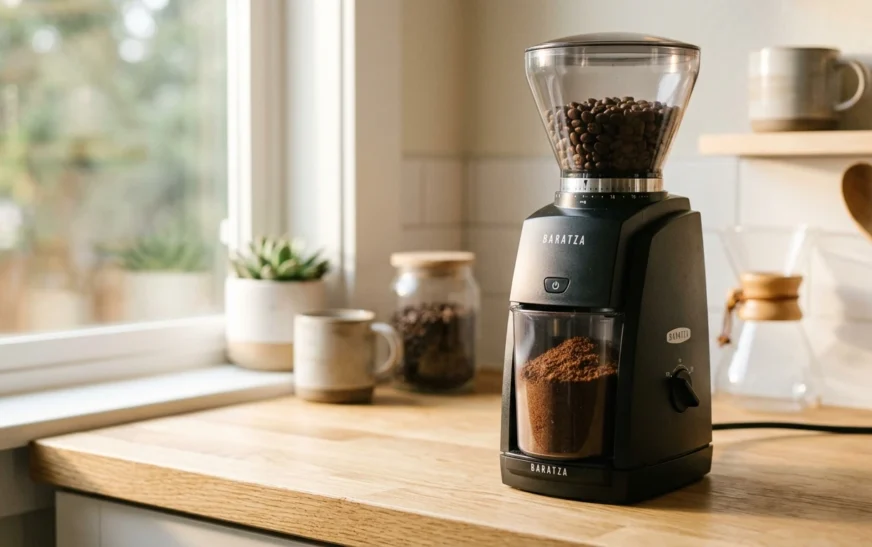
If a friend texts me asking what grinder to buy, the answer is usually the Baratza Encore at around $150. It’s a stripped-down conical burr grinder with 40 grind settings and a single start/stop button — no screen, no gimmicks. It excels at filter brewing (drip, pour-over, French press) and produces consistent, repeatable results.
What makes it the value benchmark isn’t just performance — it’s longevity. The Encore lineage traces back to 2002, parts are widely available, and it’s designed for home repair. People are still running units from 2012 on their third set of burrs. That’s the opposite of disposable. Just know its limitation up front: the standard Encore is not built for espresso. For that, you want its sibling. You can confirm current specs and warranty on the official Baratza site.
Baratza Encore ESP — budget espresso that also does filter
The Encore ESP (~$199) is the default recommendation when someone wants one electric grinder that can handle both espresso and filter without breaking the bank. It adds the finer, more precise grind range espresso demands while still covering your morning drip. If you’re espresso-curious but not ready to commit $500, start here.
Fellow Opus — the stylish all-rounder
The Fellow Opus (~$195) is the design-forward pick that genuinely backs up its looks. Conical burrs, micro-fine adjustment, a single-dose workflow, and enough range to attempt espresso and filter. The trade-off versus pricier Fellow models is a plastic chassis instead of metal — but for the versatility at this price, that’s an easy compromise for most home brewers.
Fellow Ode Gen 2 — premium, but filter only
Read this twice: the Fellow Ode Gen 2 (~$400) does not make espresso. Fellow has been explicit about this, and people still buy it for espresso and regret it. What it does do is produce some of the cleanest filter coffee you can grind at home, thanks to 64mm flat burrs, a single-dose bin, and near-silent operation. If pour-over is your religion and espresso doesn’t interest you, it’s spectacular. If you want one grinder for everything, it’s the wrong tool.
DF64 Gen 2 — the espresso “endgame” on a home budget
At ~$499, the DF64 Gen 2 sits at the top of this list for a reason. Its 64mm flat burrs deliver espresso clarity and definition that conical grinders simply can’t match, with a stepless adjustment dial for dialing in shots precisely. This is enthusiast territory — overkill for casual drinkers, but the sweet spot for anyone serious about espresso who doesn’t want to spend four figures.
The best manual coffee grinders
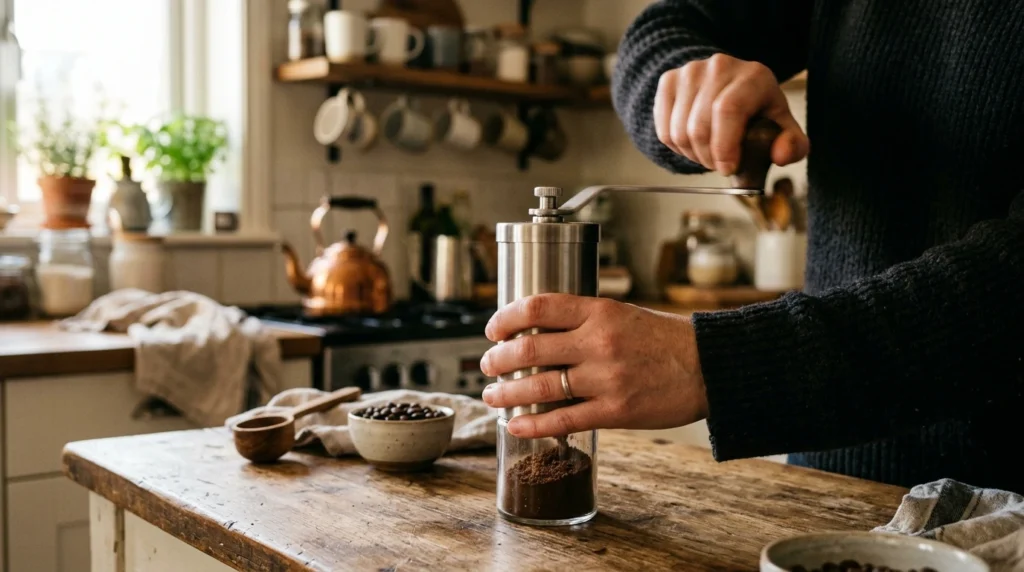
Manual grinders deliver more grind quality per dollar than electrics — the catch is 30–45 seconds of hand-cranking per dose. If you make three-plus drinks a day, go electric. If you make one or two, or you travel, a hand grinder is a steal.
Timemore Chestnut C3 — the budget champion
The Timemore C3 (around $85–95, and often less on sale) punches absurdly above its weight. Stainless steel S2C conical burrs, excellent grind consistency, and a compact body make it the easy budget pick for pour-over and French press. The C3 ESP variant adds espresso-capable fineness for those willing to do a little more cranking.
1Zpresso J-Max / J-Ultra — manual espresso done right
For manual espresso, the 1Zpresso J-Max (~$199–229) is the one. Its fine-adjustment system lets you dial in shots with a precision that rivals electric grinders costing twice as much. The newer J-Ultra slims down the body for easier grip. If espresso is the goal but a $500 electric isn’t, this is the smart spend.
Comandante C40 MK4 — the cult benchmark
The Comandante C40 MK4 (~$300+) is the hand grinder serious brewers measure others against. Premium build, a famously smooth crank, and consistency that holds across brew methods. It’s a luxury, not a necessity — but if you want a heirloom-grade manual grinder, this is it.
How much should you actually spend?
A useful rule of thumb: budget 40–50% of your total coffee setup cost on the grinder. Beyond that:
- Below ~$60: grind consistency drops off sharply. Avoid, unless it’s a quality manual like a sale-priced Timemore.
- $85–200: the genuine sweet spot for most home brewers. This is where the Encore, Opus, C3, and J-Max live.
- $200–500: you’re paying for flat burrs, espresso precision, and better build.
- Above $500: diminishing returns and enthusiast bragging rights.
Most people find their ideal price-to-quality ratio through experience, not spreadsheets. Start in the sweet spot, brew for a few months, and upgrade only if you hit a real wall.
One small lifestyle note: if you’re the type who tracks how that late-afternoon cup wrecks your sleep, the data from a sleep-tracking smart ring will tell you more than any caffeine myth online. And if you’re optimizing your whole morning, pairing fresh coffee with the right time-saving software is a surprisingly effective combo.
Frequently asked questions
Is a burr grinder really worth it over a blade grinder? For espresso, absolutely — blade grinders make consistent extraction impossible. For filter coffee the gap is smaller but still real: a burr grinder gives noticeably cleaner, more balanced flavor. Every pick in this guide is a burr grinder for that reason.
Conical or flat burrs — which should I buy? Conical for most home brewers: quieter, cooler, cheaper, and great for filter. Flat burrs matter when you want maximum clarity in pour-over or are dialing in espresso, and you’re willing to pay more.
What’s the best budget coffee grinder in 2026? The Timemore Chestnut C3 (~$85–95) if you don’t mind hand-grinding, or the Baratza Encore (~$150) for the best value electric. Both punch well above their price.
Can manual grinders make espresso? The good ones can. The 1Zpresso J-Max and Comandante C40 MK4 produce espresso-fine, consistent grinds. Budget manuals generally can’t hold the tight tolerance espresso needs.
Do I need to spend $400+ on a grinder? No. Most people are exceptionally well served in the $85–200 range. Spend $400+ only if you’re a dedicated pour-over or espresso enthusiast chasing the last few percent of quality.
How long should a good grinder last? A well-built burr grinder like the Baratza Encore can run for a decade or more, especially since burrs are replaceable and parts are available. That longevity is a big part of why it’s worth buying once instead of upgrading twice.
The bottom line
Most people overthink this. If you want one recommendation and you’re done: buy the Baratza Encore for filter, the Encore ESP if you also want espresso, or the Timemore C3 if you’re on a budget and don’t mind cranking. Step up to the Fellow Ode Gen 2 or DF64 Gen 2 only when you’ve outgrown the basics and know exactly what you’re chasing.
A great grinder is the single best upgrade you can make to your home coffee — more than beans, more than your brewer. Buy a good one once, keep it for years, and every cup after that is better. For more honest, tested gear guides, that’s what we do over at CripsyWire — no hype, just verified results.

Continue Reading on CripsyWire
For more practical tutorials and hidden features, see our full how-to guides section. AI workflow guides feed into the broader AI tools and agents coverage, phone tricks live in smartphones, and wearable setup walkthroughs in wearables. When you are deciding what to buy, the reviews and comparisons section helps. All part of CripsyWire Tech, and the homepage shows what is newest.