Quick answer: A UUID v4 generator creates a 128-bit identifier in which 122 bits come from a secure source of randomness and the other 6 bits are fixed. The version digit is always 4, and the variant digit is always 8, 9, A, or B. That gives about 5.3 × 1036 possible values, so two independently generated IDs are extraordinarily unlikely to collide when the randomness is genuinely secure.
If you have ever pasted a string like 550e8400-e29b-41d4-a716-446655440000 into a database or an API request, you have handled a UUID. Developers use them to give something a unique name without asking a central server first.
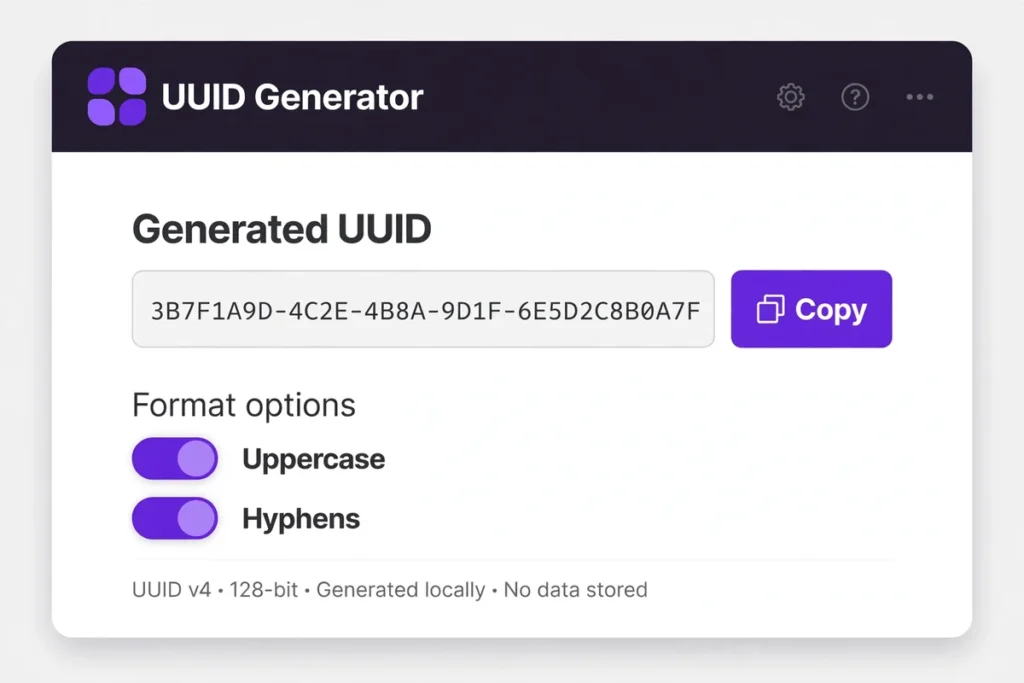
You can try a generator right away with the CripsyWire UUID tool, then read on to learn what its output means and how to use it well.
What a UUID v4 Really Is
A UUID is a 128-bit value, usually written as 32 hexadecimal characters split into five groups by hyphens: 8-4-4-4-12. Each hex character represents 4 bits, so 32 times 4 gives 128. The hyphens are only presentation. Remove them and you still have the same 128 bits.
Version 4 is the random version. The current standard is RFC 9562, published in May 2024, which obsoletes the older RFC 4122. A v4 ID encodes no time, no machine address, and no name. That is the point. Nothing about the value reveals when it was made, where it was made, or what it refers to. Two people on opposite sides of the world can generate IDs at the same second without coordinating.
That independence is why v4 IDs appear as primary keys, session tokens, file names, request IDs, test fixtures, and message IDs. They are cheap to create, need no network call, and do not leak ordering information. If you need IDs that sort in creation order, v4 is the wrong choice. A time-ordered version fits that job better. If you need an opaque, unique label, v4 is hard to beat.
The Anatomy: 122 Random Bits, 6 Fixed Bits
Here is the layout, group by group:
xxxxxxxx-xxxx-4xxx-yxxx-xxxxxxxxxxxx
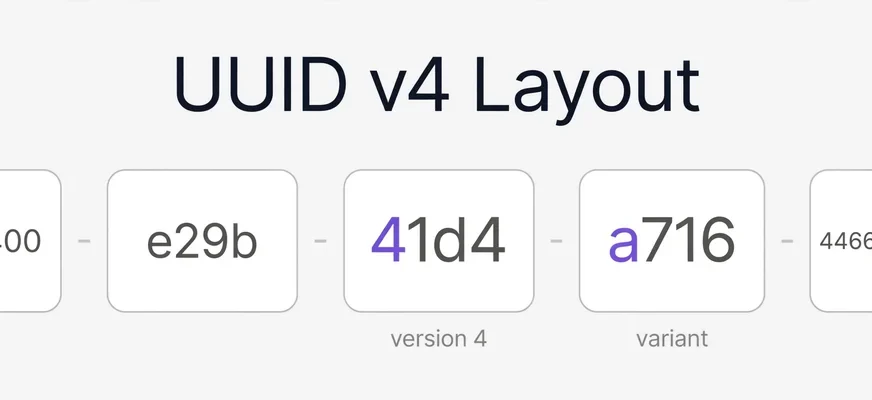
The x positions are random hex digits. The 4 in the third group is the version field: four bits set to 0100 in binary, which is the digit 4 in hex. That is how a reader knows this is a version 4 ID.
The y in the fourth group is the variant field. Its top two bits are fixed to 10 in binary, leaving two random bits in that hex digit, so y can only be 8, 9, A, or B. If you see a C or an F there, the value is not a standard v4 ID, even if the rest looks right.
Count the fixed bits: 4 for version, 2 for variant, 6 in total. Subtract from 128 and you get 122 random bits. The total space is about 5.3 × 1036 possible values — roughly 5 followed by 36 zeros.
Collision risk is usually described with the birthday bound. For 122 random bits, the point where a collision becomes roughly a coin flip sits near 261 generated values, about 2.3 quintillion IDs. Below that scale, the risk stays tiny. At the scale of a normal application or a large company, collisions from genuine v4 generation are not a realistic worry.
Secure Randomness Is the Whole Game
There are two kinds of “random” in programming, and confusing them is the most common v4 mistake.
Cryptographically secure randomness comes from the operating system or hardware: /dev/urandom on Linux, BCrypt on Windows, SecRandomCopyBytes on Apple platforms, and crypto.getRandomValues() or crypto.randomUUID() in browsers and Node.js. These sources are designed to stay unpredictable even to an attacker who knows a lot about the system.
Ordinary functions such as Math.random() in JavaScript are not in that category. They are fine for shuffling a playlist. They are not suitable for identifiers that must stay unpredictable, because their output can be predictable and some implementations repeat far sooner than 2122 values.
The safest path is a standard library function. Python has uuid.uuid4(), Java has UUID.randomUUID(), .NET has Guid.NewGuid(), and modern JavaScript has crypto.randomUUID(). These already set the version and variant bits correctly. Hand-rolling a hex-string builder and forgetting to force those bits is how non-standard IDs get created.
How to Use a UUID v4 Generator Well
Using a generator well is less about clicking a button and more about deciding what happens to the output.
Start with one ID per thing: a user, an order, a file upload, a log event, a message. Reusing one ID across unrelated records defeats the purpose and creates collisions in meaning, even if the value itself is unique. If two records share an ID because you copied a sample from documentation, no amount of randomness will save you.
Decide on case and format before you store the first ID, then enforce it everywhere. Lowercase with hyphens is the most common convention and matches what most libraries produce by default. Uppercase is valid, but mixing cases in one column invites duplicate-looking records and failed lookups. Pick lowercase, store lowercase, and normalise input to lowercase on the way in.
Decide whether you need hyphens. Most APIs, JSON payloads, and URLs keep them. Some storage formats strip them to save 4 characters per record. Either choice is fine, but switching halfway through a project is not. If you strip hyphens for storage, document that choice so the next developer does not assume the stored string is the canonical form.
Treat a v4 ID as an identifier, not as a secret. It is unique, but it is not unguessable in the way a password or API key must be. Anyone who sees an ID in a URL can reuse it, so if your logic is “knows the ID, gets the data”, you have built an insecure direct object reference, not a security control. Use real authentication and authorisation, and let the ID do the job it was designed for: naming things uniquely.
If you move records between devices, the same discipline applies. Keeping a clean copy of your data matters when you back up an Android phone, because a restored database with duplicated or truncated IDs is harder to repair than a backup made before the migration.
Bulk Generation Without Creating a Mess
Generating one ID is easy. Generating 10,000 IDs for a migration or a test dataset needs a plan, because small format decisions turn into large clean-up jobs at that scale.
First, fix the output format for the whole batch. One ID per line is simplest for files and scripts. A JSON array suits an API import. A CSV column suits a spreadsheet handoff, but only if you control quoting and line endings. Do not mix formats in one file and expect the importer to guess.
Second, generate the batch in one run from one source, rather than stitching together outputs from several generators with different case or hyphen conventions. Mixed batches look harmless in a preview and fail in bulk when a validator rejects half the rows.
Third, check for duplicates in the batch itself, even though the odds are tiny. A duplicate check is cheap — sort and count unique values, or load into a set — and it catches the real bulk risks, which are not cosmic collisions but human errors: a pasted block repeated twice, a script that reused a variable, or a file appended to itself. If your check finds a repeat, the generator is not the suspect. Your pipeline is.
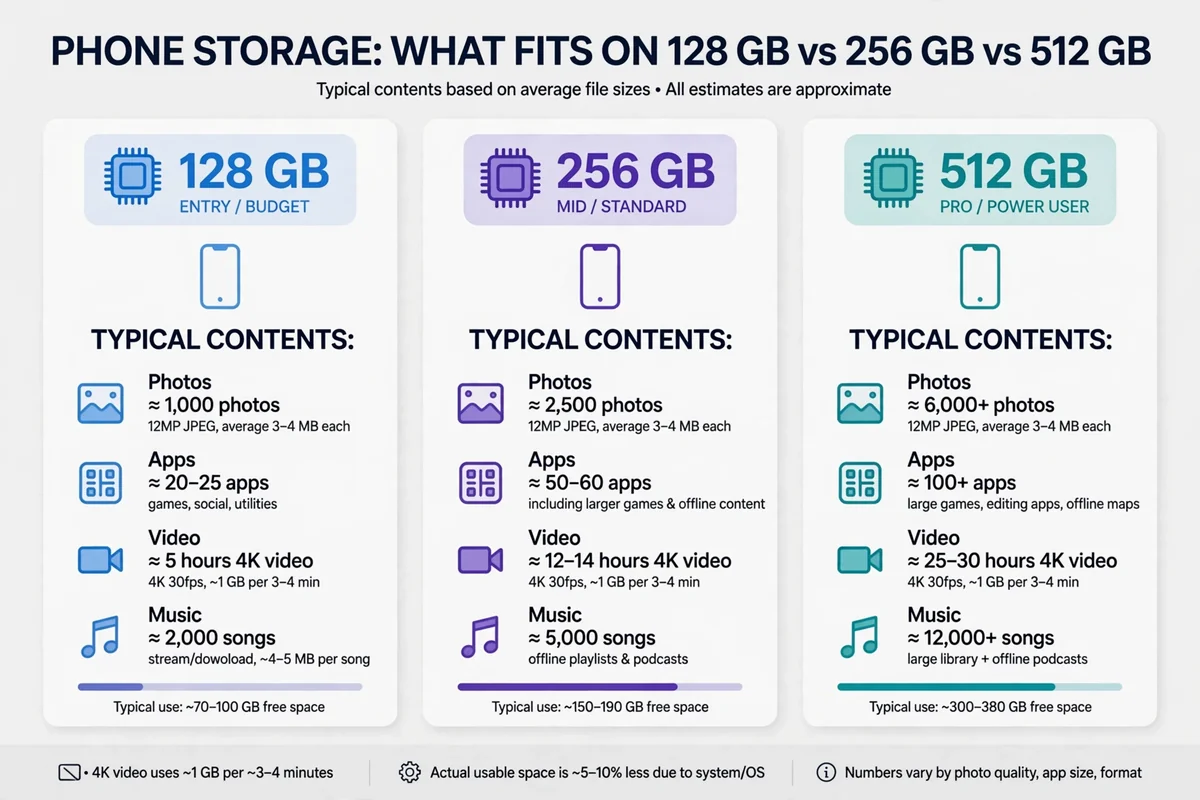
For storage planning, the size question is small per ID but real at scale: 36 characters as text, 16 bytes as binary. At millions of rows, that difference matters for index size and memory. If you are sizing a local store for a large dataset, a quick check with a phone storage calculator can help you sanity-check how text-heavy data adds up, even though that calculator is aimed at media and files rather than database rows.
Format Options, Explained Plainly
The same 128-bit value can be written several ways, and all of them can be correct depending on context:
- Standard hyphenated lowercase:
550e8400-e29b-41d4-a716-446655440000. The default for most tools and APIs. Use it unless you have a reason not to. - Uppercase:
550E8400-E29B-41D4-A716-446655440000. Valid, but only if your whole system agrees on it. Case-sensitive comparisons will treat this as different from the lowercase form. - Without hyphens:
550e8400e29b41d4a716446655440000. A 32-character string, common in compact storage. Keep a note of which form you stored. - Braced:
{550e8400-e29b-41d4-a716-446655440000}. Common in Windows and .NET contexts. The braces are wrappers, not part of the value, so strip them before storing in a strict UUID column. - URN form:
urn:uuid:550e8400-e29b-41d4-a716-446655440000. Used when an identifier needs to be a URI. The prefix is not part of the 128 bits.
None of these forms changes the underlying bits. What changes is how parsers, databases, and humans treat the string. A parser that expects hyphens will reject the hyphen-less form. A human who copies a braced ID into a form that does not strip braces will get a validation error that looks mysterious until the braces are spotted.
When you send IDs over a network, each ID is 36 characters of text plus whatever JSON or URL encoding surrounds it. At high volume that overhead adds up. If you are estimating that cost for a mobile app, a data usage calculator gives a rough sense of how repeated identifiers accumulate, though the real answer always comes from measuring your actual API traffic.
Common Mistakes That Break Good IDs
Using a sample ID from documentation in production. The example 550e8400-e29b-41d4-a716-446655440000 appears in RFC documents and countless tutorials. It is an example, not a free ID to reuse. If it ships in your database, it will collide with every other tutorial copy in the world. Generate a fresh ID for every real record.
Treating the ID as a password. A v4 ID is hard to guess, but it is not a credential. It appears in URLs, logs, error messages, and support tickets. If access depends only on knowing the ID, anyone who finds it in a log file or a shared screenshot has access. Pair IDs with proper authentication and permission checks.
Assuming IDs sort in creation order. They do not. Random bits have no time component, so sorting v4 IDs gives random order, not chronological order. If your list or pagination depends on creation order, store a separate timestamp and sort by that. For a sense of how newer standards trade raw speed for smarter scheduling, the explainer on Wi-Fi 8 is a useful parallel: the right choice depends on the job, not on habit.
Parsing with a loose pattern and no validation. A pattern that accepts any 32 hex characters will accept a malformed value and call it v4. A strict check should confirm length, hyphen positions, the version digit 4, and the variant digit 8, 9, A, or B. Reject the rest with a clear error, rather than storing a value that fails later in a stricter system.
Storing IDs as numbers. A UUID is not a number in the arithmetic sense. Do not store it as an integer, do not do math on it, and do not let a spreadsheet strip leading zeros from a hyphen-less ID. Once a leading zero is lost, the value is corrupted, even if it still looks like a hex string.
Generating IDs client-side with a weak source. A browser or mobile app that generates IDs with a non-secure function can produce predictable values, especially on older devices. Use the platform secure API, or generate the ID server-side and return it to the client. If a phone behaves oddly during this kind of work, a guide on why a phone overheats can help you rule out thermal throttling before you blame your code.
Forgetting the database index. A UUID primary key without an index, or a query that casts the UUID to text on every row, will be slow at scale. Index the column in its native type, query in that type, and test with realistic row counts. Random IDs also fragment some B-tree indexes more than sequential IDs, which is a real cost to weigh for very large, write-heavy tables.
Version 4 Compared With Other Versions
Version 1 combines a timestamp with a node identifier, historically a MAC address. That makes v1 IDs roughly time-ordered and unique per machine, but it also leaks timing and hardware information. RFC 9562 flags that privacy issue and recommends against exposing v1 IDs where that leakage matters.
Version 5 is name-based. It hashes a namespace ID plus a name with SHA-1 and sets version and variant bits on the result. The same namespace and name always produce the same v5 ID, which makes it deterministic and reproducible. That is useful for stable IDs from known inputs, such as a URL, but useless when you need a fresh, unpredictable ID.
Version 7 is time-ordered. It stores a Unix millisecond timestamp in the first 48 bits, followed by version bits and random bits. That gives IDs that sort in creation order and still carry a large random component, which makes them friendlier for database indexes than v4. If your main complaint about v4 is index fragmentation or unsorted inserts, Version 7 is the version to evaluate first, not a workaround that bolts a timestamp onto a v4 value.
The Nil UUID is all zeros: 00000000-0000-0000-0000-000000000000. The Max UUID is all ones: ffffffff-ffff-ffff-ffff-ffffffffffff. Both are special values, not random IDs. Use Nil as a placeholder for “no ID yet” only if your system documents that meaning, and never generate Nil or Max as if they were fresh random values.
A Practical Checklist Before You Ship
- The generator uses a cryptographically secure source, or a standard library function that does.
- Output passes a strict check: version digit 4, variant digit 8, 9, A, or B, correct hyphen positions, correct length.
- Case and hyphen format are fixed in one place and enforced on input.
- Each real record gets a fresh ID. No documentation sample, no reused test ID.
- IDs are stored in a native UUID column or a fixed-length string column, indexed in the same type you query.
- IDs are not used as passwords, and access is checked separately from knowledge of the ID.
- Sorting, if needed, uses a timestamp column, not the ID itself.
- Bulk imports are checked for duplicates and format consistency before they are committed.
Frequently Asked Questions
What does the 4 in a UUID v4 mean?
The 4 is the version field. It tells any reader that this ID follows the version 4 rules: 122 random bits, with version bits set to 0100 and variant bits set to 10. If the third group does not start with 4, the value is not a v4 ID, even if it has the right length and hyphen pattern.
How many possible UUID v4 values are there?
About 5.3 × 1036, from 2122, because 122 bits are random and 6 bits are fixed. Generating billions of IDs still leaves the collision risk negligible, as long as the random source is cryptographically secure.
Is a UUID v4 safe to use as a password or secret key?
No. Use it as an identifier, not as a credential. IDs show up in URLs, logs, and support threads, and access control should never rest on knowledge of the ID alone. For secrets, use a dedicated secret generator, store hashes where appropriate, and rotate credentials on a schedule.
Can two UUID v4 IDs ever be the same?
In theory, yes, because the space is finite. In practice, with a secure random source, the chance is governed by the birthday bound near 261 values for a roughly even chance. If you see a duplicate in a small batch, suspect a copied sample, a reused variable, or a repeated file, not the mathematics.
When should I not use version 4?
Skip v4 when you need IDs that sort in creation order, when you need the same input to always produce the same ID, or when you need a short public code. Time-ordered IDs suit the first case, name-based hashing suits the second, and a separate short-code system suits the third. If you are weighing tools for a project that needs this kind of decision, the roundup of the best AI productivity tools for 2026 shows how a structured comparison beats picking the first familiar option.
How do I check whether an ID I received is a valid v4 ID?
Check five things: 36 characters including hyphens, hyphens in positions 9, 14, 19, and 24, only hex characters elsewhere, a 4 as the first character of the third group, and an 8, 9, A, or B as the first character of the fourth group. A value that passes all five is structurally valid. That check does not prove the value was generated securely, only that its shape is right. The guide on how to fix a slow DNS lookup follows the same pattern: verify the exact failure point before you change anything else.
Final Word: Randomness Done Right, Used Simply
A UUID v4 generator is a simple tool with a strict contract. Give it a secure random source, let it set the version and variant bits, and it will hand you an identifier unique enough for almost any job. Break that contract with a weak source, a copied sample, or a mixed format, and the simplicity disappears into debugging.
Keep the format fixed, generate fresh IDs, store them consistently, index them properly, and never let an ID stand in for authentication. Do those things and v4 will stay boring in the best possible way: it will just work, quietly, in the background, while you focus on the product itself.
If you want more hands-on tools in the same spirit, browse the full CripsyWire tools collection.
The CripsyWire blog carries the longer explainers behind those tools.
The about page explains what the site is trying to do for US readers.
For readers planning a device upgrade alongside a new project, the iPhone battery replacement guide covers the hardware side of keeping a working machine ready.
Generate Your Next v4 ID in Seconds
Create a fresh, correctly formatted v4 ID and copy it straight into your project — no sign-up, no guesswork about the format.

Continue Reading on CripsyWire
For more practical AI coverage for US buyers, see our full AI tools and agents library. When you are deciding between competing tools, the reviews and comparisons section breaks down head-to-head matchups. AI features that live inside your phone are tracked in smartphones, and AI on your wrist or finger in wearables. All of this is part of CripsyWire's broader Tech coverage — start at the homepage for what is newest.