Quick answer: Good AI news habits come down to three things: pick two or three sources instead of twenty, check in weekly instead of hourly, and treat company blog posts and research papers as more reliable than secondhand summaries. Everything else in this guide is detail on top of that.
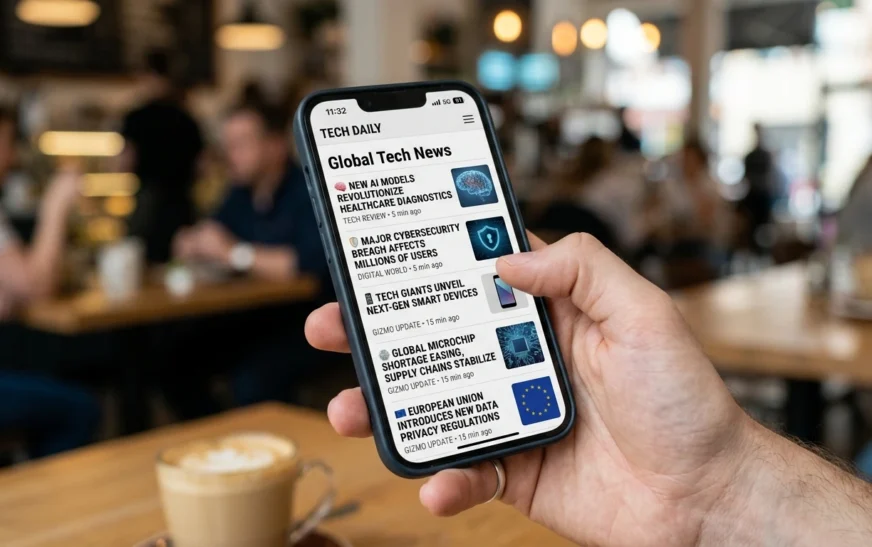
Open any tech app on your phone right now and count how many AI headlines show up before you scroll past the fold. I did this on a random Tuesday morning last month. Eleven. Eleven separate “AI just changed everything” stories before I’d finished my coffee, and by lunch, four of them had already been quietly walked back or forgotten.
That’s the actual state of AI news in 2026. It’s not that there’s too little information. There’s a genuinely overwhelming amount, coming from research labs, startups, regulators, journalists, and a small army of newsletter writers, and most of it is either recycled, exaggerated, or irrelevant to whatever you’re actually trying to do with your day.
I’ve been covering AI tools and product launches for this site since early 2026, testing everything from video generators to writing assistants, and the single most common question readers send me isn’t “which AI tool should I buy.” It’s some version of “how do you even keep up with this.” So that’s what this guide actually answers. Not a listicle of fifteen tabs to bookmark and never open again. A real system, plus the sources and topics that are worth your limited attention this year.
What Counts as “AI News” Right Now
“AI news” used to mean a research lab announcing a new model every few months. That’s not what the term covers anymore. In 2026 it’s a blanket category stretching across at least five very different beats:
- Model releases: new large language models, image generators, video tools, and the benchmark wars that follow every launch
- Business and funding: who raised money, who got acquired, which companies are quietly burning cash
- Policy and regulation: government rules, export controls, lawsuits, and the slow grind of figuring out who’s liable when an AI system gets something wrong
- Infrastructure: chips, data centers, power consumption, the physical stuff that makes any of this run
- Culture and jobs: how AI is reshaping work, education, and the everyday tools people use
Most publications you’ll find covering “AI news” only really specialize in one or two of these lanes. TechCrunch leans startup and funding. MIT Technology Review leans research and policy. VentureBeat leans enterprise deals. Knowing which lane a source lives in tells you more about whether it’s useful to you than any star rating ever could.
Why the AI News Cycle Feels Nonstop
There’s a real reason this beat feels different from, say, smartphone news, where you get a predictable burst around launch season and then quiet. AI doesn’t have a launch season. Model updates, funding rounds, and policy fights are happening across dozens of companies and countries at the same time, on independent schedules, which means there’s essentially always something breaking somewhere.
Agentic AI Is Eating the Headlines
If there’s one theme dominating coverage this year, it’s agentic AI, systems built to plan and carry out multi-step tasks on their own instead of just answering a single prompt and stopping. Coding assistants that open pull requests unsupervised. Customer support bots that resolve a ticket end to end. Research tools that go off, gather sources, and come back with a draft. It’s the thing every major lab is racing to ship, and it’s also where a lot of the genuinely useful product news is happening right now, as opposed to the marketing fluff.
The AI Bubble Debate Nobody Can Settle

Sitting right next to the agentic AI hype is a much more skeptical thread: is this a bubble. Infrastructure spending across the industry has climbed into the hundreds of billions, and a growing number of analysts are asking, reasonably, whether the revenue is actually going to show up to match it. I’m not going to pretend I know how this resolves. Nobody covering this beat honestly can. What I will say is that treating every headline as either “AI is about to replace everyone” or “it’s all a scam that’s about to collapse” is lazy reading. The believable stories usually sit in the boring middle, and that’s exactly why they don’t go viral.
The Problem With How Most People Follow AI News
Here’s the pattern I see constantly, in comment sections and in messages from readers: someone gets excited, subscribes to eight newsletters and follows twenty accounts, reads intensely for about two weeks, and then quietly gives up because it became a second job. Then they swing the other way and ignore the topic entirely until something forces their hand, like their employer rolling out a mandatory AI tool overnight.
Both extremes fail for the same reason. They treat AI news as something you either master completely or ignore completely, when it’s really more like weather. You don’t need to understand meteorology. You just need enough of a system that you’re never caught without an umbrella.
A Simple System for Following AI News (Without Burning Out)
This is the part most guides skip, because “read these ten sites” is easier to write than “here’s how to actually use your time.” After doing this daily for work, here’s what actually holds up.
Pick Two or Three Sources, Not Twenty
More sources doesn’t mean more signal. It usually means the same three stories rewritten nine different ways, and you reading the same headline nine times without realizing it. Pick one fast daily source for headlines, and one slower, deeper source for context. That’s genuinely enough for most people. Adding a third only makes sense if it covers a beat the other two skip entirely, like policy or hardware. A good browser extension for managing tabs and newsletters helps too, more than any AI news app I’ve tried.
Weekly Beats Daily for Almost Everyone
Unless your job literally depends on knowing something the hour it breaks, checking in weekly instead of daily changes almost nothing about how informed you end up, and it saves you an enormous amount of time. Most “breaking” AI stories aren’t actually time-sensitive for the average reader. The model that launched Tuesday will still be there, with a clearer picture of whether it actually matters, by the following Monday.
Primary Sources Beat Secondhand Summaries
When a lab ships something significant, their own blog post or research paper is almost always more accurate than the wave of hot takes that follows it within the hour. Secondhand coverage adds speed, not accuracy. If a story matters enough to change a decision you’re making, it’s worth the extra three minutes to find where it originated.
The Best AI News Sources in 2026 (And Who Each One Is For)
I’m not going to pretend one source fits everyone, because it genuinely doesn’t. Here’s how I’d actually split it up based on what you’re trying to get out of it.
| If you want… | Go to | Why it works |
| Fast daily headlines, no fluff | A short daily digest newsletter | Built for skimming in under five minutes |
| Startup and funding moves | TechCrunch’s AI coverage | Strongest on who’s raising, who’s acquiring |
| Enterprise and business impact | VentureBeat | Reports on vendor launches and real deployments, not just demos |
| Deep context and policy | MIT Technology Review | Slower pace, research-grounded, less hype-driven |
| Consumer-facing product stories | The Verge | Good at translating launches into “does this affect me” |
| Original research directly from labs | Company blogs (OpenAI, Anthropic, Google DeepMind) | No middleman, no spin, just the source |
Notice none of these are “AI news aggregator apps.” I tried a handful of them while researching this piece, and almost every single one is just wrapping the same handful of RSS feeds you could subscribe to directly. A folder in your inbox for two or three newsletters beats any app that promises to collect “everything” for you.
How to Spot AI Hype vs Real News (5 Red Flags)
This is the skill that actually matters more than which sources you pick. After enough time on this beat, patterns start repeating.
- The headline makes a claim the article can’t back up. “This AI just replaced doctors” and then paragraph six admits it was a narrow diagnostic task in a controlled study. Read past the headline before you believe it.
- There’s no link to the original source. If a story about a new model or a research finding doesn’t link to the actual paper, blog post, or filing, be skeptical of what’s been lost or exaggerated in the retelling.
- The only source quoted works for the company being covered. A launch article that’s entirely built on quotes from the company’s own press release is marketing with a byline attached, not journalism.
- The numbers are aggressively rounded or unsourced. “Millions of users” and “billions in value” sound impressive and mean almost nothing without a defined timeframe or methodology behind them.
- It confirms exactly what you already believed. This one’s uncomfortable, but it’s real. Stories that perfectly match your existing opinion about AI, whether that’s excitement or dread, deserve extra scrutiny, not less. Confirmation bias doesn’t care how informed you are.
How AI News Actually Affects Your Buying Decisions
Here’s where this stops being abstract. A lot of AI news directly changes what’s worth buying or downloading, and this is honestly the part most coverage skips entirely because it’s not glamorous.
New chip announcements ripple down into the laptops and phones on shelves months later, whether you ever notice the connection or not. Phone makers are packing AI features into flagship releases faster than most buyers can evaluate whether they’re actually useful, which is a big part of why our breakdown of the best Android phone in 2026 spends so much time separating genuinely useful AI features from marketing checkboxes.
The same goes for software. Every few weeks there’s a new headline about a writing tool or video generator “beating” the competition, and most of those claims fall apart under actual testing rather than a press release. That’s the whole reason independent testing exists as a category, and it’s worth remembering the next time a launch headline sounds too clean to be true.
AI News Topics Worth Tracking Closely in 2026
Not every beat deserves equal attention. If your time is limited, here’s where I’d actually spend it.
Regulation and Policy
This is the slowest-moving beat and also the one with the longest-term consequences. Export controls, liability rules, and copyright lawsuits move at government pace, which means individual headlines rarely matter, but the direction they’re heading absolutely does. Check in monthly rather than daily here.
AI Chips and Infrastructure
Compute is the bottleneck for almost everything else in this industry, and shortages or breakthroughs on the chip side eventually show up in product pricing and availability. This is a beat worth actually reading in depth rather than skimming, because the details compound.
New Tools and Model Releases
This is the loudest and most crowded beat, and also the one most worth filtering hard. Most new tool launches are minor iterations dressed up as breakthroughs. If you create content professionally, tools like AI image generators are worth watching closely; our guide to AI image prompt examples that actually work and our AI Image Prompt Builder exist specifically because most “prompt guide” content out there is generic filler that doesn’t hold up against real tools.
AI and Work
The jobs conversation gets the most emotionally charged coverage, and also the least nuanced. It’s rarely a clean story of “AI took my job.” It’s usually slower and messier: workflows quietly shifting, some roles shrinking while new ones appear. If you’re weighing whether AI tools can realistically supplement your income rather than threaten it, our rundown of AI side hustles that actually pay is a more grounded starting point than most of what circulates on social media.
My Honest Take After Following This Beat for Years
I’ll be straight with you: most AI news isn’t actually news. It’s the same three or four underlying stories, repackaged with a new company name attached, over and over. A new model that’s incrementally better than last month’s. A funding round that inflates a valuation nobody can fully justify yet. A regulatory hearing that produces a lot of quotes and very little actual policy. That’s not cynicism, it’s just what the beat looks like once you’ve been reading it daily for a while.
The stories that genuinely matter are quieter than the ones that trend. A chip shortage easing. A policy shift that changes what companies are allowed to do with your data. A tool that solves a real, boring problem instead of promising to reinvent an industry. If you build your system around catching those instead of chasing whatever’s loudest on a given day, you’ll end up more informed than someone who reads every headline, and with a lot more of your week left over.

Frequently Asked Questions
What counts as AI news in 2026?
AI news spans model releases, funding and business deals, government regulation, chip and infrastructure developments, and the impact of AI tools on jobs and daily life. Most outlets specialize in just one or two of these areas rather than covering all of them equally well.
Why does AI news move so fast right now?
Because model development, funding, and policy are all advancing simultaneously across dozens of companies and countries with no shared schedule. There’s no single “launch season” the way there is for phones, so something is always breaking somewhere.
What are the best AI news sources in 2026?
It depends on what you need. TechCrunch is strongest for startup and funding coverage, VentureBeat for enterprise deployments, MIT Technology Review for research and policy depth, and company blogs for original, unfiltered announcements straight from the source.
How much time should I spend following AI news?
For most people, ten to fifteen minutes a few times a week is plenty. Checking in weekly instead of hourly rarely costs you anything meaningful, since most stories that matter are still relevant days later.
Is the AI industry actually in a bubble?
Nobody credible can say for certain. Infrastructure spending has grown extremely fast and some analysts compare it to the dot-com era, while others argue the underlying demand is real. Treat confident claims in either direction with some skepticism.
What is agentic AI?
Agentic AI refers to systems designed to plan and complete multi-step tasks with minimal supervision, rather than just responding to a single prompt. It’s currently the most active area of product development across major AI labs.
How do I know if an AI news story is hype?
Check whether the headline’s claim is actually backed up in the article, whether there’s a link to the original source, and whether anyone outside the company being covered was quoted. Stories missing all three deserve real skepticism.
Should I follow AI news apps or aggregators?
Most aggregator apps just repackage the same RSS feeds you could subscribe to directly, without adding real editorial judgment. A couple of well-chosen newsletters in a dedicated inbox folder is usually a better use of your time.
Final Verdict
You don’t need to read everything to be genuinely informed about AI. You need two or three sources you trust, a weekly instead of hourly habit, and a working nose for which headlines are marketing dressed up as news. Everything else is noise dressed up as urgency.
Start small. Pick one fast source and one slow one this week, ignore everything else for seven days, and see how much you actually missed. My honest bet: almost nothing that mattered.

Continue Reading on CripsyWire
For more practical AI coverage for US buyers, see our full AI tools and agents library. When you are deciding between competing tools, the reviews and comparisons section breaks down head-to-head matchups. AI features that live inside your phone are tracked in smartphones, and AI on your wrist or finger in wearables. All of this is part of CripsyWire's broader Tech coverage — start at the homepage for what is newest.