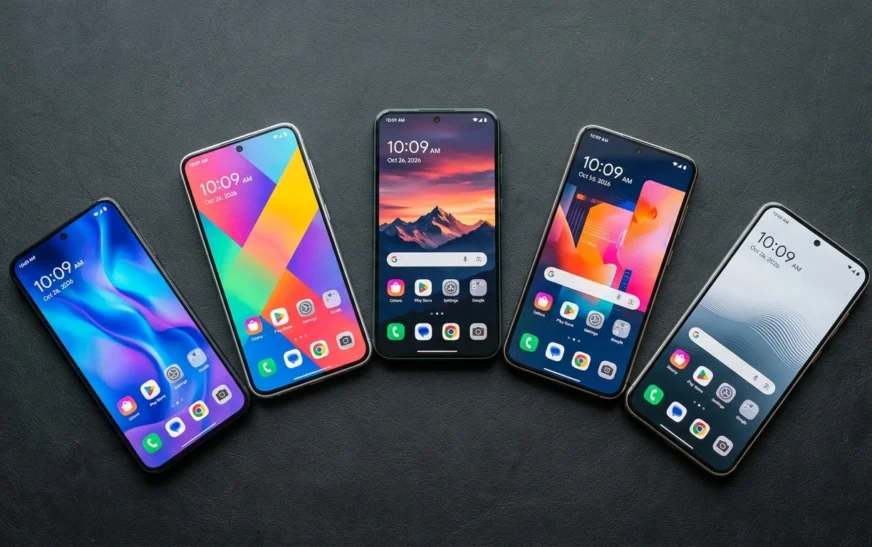
Let me save you the scroll if you’re in a hurry. In 2026 the Android phone most people should actually buy is the OnePlus 15 — it has the battery of a power bank, performance nothing else touches in daily use, and a price that undercuts the giants. But “best” is personal, and the phone that’s right for you depends on whether you care more about cameras, software, size, or just not spending a grand. That’s what the rest of this is for.
Here’s the thing the big review sites won’t lead with: most of the phones on every “best Android phone 2026” list are genuinely good. The hardware war is mostly over. What separates them now is software support, how Android handles its AI promises, battery endurance, and — the part nobody enjoys talking about — how much you’ll really pay once carrier trade-ins and missing chargers enter the math.
I’ve spent real time with some of these, and for the rest I’ve leaned on the most credible long-term testing out there, cross-checked against spec sheets and update records. No phone here got a spot because a brand sent a press kit.
The Short Answer (Best Android Phone 2026)
The best Android phone in 2026 is the OnePlus 15 for most people, thanks to its 7,300mAh battery, Snapdragon 8 Elite Gen 5 speed, and sub-$1,000 price. For the best cameras and the S Pen, the Samsung Galaxy S26 Ultra wins. For the cleanest software and smartest AI, the Google Pixel 10 Pro XL leads. On a budget, the $499 Pixel 10a is unbeatable value.
Best Android Phone 2026 at a Glance
| Phone | Best For | Battery | Approx. US Price |
| OnePlus 15 | Best overall / battery | 7,300mAh, 120W | ~$899–$999 |
| Galaxy S26 Ultra | Cameras, S Pen, power users | 5,000mAh, 60W | ~$1,025–$1,299 |
| Pixel 10 Pro XL | AI, software, photos | 5,200mAh, 45W | ~$1,000–$1,199 |
| OnePlus 13R | Best value flagship | ~6,000mAh, 80W | ~$599 |
| Pixel 10a | Best under $500 | ~4,400mAh, 23W | ~$499 |
| Moto G Power (2026) | Best budget | 5,200mAh, 30W | ~$299 |
Prices move constantly. Treat these as ballpark street prices, not gospel — more on why that matters below.
How I Picked These Phones
I didn’t rank these on raw spec sheets, because spec sheets lie by omission. A phone can have a 200MP camera and still take mushy photos. A 7,300mAh battery means nothing if the software is a mess.
So the weighting went roughly like this: real-world battery endurance, day-to-day performance and thermals, camera output (not megapixels — actual photos), software quality and years of guaranteed updates, build and durability, and finally value once you account for what you’ll actually pay in the US. Availability matters too — a phone you can’t buy with a real warranty in the States didn’t make the cut, no matter how good the reviews abroad are.
Best Overall: OnePlus 15
Quick answer: The OnePlus 15 is the best overall Android phone in 2026. Its 7,300mAh battery lasts up to two days, the Snapdragon 8 Elite Gen 5 keeps it flagship-fast, and 120W charging refills it in about 35 minutes — all for under $1,000, undercutting both Samsung and Google.
For two or three years OnePlus felt like the “almost” brand. Great phone, one annoying compromise. The OnePlus 15 finally stopped compromising.
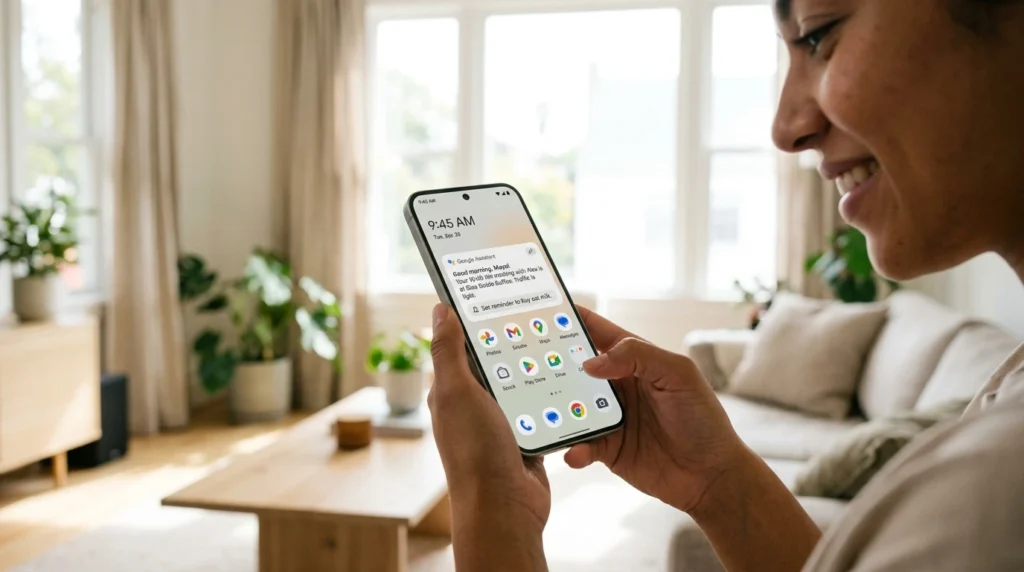
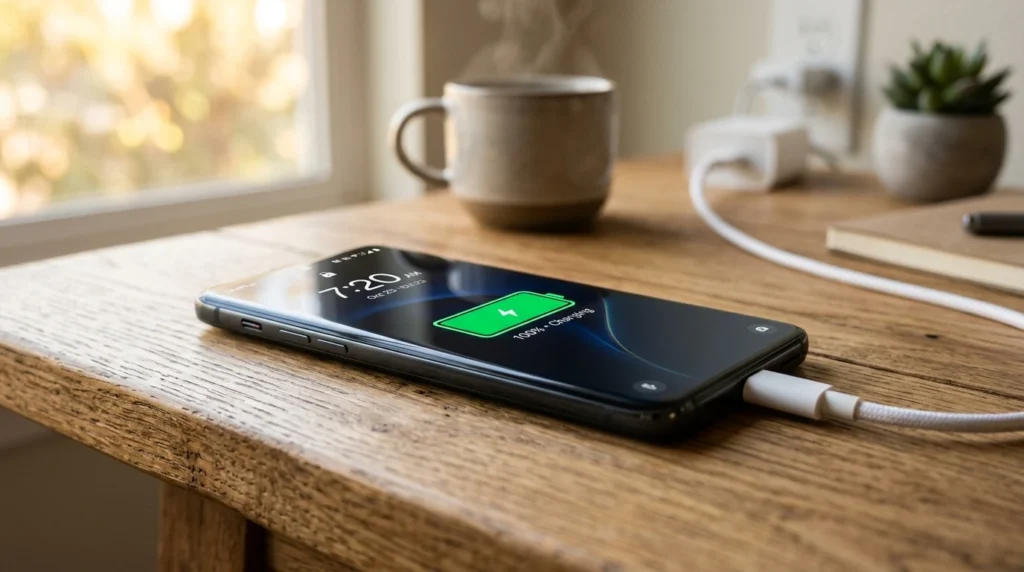
The headline is that 7,300mAh battery — a number that used to be physically impossible in a phone this thin, now real thanks to silicon-carbon cells. In practice it means two days of normal use, or a full day of the kind of heavy gaming-and-streaming abuse that flattens other flagships by dinner. And when it does run down, 120W wired charging refills it in roughly 35–40 minutes. No other mainstream US flagship is close on this combination.
Performance is the Snapdragon 8 Elite Gen 5, the same top-tier chip in the pricier phones, paired with a 165Hz LTPO display that stays locked smooth. The triple 50MP camera system — main, ultrawide, and a 3.5x periscope telephoto — is genuinely good now, not just “good for OnePlus.” It won’t out-shoot the Galaxy Ultra in every scene, but the gap is small enough that most people would never notice.
There are real trade-offs. OnePlus replaced the beloved physical Alert Slider with an AI “Plus Key,” which some long-time fans hate. Software support trails Samsung and Google. And OxygenOS, while fast, sprinkles in a few features you’ll want to switch off.
Pros: Class-leading battery, flagship speed, fast 120W charging, IP69K durability, aggressive price.
Cons: Shorter update window than Samsung/Pixel, no Alert Slider, OxygenOS bloat to tidy up.
Who it’s for:
Anyone who wants the most phone for the money and is tired of charging anxiety. If you gravitate toward a no-nonsense device, the same instinct that draws people to lean, useful AI productivity tools over bloated ones is exactly the OnePlus 15’s appeal.
Best Cameras & Power User: Samsung Galaxy S26 Ultra
Quick answer: The Samsung Galaxy S26 Ultra has the best camera system on any 2026 Android phone, led by a 200MP variable-aperture (f/1.4–f/4.0) main sensor and a 5x periscope zoom. Add the built-in S Pen and a first-of-its-kind Privacy Display, and it’s the top pick for power users — if you can afford it.
If money is genuinely no object and you want the do-everything phone, it’s still the Galaxy S26 Ultra. Nothing else bundles this much capability into one slab.
The camera system is the star: a 200MP main sensor with a variable f/1.4–f/4.0 aperture, a 50MP ultrawide, a 10MP 3x telephoto, and a 50MP 5x periscope. That variable aperture is the quiet upgrade — it lets the phone pull in serious light at night and tighten up for sharp daylight detail, and Samsung’s low-light “Nightography” finally looks natural instead of over-brightened. The 100x Space Zoom is still mostly a party trick past 30x, but 10x is sharp enough to use for real.
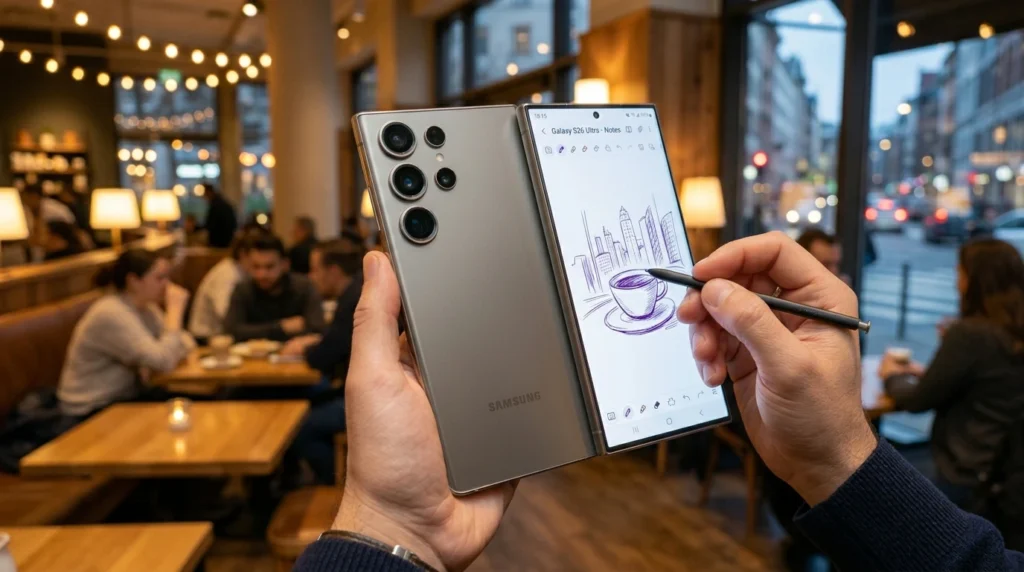
Then there’s the stuff only Samsung does. The built-in S Pen still lives inside the phone, which remains the single feature no other flagship can match if you sketch, sign documents, or take handwritten notes. New this year is a hardware-level Privacy Display that narrows viewing angles on demand so the person next to you on the train can’t read your screen — a genuine first.
The catch is the wallet. Samsung’s launch list price climbs to $1,299 for higher storage, the charger is not in the box, and the move from titanium back to an aluminum frame disappointed people who loved the S24 Ultra’s industrial feel. Battery is a sensible 5,000mAh with 60W charging — fine, not exciting next to the OnePlus.
Pros: Best-in-class versatile cameras, S Pen, Privacy Display, 7 years of updates, gorgeous 2,600-nit screen.
Cons: Expensive, no charger included, battery and charging only average for the price.
Who it’s for: Power users, mobile photographers, and anyone deep in Samsung’s ecosystem. If you already wear or want the Galaxy Watch 8 Classic or the Galaxy Ring, the Ultra is the hub that ties it all together.
Best AI & Software: Google Pixel 10 Pro XL
Quick answer: The Google Pixel 10 Pro XL is the best Android phone for software and AI in 2026. Its Tensor G5 chip powers genuinely useful features like Magic Cue and Camera Coach, the cameras nail photos with zero effort, and Google guarantees seven years of OS and security updates.
The Pixel 10 Pro XL is the phone for people who want their phone to feel smart rather than just fast.
It runs on Google’s new Tensor G5 — the first Pixel chip built by TSMC instead of Samsung Foundry, which translates to better efficiency, cooler running, and fewer of the thermal hiccups that nagged older Pixels. Raw benchmark numbers still trail Qualcomm, and honestly, you won’t care. Where the Pixel pulls ahead is the AI that actually does something useful: Magic Cue quietly surfaces your flight details mid-call when you ring an airline, Camera Coach uses Gemini to teach you better framing, and the on-device Gemini Nano model handles tasks the competition pushes to the cloud.
The cameras remain a point-and-shoot dream. Google’s computational photography means you take a photo and it’s right — balanced, true-to-life, no fiddling. Pro Res Zoom stretches to 100x with AI fill-in, and unlike most digital zoom, it’s weirdly usable. Battery is a healthy 5,200mAh, charging is a slower 45W (about 70% in 30 minutes), and you get seven years of OS and security updates, which is as future-proof as Android gets.
Downsides? It’s pricey, Google dropped the cheapest 128GB tier so you start higher, and a couple of the flashiest AI features are still labeled “beta.”
Pros: Smartest, most genuinely useful AI; best straight-out-of-camera photos; 7 years of updates; clean software.
Cons: Slower charging, no base storage tier, premium price, some AI still in beta.
Who it’s for: People who value software and photos over spec-sheet bragging rights — and who’d rather the phone do the thinking.
Best Value Flagship: OnePlus 13R
Quick answer: The OnePlus 13R is the best value Android phone in 2026. At around $599 it delivers fast performance, a big battery, a bright 120Hz screen, and a premium build — roughly 90% of a flagship experience for about 60% of the price.
Not everyone needs to spend four figures, and the OnePlus 13R is the proof. For around $599 it delivers the things you feel every day — fast performance, a big battery, a bright 120Hz screen, and a genuinely premium build — while quietly skipping the things you don’t (the absolute latest chip, a periscope zoom you’d rarely use).
It’s the phone I point friends to when they say “I want something that feels expensive but isn’t.” Most of them never realize they’re missing anything.
Who it’s for: Smart spenders who want 90% of a flagship for 60% of the price.
Best Under $500: Google Pixel 10a
Quick answer: The Google Pixel 10a is the best Android phone under $500. For $499 it bundles the full Pixel software experience, excellent point-and-shoot cameras, and seven years of OS updates — long-term value no other phone near this price can match in 2026.
The Pixel 10a is almost unfair to the competition. Google kept the price at $499 and still gave it the full Pixel experience — the same clean software, Google’s calling and call-screening tools, Now Playing, and the same seven years of updates as the expensive Pixels. You drop to a year-old Tensor G4 and 8GB of RAM, which means a few of the heaviest AI tricks are off the table. For everyday life, you’d struggle to feel it.
No other phone near $500 bundles this much camera quality, software polish, and long-term support into one package. If your budget tops out here, stop looking.
Who it’s for: Anyone who wants a phone that’ll still get updates in 2033 without spending flagship money.
Best Budget: Motorola Moto G Power (2026)
Quick answer: The Motorola Moto G Power (2026) is the best budget Android phone in 2026. At about $299 it offers dual IP68/IP69 water resistance, a 5,200mAh two-day battery, and a real ultrawide camera — a more complete package than most phones at this price.
At $299.99, the Moto G Power (2026) is the most complete cheap phone right now. Dual IP68/IP69 water resistance, a Gorilla Glass 7i screen, a real ultrawide camera, and a 5,200mAh battery that comfortably pushes into a second day — that’s a more honest spec list than most phones at this price bother with. The design is forgettable and the software updates are limited, but for a backup phone, a kid’s first phone, or a no-fuss daily driver, it punches above its tag.
Anyone who wants a phone that’ll still get updates in 2033 without spending flagship money.
Full Spec Comparison
| Spec | OnePlus 15 | Galaxy S26 Ultra | Pixel 10 Pro XL |
| Display | 6.78″ 165Hz LTPO | 6.9″ 120Hz, 2,600 nits | 6.8″ 120Hz OLED |
| Chip | SD 8 Elite Gen 5 | SD 8 Elite Gen 5 (Galaxy) | Google Tensor G5 |
| RAM / Storage | 12–16GB / 1TB | 12–16GB / 1TB | 16GB / 256GB+ |
| Main camera | 50MP (OIS) | 200MP, variable f/1.4 | ~50MP computational |
| Battery | 7,300mAh | 5,000mAh | 5,200mAh |
| Wired charging | 120W | 60W | 45W |
| Software updates | ~4 OS years | 7 OS years | 7 OS years |
| Standout | Battery + speed | S Pen + cameras | AI + photos |
How to Choose the Right Android Phone in 2026
Forget the spec-sheet arms race. Five things actually decide whether you’ll be happy a year from now.
Battery and charging. This is the upgrade you feel most. A phone that lasts two days changes how you live with it. The OnePlus 15 wins outright here; the others are merely fine.
Years of updates. A phone with seven years of support (Samsung, Pixel) costs less per year than a cheaper phone that’s abandoned in two. Do that math before you decide something is “too expensive.”
Camera that matches how you shoot. If you point and shoot, the Pixel is foolproof. If you want zoom range and manual control, the Galaxy Ultra. Megapixel counts are marketing.
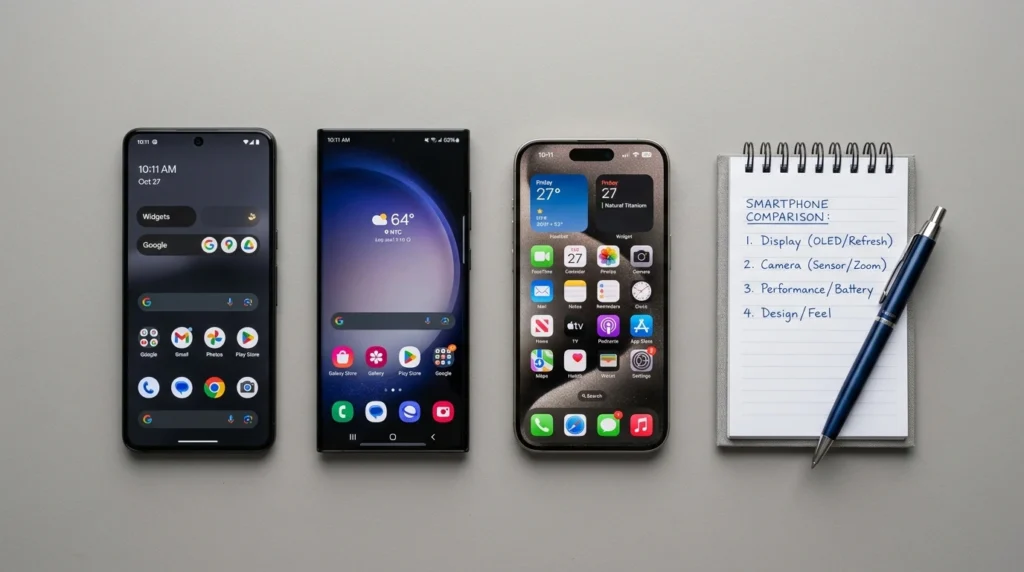
Size and feel. A 6.9″ Ultra is a brick for small hands. The Galaxy S26 and Pixel 10 (both ~6.3″) exist for a reason. Hold one before you commit.
Ecosystem. Your watch, earbuds, and laptop matter. Samsung phones play best with Galaxy wearables; Pixels pair seamlessly with Google services.
The Honest Money Talk Nobody Includes
Here’s the section the affiliate-driven lists skip, because it doesn’t sell expensive phones.
The sticker price is rarely the real price. Carriers routinely knock the Galaxy S26 Ultra down to near zero with an eligible trade-in, while the same phone is $1,299 unlocked. If you’re not playing the trade-in game, you’re often the one subsidizing everyone who is.
Check what’s in the box. Samsung doesn’t include a charger. Factor $20–$40 for a proper 60W+ brick into the true cost.
You probably don’t need a flagship. This is the ruthless truth: for most people, the $499 Pixel 10a or the $599 OnePlus 13R does 95% of what the $1,200 phones do. The flagship gap is real, but it’s incremental — a slightly better zoom, a slightly nicer screen. If money is tight, a mid-range phone in 2026 is not a compromise. It’s a smart purchase.
Watch the “global” phones. Some phones that dominate international “best of” lists — certain Xiaomi, Honor, and Vivo flagships — have spotty US availability and warranty coverage. A phone you can’t get serviced isn’t a deal.
Common Mistakes When Buying an Android Phone
- Buying for megapixels. A 200MP sensor doesn’t beat a well-tuned 50MP one. Look at sample photos, not numbers.
- Ignoring the update window. That “cheap” phone abandoned after two updates costs more long-term than a supported flagship.
- Overbuying storage you’ll never use. Most people are fine on 256GB. Cloud storage covers the rest for less than the upgrade costs.
- Forgetting the charger. Bringing home a Galaxy Ultra and realizing there’s no brick in the box is a classic.
- Paying full price impulsively. Trade-in and carrier deals can cut hundreds. Never buy a flagship on launch day at full retail unless you have to.
- Skipping the in-hand test. Screen size and weight are deeply personal. A spec that reads great can feel terrible in your palm.
Expert Tips
- Buy last year’s flagship. A 2025 Galaxy S25 Ultra or Pixel 9 Pro at a discount often beats a brand-new mid-ranger and still has years of updates left.
- Turn off the AI bloat you won’t use. Most of these phones ship with features that drain battery and clutter the UI. Spend ten minutes pruning on day one.
- Use eSIM, but know the catch. eSIM-only phones (like Pixels) are convenient until you travel somewhere that hands you a physical SIM. Check before you fly.
- Protect the screen from day one. Gorilla Armor and Victus glass are tough, not invincible. A $10 protector beats a $200 repair.
- If your mic ever fails, don’t panic-buy a new phone. A surprising number of “dead phone” moments are software gremlins — here’s how to fix a phone microphone that stopped working before you spend a cent.
Android vs iPhone in 2026: A Quick Word
If you’re cross-shopping, the honest summary is this: Android gives you more choice, better battery options, faster charging, and more hardware variety; Apple gives you tighter ecosystem lock-in and longer-tail resale value. The cameras are a wash at the top end. If you’re curious how the other side lives, our breakdown of the iPhone 17 Pro’s hidden features shows what Android users are and aren’t missing. For most people already on Android, there’s zero reason to switch in 2026.
Frequently Asked Questions
What is the best Android phone in 2026?
The OnePlus 15 is the best Android phone for most people in 2026, thanks to its huge 7,300mAh battery, Snapdragon 8 Elite Gen 5 performance, and sub-$1,000 price. For cameras, the Galaxy S26 Ultra leads; for software and AI, the Pixel 10 Pro XL.
Which Android phone has the best battery life in 2026?
The OnePlus 15, with its 7,300mAh battery and 120W charging, has the best battery life and fastest charging of any mainstream flagship in 2026. Most users get nearly two days on a single charge.
What is the best Android phone for cameras?
The Samsung Galaxy S26 Ultra has the best and most versatile camera system, with a 200MP variable-aperture main sensor and a 5x periscope zoom. The Pixel 10 Pro XL takes the best photos with zero effort thanks to computational photography.
What is the best budget Android phone in 2026?
The Motorola Moto G Power (2026) at around $299 is the best true budget phone. If you can stretch to $499, the Google Pixel 10a is dramatically better and includes seven years of updates.
Is the Pixel 10a worth it over a flagship?
For most people, yes. The Pixel 10a delivers the full Pixel software experience, great cameras, and seven years of updates for $499 — covering about 95% of what flagship Pixels do at less than half the price.
How long do these Android phones get software updates?
Samsung Galaxy and Google Pixel phones now offer seven years of OS and security updates. OnePlus typically offers around four major OS versions, which is shorter but still solid.
Does the Samsung Galaxy S26 Ultra come with a charger?
No. Like recent Galaxy flagships, the S26 Ultra does not include a charger in the box. You’ll need a 60W-capable USB-C charger to reach its full charging speed, so budget for one.
Should I buy a flagship or a mid-range Android phone?
For most people, a 2026 mid-range phone like the OnePlus 13R or Pixel 10a is the smarter buy. Flagships are better, but the gap is incremental. Spend the flagship money only if cameras, the S Pen, or top performance genuinely matter to you.
Are Xiaomi and Honor phones good options in the US?
They make excellent hardware, but US availability and warranty support are limited, which makes service difficult. Stick to Samsung, Google, Motorola, and OnePlus for a reliable US buying and support experience.
Final Verdict
If you want the simplest possible answer: buy the OnePlus 15. It’s the best balance of battery, speed, and price in 2026, and most people will be thrilled with it.
Want the best cameras and the S Pen, and don’t mind paying for them? Galaxy S26 Ultra. Want the smartest software and the most effortless photos? Pixel 10 Pro XL. On a budget? The $499 Pixel 10a is the value champion, and the $299 Moto G Power covers the basics without drama. The real takeaway is one the glossy lists won’t tell you: the best Android phone in 2026 isn’t the most expensive one. It’s the one whose strengths line up with how you actually use a phone — and there’s a great option at every price. Buy for your life, not for the spec sheet.

Continue Reading on CripsyWire
For more practical tutorials and hidden features, see our full how-to guides section. AI workflow guides feed into the broader AI tools and agents coverage, phone tricks live in smartphones, and wearable setup walkthroughs in wearables. When you are deciding what to buy, the reviews and comparisons section helps. All part of CripsyWire Tech, and the homepage shows what is newest.