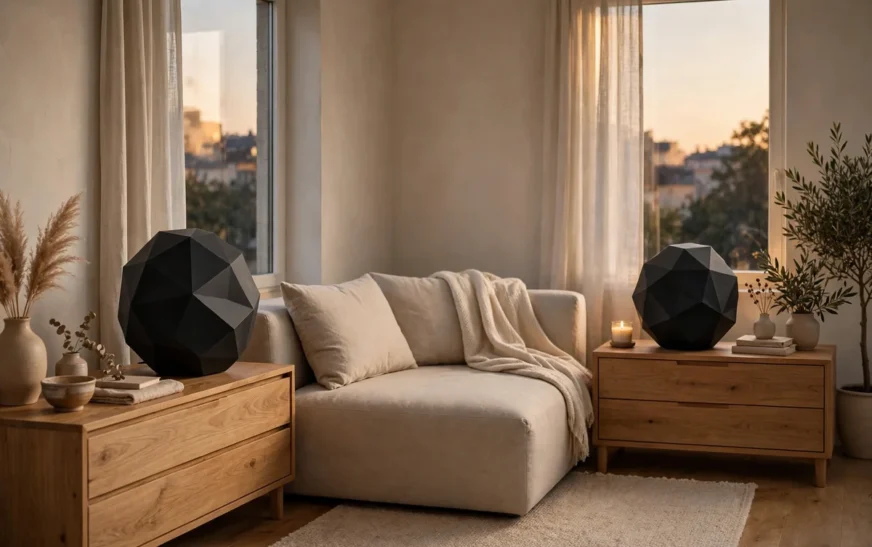
Search for an “obsidian stereo wifi speaker – set of 2 obsidian black” and you land in a strange corner of the internet. The query sounds like a product code. It is not. It is a shopper’s shorthand for two Pantheone Obsidian Black speakers, bought as a pair, and set up as dedicated left and right channels over Wi-Fi. That distinction matters, because a single Obsidian is already a stereo speaker on its own. A pair is a different purchase, a different setup, and a very different bill.
This article answers the question the product pages mostly dodge: what changes when you buy two, what stays the same, and where the deal falls apart. No listening test is claimed here. No secret discount is hidden in the text. The specs below come from Pantheone’s own product pages, checked for this draft, and anything that could not be verified is left out of the buying advice.
Obsidian Stereo WiFi Speaker – Set of 2 Obsidian Black: What You Actually Get
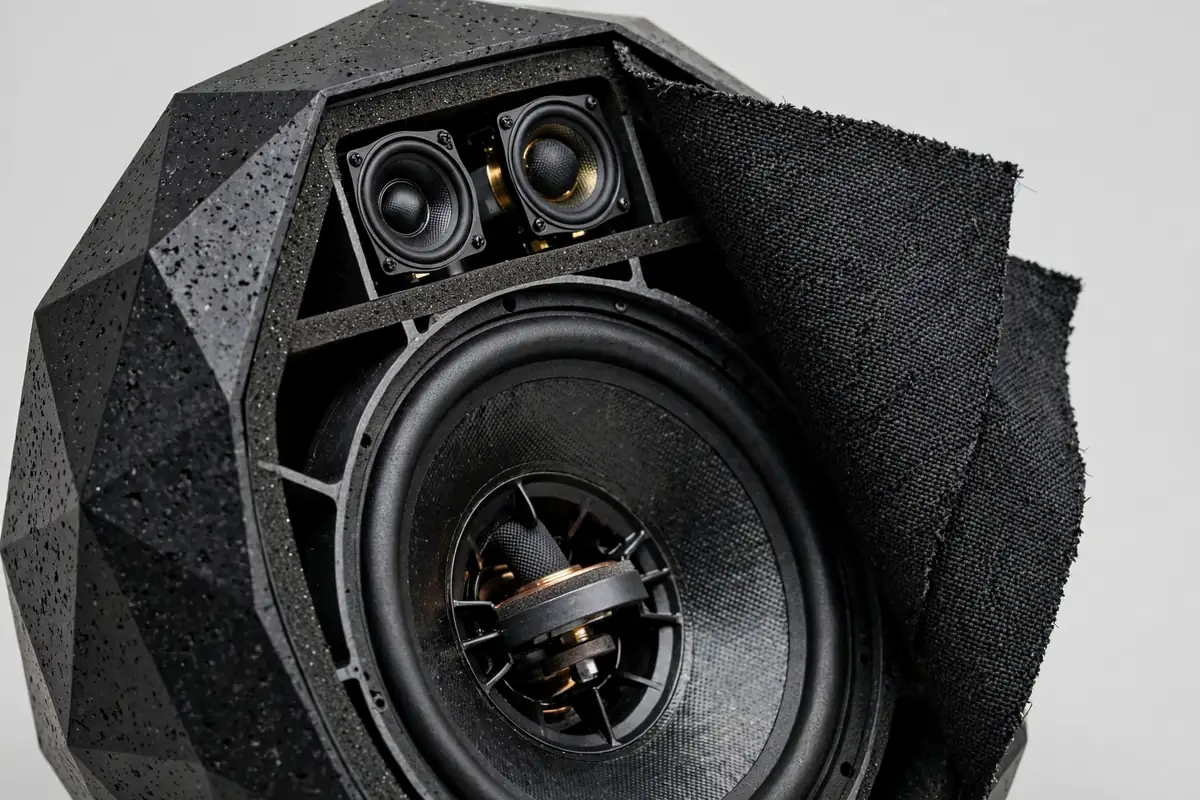
You get two identical Obsidian Black speakers. Each one is a compact, faceted, hand-finished unit inspired by volcanic obsidian, cast from a high-density mineral composite with ABS plastic and acoustic fabric. Pantheone lists each speaker at 5 kg, with dimensions of 359 x 258 x 178, and the unit given on the product page is not spelled out in the text checked, so treat that size figure as a listing to confirm against the current page before you plan a shelf around it.
The box for a single Obsidian, according to Pantheone, includes a power cord, a bag cover, and a quick start guide. A stereo set is two speakers in the selected colour, so the honest way to read the pair is as two complete speakers, not as one speaker plus a cheap satellite. That is also why the pair costs what it costs. You are paying twice for the same driver set, the same battery, and the same hand-finished enclosure.
Stereo pairing is done in the Pantheone app. You assign one Obsidian to the left channel and the other to the right. Pantheone’s own FAQ warns about a trap that catches people later: if you unpair the two speakers and want to use each one alone again, you must change each speaker back to Stereo mode in the app. Skip that step and a speaker can stay locked to one channel, which sounds broken even though nothing is broken. That one detail tells you a lot about this product. The hardware is simple to admire. The app is where the pair lives or dies.
A pair is not the same thing as multiroom. Stereo pairing puts left and right in one room, for one listener position, with separation between the two boxes. Multiroom puts the same music, or different music, in different rooms. The Obsidian pair can do both jobs at different times: paired in one room for stereo, or split across rooms for multiroom listening through the app. Pantheone lists multiroom support up to 8 rooms for its system. Do not confuse that 8-room figure with stereo. You do not need eight speakers to get stereo. You need two, placed properly, in the same room.
Your home Wi-Fi has to carry this setup, because the stereo link and the app control run over your network, not over a private radio link between the speakers. If your router drops out in the far room, the pair will remind you of that fact at the worst moment. A stable network matters more here than it does for a single Bluetooth speaker sitting next to your phone, and that is worth checking before you spend luxury money. For a refresher on what makes home Wi-Fi actually stay stable, read our guide to home Wi-Fi that actually stays stable.
The Specs, Without the Marketing Fog
Here is what Pantheone actually publishes for one Obsidian, and therefore for each speaker in the pair. Nothing in this table is a guess, and nothing has been rounded up to sound better.
| Drivers | 1 x 5.25-inch high-excursion woofer, 2 x 1-inch silk-dome tweeters |
| Amplifier | Class D with built-in DSP: 1 x 40 W for the woofer, 2 x 20 W for the tweeters |
| Frequency response | 55 to 22,000 Hz |
| Weight | 5 kg |
| Dimensions as listed | 359 x 258 x 178 (unit not spelled out on the page checked) |
| Enclosure | High-density mineral composite, cast and finished by hand, plus ABS plastic and acoustic fabric |
| Wi-Fi | 802.11 b/g/n/ac, dual band 2.4 GHz and 5 GHz |
| Bluetooth | Bluetooth 5.0, codecs SBC and AAC |
| Wired input | 1 x minijack AUX |
| Streaming | AirPlay 2, Spotify Connect, TIDAL Connect, Amazon Music, TuneIn |
| Voice | Amazon Alexa built in |
| Hi-res over Wi-Fi | Up to 24-bit/192 kHz, depending on service, file, and network |
| Battery | Up to 15 hours at normal listening volume; 2 hours for a full charge, 30 minutes for 50% |
| Controls | On/off switch, volume, play/pause, next/previous, Wi-Fi/Bluetooth/AUX mode, Alexa voice control |
| Multiroom | Up to 8 rooms in the Pantheone system |
Read that table like a buyer, not like a fan. The 80 W total per speaker (40 W plus 20 W plus 20 W) is amplifier power, not a promise about how loud the pair will sound in your room. The 55 Hz low end tells you the woofer reaches into real bass territory for a compact speaker, but it does not tell you how that bass behaves in a corner, against a wall, or on a hollow console. The 15-hour battery figure is qualified by Pantheone itself: normal listening volume. Turn the pair up for a party and that number will fall. Any review that quotes 15 hours without the word “normal” is quoting half the spec.
The codec list is another place to stay honest. Over Wi-Fi, with a service like TIDAL or Qobuz, Pantheone says the Obsidian can handle hi-res up to 24-bit/192 kHz. Over Bluetooth, the listed codecs are SBC and AAC only. That gap matters. If you buy this pair dreaming of hi-res sound and then stream everything over Bluetooth from your phone, you are not getting the hi-res path. Wi-Fi is the path that matters here, and the app plus your network are part of the sound, whether you like that or not.
One Speaker vs. Two: The Only Comparison That Matters
A single Obsidian already plays in stereo from one box, using its woofer and two tweeters. That is a real strength for a bedroom, a study, or a shelf where you sit close. It is also the reason a second speaker can feel like a small upgrade for a large price. The pair does not add new drivers to the recipe. It spreads the same recipe across two boxes, so instruments and voices get physical separation: left sounds come from the left, right sounds come from the right, and the space between the speakers starts to feel like a stage instead of a point.
That separation is the whole case for the pair. It is strongest when you sit roughly between the two speakers, with space between them, facing them, in a room that is not too echoey. It is weakest when the speakers end up side by side on one console because that was the only free surface, or when one speaker sits behind a plant and the other sits in open air. A stereo pair punishes lazy placement in a way a single speaker forgives. If your room forces both speakers onto one shelf, save your money and buy one.
There is a second, quieter case for the pair: two rooms. Buy two, pair them for a film night, then split them the next morning, one for the bedroom and one for the study. That flexibility is genuine, and it is the one argument that can justify the pair for someone who does not have a perfect listening chair. But be clear about what you are buying in that case. You are buying two portable speakers that can sometimes act as a pair, not a dedicated home cinema system. A tidy desk setup that stays put will reward a pair more than a chaotic room will, and the same discipline applies to speaker placement. If you want a workspace that stays organised around your audio gear, our guide to a desk setup that stays tidy makes the same point in a different room: placement is the upgrade.
Volume is a trap in this comparison. Two speakers can play louder and fill a larger room than one, but “louder” is not “better” by itself. In a small room, one Obsidian at a comfortable volume will sound fuller than a pair pushed to the same level from bad positions. In a large, open-plan room, the pair earns its keep by covering space without straining a single box. Room size, not enthusiasm, should decide this.
Setup: The Steps the Product Page Skips Over
Pantheone’s setup story is short: download the Pantheone app for iOS or Android, power on each speaker, follow the app to connect both to the same home Wi-Fi network, then assign left and right. That is accurate as far as it goes. It leaves out the parts that actually cause support tickets, so here they are, in order, before you unbox anything.
First, put both speakers where they will live, on the same Wi-Fi network, before you pair them. Do not pair them in one room and then carry one to a dead zone and wonder why the stereo image collapsed. Second, update firmware over the air if the app offers it, before you judge the sound. Third, assign left and right while you are sitting in your listening spot, and play something with a clear left-right difference, a song where a guitar sits on one side and a keyboard on the other, so you can confirm the channels are not swapped. Fourth, test the pair on Wi-Fi, then test Bluetooth separately, so you know which path you are actually hearing. Fifth, write down, or at least remember, how to return each speaker to Stereo mode if you unpair them later. That last step is the one Pantheone’s FAQ specifically warns about, and it is the step most people skip.
Network trouble looks like audio trouble with a Wi-Fi pair. Dropouts, one speaker lagging, or the app losing a speaker are usually network symptoms, not driver failures. Check that both speakers sit on the same network band and the same network name, that your router is not isolating devices from each other, and that the far speaker has a usable signal where it sits. Slow network lookups and weak coverage cause the same kind of frustration in a speaker pair as they do on a laptop, and the fix is usually the network, not the speaker. If your home network already struggles, our guide to slow network lookups is a better first purchase than a second speaker.
Placement: Where a Pair Earns Its Price
Start with the listening position, not the furniture. Sit where you will actually listen, then place the speakers roughly equidistant from that spot, with clear space around each one, and no speaker shoved into a corner unless you have tested that corner and liked what it did to the bass. Keep both speakers at a similar height. Keep the left speaker’s surroundings roughly similar to the right speaker’s surroundings. A speaker firing into a bookshelf and a speaker firing into open air are not a matched pair, even if the boxes match.
Distance between the speakers is a trade-off, not a magic number. Too close and the stereo effect collapses back toward a single point. Too far apart and the middle of the soundstage hollows out, leaving a hole where the vocal should sit. Pantheone does not publish a placement distance for the pair on the pages checked, so this article does not invent one. Start with the speakers a comfortable conversational distance apart in your room, sit back at a similar distance, listen, then move them in small steps. Your ears, in your room, beat a generic diagram.
The enclosure matters to placement too. This is a 5 kg object with a hand-finished mineral composite shell. It is not a featherweight plastic box you toss on a shelf and forget. Put it where it will not be knocked, where the fabric front is not pressed against a wall, and where you can reach the controls. The sculptural look is part of what you paid for. Hiding it behind a curtain to protect it defeats the purchase, and putting it on a wobbly stand invites the one accident this price does not forgive.
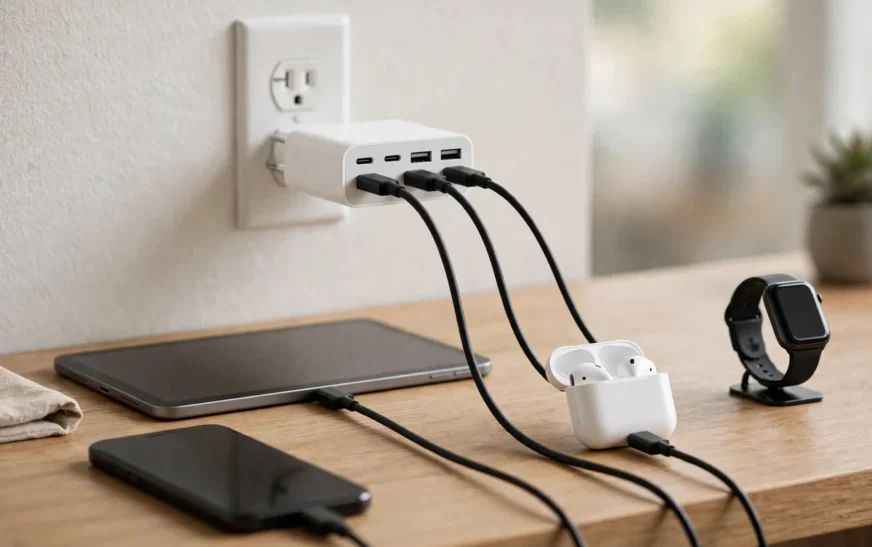
Battery placement deserves its own warning. A speaker that moves between rooms is a speaker that ends up uncharged at the wrong moment. If the pair lives in one room, keep both plugged in or on a charging routine. If the pair splits across rooms, charge both the night before you need them together. The phone in your hand is the remote for this system, and a dead phone ends the session just as surely as a dead speaker. Keeping your phone charged while it acts as the remote is a small habit that saves a ruined evening, and our roundup of charging gear for the rest of your desk covers that side of the setup.
Sound and Streaming: What Wi-Fi Changes
Wi-Fi is not just a fancier Bluetooth here. It changes what the speakers can do. Over Wi-Fi, the pair can stream directly from services like Spotify Connect, TIDAL Connect, and Amazon Music, and it can join AirPlay 2 multiroom playback. Over Bluetooth, the phone stays in the chain, the listed codecs narrow to SBC and AAC, and the phone’s notifications, calls, and battery become part of your listening session. For serious listening, Wi-Fi wins. For a quick song while you cook, Bluetooth is fine, and pretending otherwise is snobbery, not advice.
Alexa is built in, which makes the pair a voice-controlled system as well as a music system. That is a genuine convenience and a genuine privacy decision. A speaker that listens for a wake word belongs in a room where everyone who lives there is comfortable with that. It does not belong in a guest room by surprise. Pantheone lists Alexa control for requests and privacy, and the app is the control point, so check the app’s privacy settings on day one rather than discovering them months later.
One more honest limit: this article does not claim a measured sound score, a frequency graph, or a blind test result for the pair, because no such measurement was performed for this draft and none was found on the manufacturer pages checked. What can be said, from the published driver and amplifier figures, is that the pair has the parts for controlled bass and detailed highs in a small-to-medium room, and that the stereo separation, not raw power, is the reason to buy two. Anyone who promises you a precise sound quality verdict on this pair without telling you the room, the source, and the volume is selling you a story, not a test.
Short video clips will not settle this purchase either. A phone recording of a luxury speaker tells you about the phone’s microphone, not the speaker. If you want to judge the pair, listen in person, in a quiet room, on Wi-Fi, with music you know well. That is slower than watching a clip, and it is the only method that works. For a different kind of video test, our look at free tools that test video ideas is a reminder that a polished clip is a production choice, not proof of quality.
Battery, Charging, and the Portable Promise
The portable promise is real, with limits. Each Obsidian runs on its rechargeable battery for up to 15 hours at normal listening volume, or plugged in for all-day listening. Charging takes 2 hours for a full charge and 30 minutes for 50%, according to Pantheone. For a pair, that means two batteries to manage, two charge levels to check, and twice the chance that one speaker dies mid-album while the other keeps playing. The pair sounds worst exactly when one side quits, because the stereo image collapses to one channel and the music suddenly feels lopsided.
Treat the pair like a pair of devices, not like one device with a spare. Charge both together. Check both levels before a long session. If you mostly listen plugged in, the battery is a bonus, not the reason to buy. If you mostly listen on battery, the 15-hour figure is a normal-volume figure, and loud listening, weak Wi-Fi, and constant app control will all pull it down. No battery figure survives contact with a party at full volume, and this one does not claim to.
The phone-as-remote problem shows up here too. If you use voice commands through Alexa, or the app to change volume, and your phone’s microphone or speaker is misbehaving, you will blame the speakers for a phone fault. Before you reset a speaker, check the phone. Our guide to fixing a phone microphone that stopped working exists because that confusion is common, and it is cheaper than returning a speaker that was never broken.
Design: The Part You Pay For Even in Silence
Pantheone is blunt about this, and for once the marketing is the point. The Obsidian is meant to be seen as much as heard. The faceted form, the hand-finished mineral composite, the black finish that reads as stone rather than plastic, all of it is designed to sit in a considered interior and hold its own when the music is off. That is not a flaw. It is the product. A buyer who hides the speakers, or who only cares about sound per dollar, is paying for a feature they will not use.
That design choice has practical costs. A hand-finished enclosure will show variation from unit to unit, because hand finishing does that. Pantheone itself notes that surface and tone can vary slightly, making each speaker distinct. For a pair, that means your two speakers may not be perfect visual twins, and a buyer who expects factory-perfect matching should know that before ordering. The 5 kg weight per speaker also means the pair is portable in the room-to-room sense, not in the backpack sense. Nobody is carrying two of these to a picnic, and the product pages do not pretend otherwise.
Colour is the other design decision. Black is the colour in this keyword, and it is the colour that best matches the volcanic obsidian story. White is the same speaker in a lighter finish, and Sage is a limited edition. Colour does not change the drivers, the amplifier, or the battery on the pages checked. Paying extra for a limited colour is a design purchase, not a sound purchase, and it should be judged that way. Before you buy any hardware on looks alone, it is worth checking the fine print the way you would for any expensive device, including checking hardware details before you buy, because the details that disappoint you later are usually the ones printed in small type now.
Price: The Trap in This Keyword
Here is the part most pages about this query get wrong, by omission. Pantheone’s current listings checked for this draft show a single Obsidian Black at AUD $1,950, tax included, and an Obsidian White Stereo Set at AUD $3,599, tax included. Those are Australian dollars, on Pantheone’s own store, at the time of checking. Older articles quote very different numbers, including $1,399, £1,199, and $1,999, from earlier years and different markets. Prices have moved, currencies differ, and a price copied from a 2023 article is not a price you can pay today.
The black stereo set price, specifically, was not confirmed on the pages checked for this draft. The white stereo set page was opened and verified. The black single page was opened and verified. A black pair page, with its own total, was not confirmed, and this article does not invent one by doubling the single price. Two singles at AUD $1,950 each would be AUD $3,900, which is more than the white pair’s AUD $3,599, but a bundle price is not necessarily two singles added together, and assuming it is would be a guess dressed up as arithmetic. Check the black pair listing itself, in your own currency, including tax and shipping, before you budget.
Currency is the second trap. AUD $3,599 is not US $3,599. Do not convert it in your head at a round rate and call that the price. Shipping, tax, import costs, and the exchange rate on the day you pay all move the real total. Tech prices move fast in general, and luxury audio is no exception, as our coverage of tech prices that move fast shows in a different market. The only price that counts is the checkout total, in your currency, on the day you order, from a seller you trust.
Who Should Buy the Pair, and Who Should Skip It
Buy the pair if you have one room where you sit and listen, you already have solid Wi-Fi there, you like the sculptural look enough to display two of them, and you understand you are paying luxury money for separation and design, not for a home cinema. Buy the pair if you want two portable speakers that can also act as a stereo pair for films and music, and you will actually move them between rooms. Buy the pair if you have heard a single Obsidian, liked its character, and found yourself wishing for a wider image rather than a louder box.
Skip the pair if your Wi-Fi is weak in the listening room, if both speakers would end up on one shelf, if you mostly listen on Bluetooth from your phone, or if you want the best sound per dollar and do not care about sculpture. Skip it if you need a speaker for a bathroom, a poolside, or a workshop, because no water-resistance rating was found on the manufacturer spec list checked for this draft, and a hand-finished mineral composite speaker is not the tool for wet or dusty work. Skip it if the black pair price, in your currency, with shipping, makes you wince, because that wince is information. A purchase that starts with regret rarely sounds good later.
A Chromebook, a phone, and a pair of Wi-Fi speakers make a perfectly ordinary modern home setup, and they also make a network with more points of failure than any one device. If your home already has several devices sharing one network, the pair is one more citizen of that network, not a separate world. Our guide to a Chromebook on the same home network is a reminder that the unglamorous network and device settings are what keep a multi-device home calm. The same applies here: sort the network first, then buy the speakers.
Buying Checklist Before You Pay
Use this list in order, and do not skip the boring steps. They are the steps that prevent returns.
First, confirm the black pair listing, price, currency, tax, shipping, and delivery time, in writing, before you pay. Second, confirm the return policy and the warranty length from the seller, because neither was confirmed on the pages checked for this draft. Third, measure your shelf, console, or side tables against the listed dimensions, and confirm the unit of those dimensions with the seller, since the page checked did not spell it out. Fourth, test your Wi-Fi in both speaker positions with your phone, on the network the speakers will use. Fifth, decide where the speakers will live, and whether both will stay plugged in or run on battery. Sixth, check the Pantheone app on your phone, including its privacy settings for Alexa, before the speakers arrive.
Seventh, plan the unpairing step. Learn how to return each speaker to Stereo mode in the app, so a future split does not leave you with a one-channel speaker and a support ticket. Eighth, keep the boxes, the bag covers, and the power cords until you are sure the pair stays, because luxury returns without packaging are a fight you do not need. Ninth, listen first if you can, in person, on Wi-Fi, with music you know. Tenth, if you cannot listen first, buy from a seller with a return policy you have actually read, not one you assume exists.
Researching a purchase like this takes time, and the time is well spent, because the price punishes impulse. Browser tools that save time while you research are worth using, and our roundup of browser tools that save time while you research covers that side of the job. The research itself, though, cannot be outsourced to a single review. Check the listing, check the network, check the room, then decide.
Mistakes That Ruin an Otherwise Good Pair
The most common mistake is placement by furniture, not by listening position. The second is pairing over Bluetooth and judging Wi-Fi sound quality on a Bluetooth stream. The third is forgetting the Stereo mode reset after unpairing, which Pantheone’s FAQ warns about for a reason. The fourth is buying the pair for a room with weak Wi-Fi and blaming the speakers for network dropouts. The fifth is budgeting in the wrong currency, or budgeting for two singles and being surprised by the bundle total, or vice versa.
The sixth mistake is subtler: buying two speakers for two different jobs and expecting one purchase to do both perfectly. A pair that lives in one room for stereo will not also cover the whole house. A pair split across rooms will not give you stereo in either room. Decide which job matters most, and let that decision place the speakers. Starting fresh with a new setup helps here, because it forces you to choose the job before you choose the furniture. A Mac that stays charged for long listening sessions is part of that same discipline, since the device that controls the music should not die before the music does, and our guide to a Mac that stays charged for long listening sessions covers that unglamorous but decisive detail.
Frequently Asked Questions
What is the Obsidian stereo WiFi speaker set of 2 in Obsidian Black?
It is two Pantheone Obsidian Black portable Wi-Fi speakers, assigned through the Pantheone app as dedicated left and right channels for stereo listening in one room. The same two speakers can later be split for multiroom listening in different rooms.
Is a single Obsidian already stereo?
Yes. A single Obsidian plays in stereo from one box, using one woofer and two tweeters. A pair adds physical left-right separation across two boxes, which widens the soundstage, rather than adding a new kind of driver.
How do you pair two Obsidian speakers as left and right?
Download the Pantheone app, connect both speakers to the same home Wi-Fi network, follow the app’s pairing steps, and assign one speaker to the left channel and the other to the right. Test from your listening seat with music that has a clear left-right difference. If you later unpair them, return each speaker to Stereo mode in the app, or a speaker may stay locked to one channel.
What is the battery life of the Obsidian pair?
Each Obsidian is rated up to 15 hours at normal listening volume, with a 2-hour full charge and 30 minutes for 50%. A pair means two batteries to manage, and loud listening will reduce that figure. For long sessions, keep both speakers plugged in or charged together.
What streaming services and connections does the Obsidian support?
Wi-Fi on 2.4 GHz and 5 GHz, Bluetooth 5.0 with SBC and AAC, AUX via minijack, AirPlay 2, Spotify Connect, TIDAL Connect, Amazon Music, TuneIn, and Alexa built in. Hi-res up to 24-bit/192 kHz is listed for Wi-Fi streaming, depending on service, file, and network, not for Bluetooth.
How much does the Obsidian Black stereo set cost?
The black pair total was not confirmed on the pages checked for this draft, so this article does not state one. For reference, Pantheone’s store at checking listed a single Obsidian Black at AUD $1,950 and a White Stereo Set at AUD $3,599, tax included. Verify the black pair price in your own currency, with tax and shipping, on the black pair listing itself.
Is the Obsidian waterproof or suitable for outdoors?
No water-resistance rating was found on the manufacturer spec list checked for this draft. Do not assume the pair is safe for bathrooms, poolside use, or wet outdoor use. The hand-finished enclosure is designed for interiors.
Should you buy one Obsidian or two?
Buy one if you listen alone, move between rooms, sit close to the speaker, or want the best value. Buy two if you have a dedicated listening spot, solid Wi-Fi in that room, space to separate the speakers properly, and you value a wider stereo image and the sculptural look enough to pay luxury money for it.
What is the biggest risk with this purchase?
The network and the price. Weak Wi-Fi turns a stereo pair into a dropout machine, and a price copied from an old article or the wrong currency turns a luxury purchase into a regret. Confirm the network, confirm the checkout total, and listen first if you can.

Continue Reading on CripsyWire
For more honest tech matchups, browse our full reviews and comparisons library. AI tool reviews live in AI tools and agents, phone reviews in smartphones, and wearable reviews in wearables. Before you buy, our step-by-step guides may help with setup decisions. The CripsyWire homepage highlights what is newest, all under our Tech coverage.