
Quick answer: Meta stock (NASDAQ: META) closed at $641.69 on Friday 13 November 2026, up 2.9% that day but down about 2.8% since the start of the year. Meta is worth about $1.64 trillion, earns almost all of its money from advertising, and is spending heavily on AI — $135 to $145 billion on data centers and servers in 2026 alone. Analysts rate it a Moderate Buy with an average price target of $833. This guide explains what those numbers mean. It is educational, not financial advice.
Meta Platforms owns Facebook, Instagram, WhatsApp, and Messenger — apps used by billions of people every day. Its stock, listed as META on the Nasdaq, is one of the most watched shares in the world. People search for “meta stock” for different reasons: some want the current price, some want to know whether it is a good buy, and some just want to understand what the company actually does with its money.
This guide answers all three questions in plain English. It covers the current price and performance, what Meta earns from, the latest earnings, the huge AI spending that is shaping the stock, what analysts think, the risks, and how buying shares actually works. Every number is dated, so you can tell what is current and what has moved on.
What is Meta Platforms?
Meta Platforms, Inc. is the company behind Facebook, Instagram, WhatsApp, Messenger, and Threads. It also runs Reality Labs, the division that builds Quest virtual reality headsets and Ray-Ban Meta smart glasses. The company changed its name from Facebook to Meta in 2021 to reflect that it was building more than one social network.
For a stock reader, the important thing is the shape of the business. Meta is, first and foremost, an advertising company. Businesses pay Meta to show ads to its users, and that advertising pays for almost everything else the company does, including its very expensive bets on artificial intelligence and virtual reality. When you understand that, the stock starts to make sense: the share price rises and falls mostly on how healthy the advertising business looks, and on whether investors believe the big spending will pay off.
Meta stock basics
Meta stock trades on the Nasdaq under the ticker symbol META. One share is one small piece of the company, and its price is set by buyers and sellers in the market during trading hours. As of the close on Friday 13 November 2026, one share cost $641.69.
Meta has more than one class of share. Class A shares (META) are the ones most investors buy and carry one vote each. Class B shares carry ten votes each and are mostly held by Mark Zuckerberg and other insiders, which is how Zuckerberg keeps control of the company. From 19 January 2027, Meta plans to add a publicly listed, non-voting Class C share and give one Class C share to the holder of each Class A and Class B share. That is a stock distribution, not a sale — existing shareholders receive the new shares.
The company’s total market value, called market capitalisation, is about $1.64 trillion. That makes Meta one of the largest companies in the world by value. Its price-to-earnings ratio, or P/E, is about 21.9, which means investors are paying roughly $22 for every $1 of profit the company made over the past year. Learning how investors value a company helps you read that number: a lower P/E is not automatically a bargain, and a higher P/E is not automatically a bubble — it depends on how fast profits are growing. Meta also pays a small quarterly dividend, with a yield of about 0.33% at the current price.
Meta stock price and performance
Stock prices move every trading day, so any price in this guide is a snapshot. Here is where META stood at the close on Friday 13 November 2026, with the change over different periods.
| Period | Change |
|---|---|
| Friday 13 November 2026 | +2.90% (closed $641.69, up $18.08) |
| Last 1 month | -9.54% |
| Year to date (2026) | -2.79% (started the year at $660.09) |
| Last 1 year | +5.29% |
| Last 10 years | +451.56% |
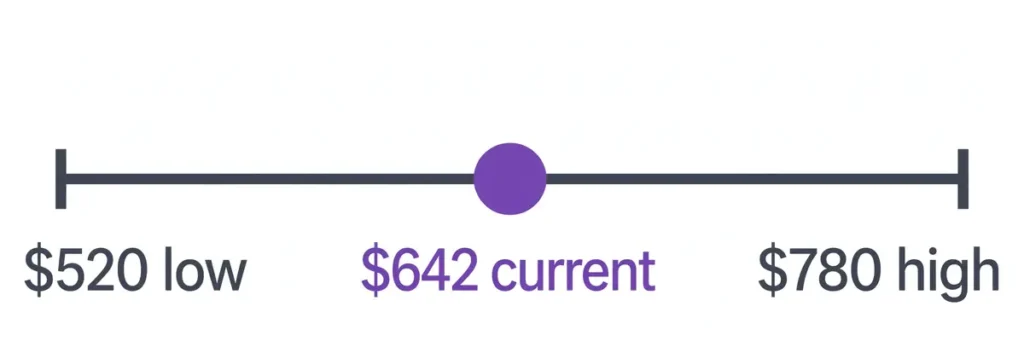
The 52-week range tells you how far the stock has swung in the past year: a low of $520.26 on 27 March 2026 and a high of $779.82 on 24 September 2026. The current price of $641.69 sits roughly in the middle of that range — about 18% below the high and about 23% above the low. The stock is also more volatile than the market as a whole: its beta is 1.28, which means it tends to move about 28% more than the wider market, up or down.
The recent picture is mixed. The stock jumped nearly 3% on 13 November, but it is down about 10% over the past month and slightly down for the year. Over ten years, though, it has returned more than 450%, which is why long-term holders and short-term traders can look at the same stock and reach very different conclusions.
What Meta actually earns from
Meta’s revenue in the third quarter of 2026 was $64.60 billion, up 26% from the same quarter a year earlier. Of that total, $63.06 billion came from advertising — about 98% of all revenue. The remaining $1.54 billion came from everything else, including Reality Labs hardware and other products.
That split matters more than any other number in this guide. Meta’s fortunes depend on businesses continuing to buy ads on Facebook and Instagram. In the third quarter, ad impressions rose 10% and the average price of an ad rose 14%, which means Meta showed more ads and charged more for each one. When both of those numbers rise together, revenue grows fast. When advertisers pull back, as they do in a weak economy, Meta feels it immediately. Video is a growing share of those ads, and AI video tools are changing how quickly advertisers can make them.
Reality Labs, the virtual and augmented reality division, brought in only $443 million in the quarter — less than 1% of revenue. It is a long-term bet, not a business that pays the bills today.
Meta’s latest earnings, in plain English
Meta reported its third-quarter 2026 results on 21 October 2026, and the numbers told two stories at once. Revenue beat expectations, but costs rose so fast that the cash the company keeps fell below zero for the quarter.
Revenue of $64.60 billion was ahead of the roughly $63.3 billion analysts expected, and adjusted earnings per share of $7.40 beat the $6.54 consensus. On paper, the advertising business is doing very well. But operating income fell 37% to $12.99 billion, and the operating margin dropped to 20% from 40% a year earlier. The main reason was a $9.89 billion legal charge tied to an agreement with 52 state attorneys general over teen mental health and social media litigation, with total payments of up to about $18.59 billion. Without that charge, earnings per share were $7.40; with it, reported net income was $9.86 billion, or $3.83 per share.
The second story is spending. Meta spent $34.91 billion on capital expenditures in a single quarter — mostly data centers, servers, and network equipment for training and running AI models — while its operations generated $32.79 billion in cash. That left free cash flow at minus $2.12 billion, compared with plus $10.63 billion a year earlier. In plain terms, Meta spent more on building AI infrastructure in three months than its business brought in. For the full year, Meta expects capital spending of $135 billion to $145 billion, nearly double the $72.22 billion it spent in 2025. It has given no number for 2027 yet and says the full outlook will come with fourth-quarter results, expected around 26 January 2027.
The AI bet behind the stock
The reason for all that spending is artificial intelligence. Meta is building enormous data centers to train and run its AI models, including its Meta AI assistant — one of many AI chatbots now competing for users — and the AI features inside Facebook, Instagram, and WhatsApp. The company says its AI investments are already improving recommendations, engagement, and advertising — which is another way of saying AI is helping the ad business earn more. More than 10 million people in the United States and Canada have created accounts for Meta’s Muse personal AI agent, and about a quarter of them use it on a given day, according to the company.
Meta AI can also generate images from text prompts, the same kind of text-to-image AI that has spread across the web in the past two years.
Visual AI is part of the same shift: AI visual search now lets a phone camera identify objects and translate text in the real world, and Meta is building similar features into its own apps.
The spending is not just about chips. Meta’s Louisiana campus in Richland Parish, home of its Hyperion AI training cluster, is being expanded to 5 gigawatts with more than $50 billion of investment. Keeping track of the hardware behind this boom means following AI chips and the data center build-out, because the companies supplying those chips are the other side of Meta’s spending. The open question for investors is whether the AI investment will earn a return. Meta says it expects to improve the cost efficiency of its Muse agent by more than tenfold over the next year, but that is a company forecast, not a result. The spending is already real and measurable; the payoff is still a promise.
Reality Labs: the expensive side project
Reality Labs is the division behind Quest headsets and Ray-Ban Meta smart glasses, and it loses a lot of money. In the third quarter it lost $4.13 billion on $443 million of revenue. Meta expects the division to lose $18 billion to $19 billion in 2026, narrowing to about $15 billion in 2027 as investment shifts toward AI. The glasses themselves are a real product with real users — the Ray-Ban Meta hidden features show how much the hardware can already do — but the division as a whole is still a long way from paying for itself. Investors watch Reality Labs because every billion it loses is a billion that does not go to shareholders, and because a narrower loss in 2027 would be one of the few things that could lift profits without any help from advertising.
What moves Meta stock
Five things move META more than anything else.
Earnings reports. Meta reports every three months, and the stock often jumps or drops several percent on the day. The market reacts not just to revenue and profit, but to the guidance for the next quarter. The next report, for the fourth quarter of 2026, is expected around 26 January 2027, with revenue guidance already set at $73 billion to $76 billion.
The advertising market. Because ads are 98% of revenue, anything that affects advertisers affects Meta: a strong economy means more ad spending, a weak one means less. Changes in how Apple and Google handle tracking on phones also matter, because they affect how well Meta can target ads.
AI spending. Every quarter, investors ask the same question: is the AI build-out worth it? Big spending with no visible return pushes the stock down; evidence that AI is lifting ad revenue pushes it up. The $135 to $145 billion capital plan for 2026 is the single biggest number in the story. The wider AI boom is visible in everyday software too — AI productivity tools are now part of daily work for millions of people.
Legal and regulatory pressure. The $9.89 billion legal charge in the third quarter is a reminder that lawsuits and regulation are a real cost. Antitrust cases, privacy rules, and state-level litigation can all move the stock, and the total payments in the attorneys general agreement could reach about $18.59 billion.
Interest rates and the wider market. With a beta of 1.28, Meta tends to swing more than the market. When investors worry about interest rates or the economy, large technology stocks usually fall first and hardest.
What analysts think
Analysts who cover Meta are mostly positive. The consensus rating is Moderate Buy, based on 3 strong buy ratings, 47 buy ratings, and 7 hold ratings, with no sell ratings at all. The average price target is $833.12, which is about 30% above the current price of $641.69. Analysts also expect earnings to grow by about 17% in the coming year, from $29.01 to $33.92 per share.
Those numbers are worth reading carefully. A price target is an analyst’s guess about where the stock could trade in a year, not a promise, and targets move after every earnings report. The fact that there are no sell ratings tells you the professional consensus is friendly, but the stock is still down for the year, which tells you the market as a whole is less sure. Targets and ratings are useful as a summary of professional opinion, not as a reason to buy on their own.
The risks, honestly
No stock is a sure thing, and Meta has real risks that a fair guide should not hide. The AI spending is the biggest one: $135 billion to $145 billion in a single year is an enormous bet, and if the returns disappoint, the stock will suffer. The legal bill is real too, with the attorneys general agreement costing up to about $18.59 billion in total. Advertising can slow sharply in a weak economy, and Meta has almost no other revenue to fall back on. Reality Labs loses $18 billion to $19 billion a year. Competition for users’ time is constant, from TikTok to YouTube to whatever comes next. And the excitement around AI itself is a risk: the AI hype around Meta is part of a wider wave, and many people are looking for ways to make money from AI, which means prices can rise on enthusiasm and fall just as fast when enthusiasm cools. A stock that has swung from $520 to $780 in a single year can do it again.
How to buy Meta stock
Buying shares is straightforward, and the steps are the same for Meta as for any listed stock. This is general information about how it works, not a recommendation to buy.
First, you need a brokerage account — an account with a broker that lets you buy shares on the Nasdaq. Many brokers let you open an account online in a day or two, and some offer fractional shares, which means you can buy a slice of a share for a smaller amount instead of paying the full $641.69. Buying shares is investing, not saving. Money you invest should be money you can leave alone for years, not money you need next month, and learning how to save money first makes the investing part less stressful.
Once the account is open, you search for the ticker META, choose how many shares or how much money you want to invest, and place the order. You will pay a small spread or commission depending on the broker, and you will own the shares once the trade settles. After that, you can follow the stock through your broker’s app, check earnings dates, and read the quarterly reports yourself. Most brokers also let you set up automatic investing, so you can buy a fixed amount on a regular schedule instead of trying to time the market. Before you invest, check the tax rules in your own country, because capital gains and dividends are taxed differently depending on where you live.
Frequently asked questions
What is Meta stock?
Meta stock is a share in Meta Platforms, Inc., the company behind Facebook, Instagram, WhatsApp, and Messenger. It trades on the Nasdaq under the ticker symbol META. One share is a small piece of ownership in the company.
How much is Meta stock right now?
Meta stock closed at $641.69 on Friday 13 November 2026, up 2.90% that day. Prices change every trading day, so check a live quote for the current price — this guide’s figures are a snapshot from that date.
Does Meta pay a dividend?
Yes, Meta pays a small quarterly dividend, with a yield of about 0.33% at the current share price. The dividend is small compared with the share price, so most of the return from Meta stock has come from price growth, not income.
Why is Meta stock down this year?
Meta started 2026 at $660.09 and closed at $641.69 on 13 November, down about 2.8% for the year, with a 9.54% fall over the past month. The main worries are the scale of its AI spending — $135 billion to $145 billion of capital expenditure in 2026 — and the $9.89 billion legal charge in the third quarter, which cut operating profit sharply.
Is Meta stock a good buy?
Analysts rate it a Moderate Buy, with an average price target of $833.12, about 30% above the current price. That is a summary of professional opinion, not a guarantee. Whether it is a good buy for you depends on your own goals, time horizon, and how much risk you can take. This article is educational, not financial advice.
What is the highest Meta stock has ever been?
In the past 52 weeks, Meta reached a high of $779.82 on 24 September 2026 and a low of $520.26 on 27 March 2026. The current price of $641.69 is about 18% below that high.
When does Meta report earnings next?
Meta’s fourth-quarter 2026 results are expected around 26 January 2027. The company has already guided fourth-quarter revenue of $73 billion to $76 billion.
How can I buy Meta stock?
Open a brokerage account, search for the ticker META, and place an order for as many shares — or as much money, using fractional shares — as you want to invest. Check your broker’s fees and the tax rules in your country first.
Bottom line
Meta stock is a bet on the world’s biggest advertising machine and on one of the largest AI spending programs in history. The advertising business is strong — revenue grew 26% in the third quarter, with ad impressions and prices both rising. The worry is the bill: $34.91 billion of capital spending in a single quarter, free cash flow turned negative, a $9.89 billion legal charge, and a Reality Labs division losing $18 billion to $19 billion a year. Analysts are mostly positive, with a Moderate Buy consensus and an average target of $833, but the stock is still down for the year, which shows the market has not made up its mind. If you are considering it, read the next earnings report when it comes, watch the AI spending, and remember that this guide explains the numbers — it does not tell you what to do with your money.

Continue Reading on CripsyWire
For more US tech news, see our full news section. Many launches have detailed reviews in reviews and comparisons. AI launches live in AI tools and agents, phone launches in smartphones, and wearable launches in wearables. Step-by-step coverage of new product features lives in how-to guides. Start at the CripsyWire homepage, all part of our Tech coverage.