Start with the workout, not the brand
Workout headphones fail in predictable ways. They slip out during a burpee. Sweat gets into a charging case and corrodes a contact. Touch controls pause a track every time a sweaty finger brushes the bud. Noise cancelling hides a car, a cyclist, or a gym announcement you needed to hear. None of those failures show up in a shop, in a photo, or in a headline battery figure. They show up at minute 30 of a session, when you are already committed.
That is why the right question is not “which earbuds sound best?” but “what do you do, where do you do it, and what has failed for you before?” A lifter who trains indoors needs a different tool from a road runner, who needs a different tool from a swimmer, who needs a different tool again from someone doing HIIT in a garage. Sound quality matters, but only after fit, sweat resistance, and awareness are sorted. An earbud with superb sound that falls out is worse than a decent earbud that stays put.
Budget changes the maths, but it does not change the rules. A cheap pair with ear hooks and a real water-resistance rating will beat an expensive pair with no fit system and a vague “sweat-resistant” claim. Spend on fit first, on a rating you can verify second, and on noise cancelling and extra features last. If a listing cannot tell you the IP rating, the bud-only battery life, and how the buds stay in, treat that silence as information.
How to choose by workout type
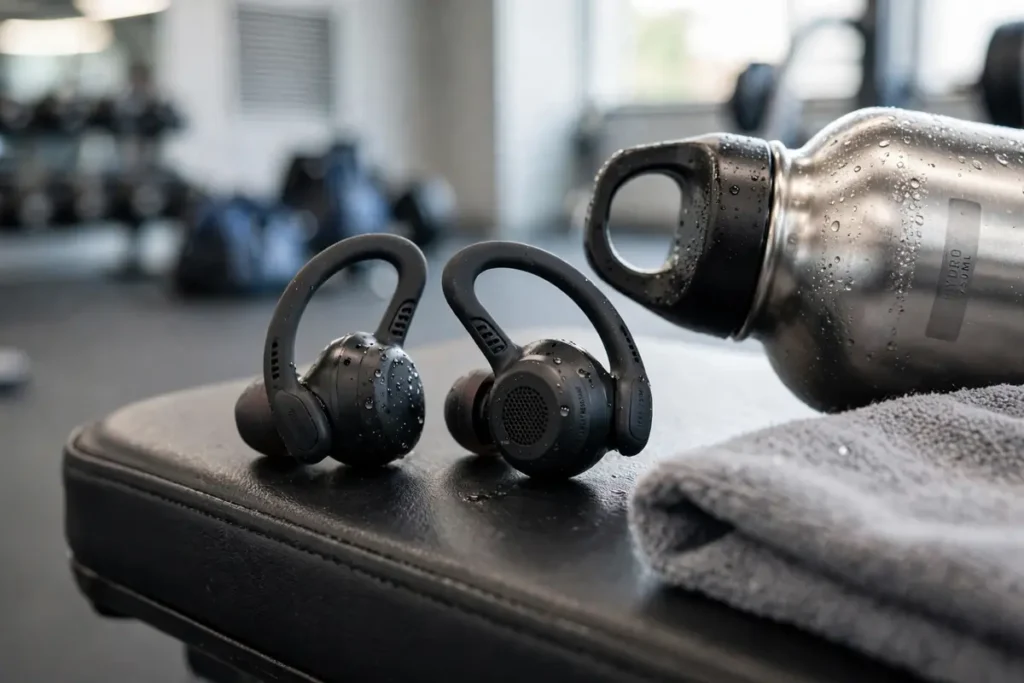
Indoor lifters and class-goers have the easiest brief. You need a secure seal, sweat resistance, and controls you can use without looking. Ear hooks or wingtips help, because a barbell, a bench, and a jump all move your head in ways a walk does not. Noise cancelling is a bonus here, not a risk, because you are not sharing the road with traffic. A sealed earbud that blocks gym music can genuinely help focus.
Road runners and cyclists have the opposite brief. Awareness is safety equipment. Open-ear or bone-conduction designs leave your ear canal open, so you hear a car, a dog, or a shout behind you. That openness costs you bass and isolation, and in a noisy city it can make podcasts harder to follow. Accept that trade, because the alternative — sealed buds on a busy road — trades a better soundtrack for a worse safety margin.
Outdoor trail runners sit in the middle. You need awareness for other trail users and for footing cues, but you also need a fit that survives uneven ground and a battery that covers a long run. A neckband open-ear design works well here because there is no bud to lose on a trail, and no case to fumble with cold hands. Swimmers are a separate case entirely: most workout earbuds in this guide are not for swimming, even if they carry a high IP rating, so do not assume a gym rating means pool safety.
Indoor cardio — treadmill, bike, rower — rewards a simple setup: buds that pair fast, stay connected across a room, and do not need a phone in your hand. Many people train with a laptop or tablet for follow-along videos, and getting that connection right matters as much as the buds themselves, as explained in guidance on pairing earbuds with a laptop for indoor sessions. If the audio drops every time you move away from the screen, the workout suffers no matter how good the buds sound.
Best secure all-rounder: Beats Powerbeats Pro 2
The Powerbeats Pro 2 is the default premium pick in most current guides for a simple reason: the ear hook does the work. The hook wraps over the ear, so the bud does not rely on ear-canal friction alone, and that mechanical security survives sprints, jumps, and heavy lifts better than a stem-only design. It carries an IPX4 rating for sweat and splashing, which is enough for gym and road training, though it is not a swimming rating, and the charging case itself is not water resistant.
Battery figures need reading carefully. Apple lists up to 10 hours per bud with noise cancelling off, or 8 hours with it on, and up to 45 hours total with the case in the first mode. For a single session, the bud figure is the one that matters. Ten hours covers any normal workout several times over, and the case total matters only for a week of sessions without a charger. Heart-rate monitoring built into the buds is a genuine bonus for runners who do not wear a watch, though it requires both buds to be worn, and it will not replace a chest strap for interval precision.
The honest downside is price and the IPX4 ceiling. Heavy sweaters who drench their gear, and athletes who train in heavy rain for hours, may want a higher-rated design or a stricter drying routine. The Powerbeats Pro 2 also assumes you like a hook over your ear. Some people find hooks irritating with glasses or a hat strap, so test that combination before the return window closes. Paired with a training watch, it forms a complete setup, and guides to GPS watches that pair well with training earbuds show how the two pieces fit together for runners who track every session.
Best for road running and awareness: Shokz OpenRun Pro 2
Bone-conduction headphones work differently from earbuds. They sit on your cheekbones and send sound through vibration, leaving your ears open. The Shokz OpenRun Pro 2 is the model most running guides point to: IP55 rated, about 30 grams, up to 12 hours of listening, and a neckband design that cannot fall out and roll down a drain.
That openness is the whole point. You hear traffic, other runners, and a shouted warning, while still hearing music or a podcast. For road running, commuting by bike in a place where it is legal to use them, and any session where awareness matters, that trade is worth it. The sound will not match a sealed earbud for bass or isolation, and in a very noisy street, podcasts can get lost. Music with a strong beat fares better than quiet speech, so match your content to the design.
Fit is almost foolproof compared with in-ear buds, because there is no tip size to get wrong. The neckband sits behind the head, the pads sit on the cheekbones, and the main question is whether the band clashes with a hat, a helmet, or a hood. Test it with the headwear you actually train in, not just bare-headed in a shop. Long outdoor sessions also pair well with spoken content, and listeners who run for an hour or more often build a habit around spoken-word listening for long outdoor sessions rather than constantly hunting for new playlists.
Do not buy bone conduction for the gym if your main goal is blocking noise. In a loud gym, open-ear sound competes with every speaker and dropped weight, and you will turn the volume up to compensate. That defeats the purpose. Use open-ear where awareness pays, and sealed buds where focus pays.
Best budget pick: JLab Go Air Sport and Soundcore Sport X20
Budget workout earbuds have improved to the point where price is no longer an excuse for a pair that falls out. The JLab Go Air Sport is the budget name that appears most often in current guides: ear-hook design, IP55-class protection in comparison tables, and 8 or more hours per bud. That combination — hook plus a real rating plus enough battery for a week of sessions — is exactly what a budget pick needs to prove.
The Soundcore Sport X20 sits a step above budget and is the usual mid-tier recommendation for people who want active noise cancelling and adjustable ear hooks without paying premium prices. Its hooks rotate and extend to fit different ears, and its battery is listed at around 12 hours per charge without noise cancelling, dropping to about 7 hours with it on. One caution from research: secondary sources disagree on its exact IP listing, with some showing IP68 imagery and others IPX7 text. Do not quote a single figure from memory when you buy it. Check the rating on the exact listing and box you receive, and treat any seller who cannot state it clearly as a reason to buy elsewhere.
Budget picks fail in boring ways, and you can screen for them. Check that the case closes firmly, that the buds charge every time they sit in it, and that spare tips are included. A pair with one tip size is a gamble on your ear shape. A pair with three sizes and a hook gives you two chances to get fit right. If the cheap pair passes a hard session in week one, it will probably last. If it slips, rattles, or loses connection in week one, return it fast, because those faults rarely improve.
Charging gear matters more at the budget end, because cheap cases are where corners get cut. A frayed cable, a loose USB port, or a case left in a sweaty gym bag will kill a good pair of buds. Keeping a reliable set of charging kit for earbuds and phones in your gym bag, and drying the case before you put buds away, does more for longevity than any premium feature.
Best for the gym: sealed earbuds with noise cancelling
In a gym, sealed earbuds earn their keep. AirPods Pro 3 appear as the all-around pick in several current guides, and Sony’s WF-1000XM5 appears as the noise-cancelling pick, with the same logic: block the gym floor, keep the seal, and let the music carry the session. Wingtip designs, such as the Powerbeats Fit, offer a middle path: a small wing braces the bud in the ear without a full hook over the top, which suits people who dislike hooks but still train hard.
Noise cancelling in a gym is a focus tool, but it has a limit. It can hide a trainer’s instruction, a class change, or a safety shout. Use transparency mode when you train in a class or with a partner, and reserve full cancelling for solo sessions where nobody needs to reach you. That single habit prevents most of the “I didn’t hear you” friction that makes gym partners hate noise-cancelling buds.
Touch controls are the hidden gym failure. Sweat, chalk, and a barbell plate can all trigger a pause, a skip, or a volume jump at the worst moment. Physical buttons, or a button-plus-touch mix, are far easier to use with wet hands. If you buy touch-only buds, learn the tap zones before a hard session, and consider locking controls in the companion app if that option exists. A bud that pauses your music mid-set is not a minor annoyance. It breaks the set.
For everyday gym-goers who already track steps, sleep, and workouts on a wrist device, the earbud choice should complement that tracker rather than duplicate it. Guides to everyday fitness trackers that complement gym earbuds help here, because a tracker that already logs heart rate means you do not need to pay extra for heart-rate buds unless you specifically want that feature in your ears.
The 10-minute fit test and the over-ear warning
Do this test inside the return window, before you throw the box away. Put the buds in, then jump ten times, do ten burpees or fast squats, shake your head side to side, and lie on a bench as if you were about to press. If a bud slips, reseats itself, or aches at any point, that is your answer. A fit that only works while you stand still is not a workout fit.
Repeat the test sweaty if you can. Ear tips that seal perfectly on dry skin often slip once sweat changes friction, and hooks that feel fine for five minutes can ache after 40. Wear the buds for a full session, not just a fitting, and check for two things at the end: red marks where a hook or wing pressed too hard, and a feeling that you had to keep pushing a bud back in. Either one means the fit is wrong for your ear, even if the model is right for someone else.
Over-ear headphones deserve a plain warning. Several guides list them as workout picks, but pads trap heat and sweat during hard sessions, headbands slide during bench work and burpees, and most over-ears are not built for sweat at all. They suit controlled, low-movement sessions — a walk on a treadmill, a light bike session, a stretching routine — where comfort and sound matter more than security. For anything intense, earbuds or open-ear designs win, and pretending otherwise is how people end up with soaked pads and a ruined pair.
Rugged training gear faces the same sweat and heat stress as workout earbuds, and the environment usually decides lifespan more than the electronics. That lesson runs through guides to rugged wearables built for harsh training conditions, and it is worth remembering before blaming a single pair of buds for a failure that heat, sweat, and a damp case caused together.
| Workout | Best fit type | Why it wins |
|---|---|---|
| Gym lifting and classes | Ear-hook or wingtip sealed buds | Stays put under movement, blocks gym noise |
| Road running | Open-ear / bone conduction | You hear traffic and warnings |
| Trail running | Open-ear neckband | Nothing to lose, awareness on shared trails |
| HIIT and CrossFit-style work | Ear-hook buds | Hooks survive jumps and floor work |
| Indoor cardio | Sealed buds, physical buttons | Fast pairing, easy control with wet hands |
| Swimming | Dedicated swim-rated buds only | Gym IP ratings do not mean pool safety |
Sweat, charging, and making buds last
Most workout earbuds do not die from a dramatic failure. They die from sweat in the case, a corroded charging pin, or a tip that was never cleaned. After a sweaty session, wipe the buds, shake off excess moisture, and let them dry before you close them in a case. Never put soaking buds straight into a sealed case and leave them in a hot car. That trapped moisture is what kills contacts over months.
Clean tips weekly if you train daily. Remove them, wash them if the maker allows it, and check for tears that break the seal. A torn tip changes sound and fit at the same time, and people often blame the buds when the tip is the fault. Replace tips when they lose their grip, not when they fall apart. They are cheap, and a fresh set can rescue a pair you were about to replace.
Battery care is simpler than the myths suggest. Do not leave buds at zero for weeks, do not leave a case baking in sunlight, and do not assume a case total means a single session will last that long. Bud-only hours are the session figure. Case hours are the week figure. If a pair stops charging on one side, clean the contacts gently and check for debris before assuming the battery is dead, because charging faults are common and often fixable, as shown in advice on fixing charging problems before you blame the battery.
Mistakes that ruin workout headphones
The first mistake is buying sealed buds for road running because they sound better in a review. Sound quality is irrelevant if you cannot hear a hazard. The second mistake is trusting a marketing phrase instead of a rating. “Sweatproof,” “sport-ready,” and “gym-tested” mean nothing without an IP rating, a fit system, and a return policy you can actually use.
The third mistake is ignoring the case. A case that is not water resistant will collect sweat from a gym bag, a pocket, and wet hands, and that moisture will find the charging pins. Keep the case dry, keep it out of a sweaty pocket, and wipe it before you put buds back. The fourth mistake is buying for a single workout and forgetting the rest of your week. If you lift, run roads, and do classes, one pair may not cover all three well. A cheap open-ear pair for roads plus a sealed pair for the gym often beats one expensive compromise that does neither job properly.
Indoor training setups cause a related mistake: people blame buds for dropouts that come from a weak connection to a screen across the room. Test the buds at the distance you actually train at, with the device in the place you actually put it, and check whether a laptop, tablet, or watch is the weak link. Advice on laptops for indoor training videos is useful here, because a device that handles video and audio cleanly removes a whole class of dropout excuses.
Frequently asked questions
What IP rating do I need for workout headphones?
IPX4 is the minimum for sweat and splashing in most gym and road sessions. IPX5 or higher gives more margin for heavy sweating and rain. No IP rating by itself makes a pair safe for swimming — check for a specific swim rating before taking buds in a pool.
Are ear hooks better than wingtips?
Hooks give the most mechanical security and suit hard, jump-heavy training. Wingtips suit people who dislike hooks but still want more grip than a plain bud. If you have never tried either, hooks are the safer first choice for HIIT and running.
Can I use noise cancelling while running outside?
You can, but you should not on roads. Noise cancelling hides traffic and warnings. Use transparency mode or open-ear designs for road running, and save full cancelling for indoor sessions where awareness is not a safety issue.
Why do my earbuds fall out when I sweat?
Sweat changes friction, tips lose grip, and a seal that worked dry no longer holds. Try a different tip size, a hook or wing design, and a fit test after a sweaty warm-up rather than before it. If the fit only works dry, it is the wrong fit.
How long should workout earbuds last?
It varies with sweat, case care, and charge cycles, but a well-kept pair should survive well beyond a single training block. Drying buds before casing them, cleaning tips, and keeping the case dry matter more than brand alone.
Are bone-conduction headphones good for music?
They are good for awareness and for beat-driven music, but they do not match sealed earbuds for bass or detail. If music quality is your top priority and you train indoors, sealed buds are the better choice. If safety outdoors is the priority, bone conduction wins.
Should I buy one pair or two?
If you train in very different places, two cheaper specialised pairs often beat one expensive compromise. Use open-ear for roads and sealed buds for the gym, and you stop asking one design to do two opposite jobs.
What to do next
Match the pair to your hardest, sweatiest, most movement-heavy session, not to your easiest one. Run the 10-minute fit test in the first week, with the headwear and glasses you actually train in, and check the IP rating, bud-only battery, and case care on the exact model you receive. If the buds stay put through jumps and a full sweaty session, keep them and build a simple drying routine around them. If they slip, ache, or lose connection in week one, swap the tip size, try a hook design, or return them while you still can — a workout tool that distracts you is worse than no tool at all.

Continue Reading on CripsyWire
For more honest tech matchups, browse our full reviews and comparisons library. AI tool reviews live in AI tools and agents, phone reviews in smartphones, and wearable reviews in wearables. Before you buy, our step-by-step guides may help with setup decisions. The CripsyWire homepage highlights what is newest, all under our Tech coverage.