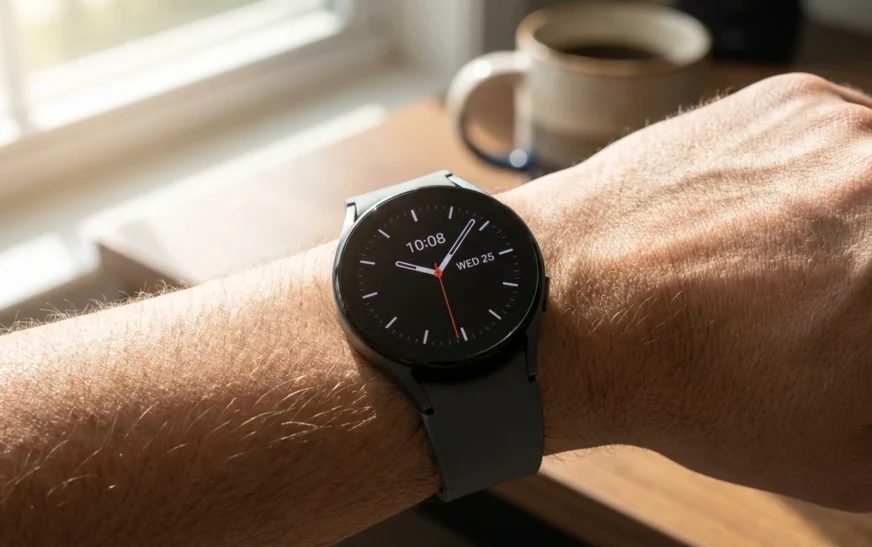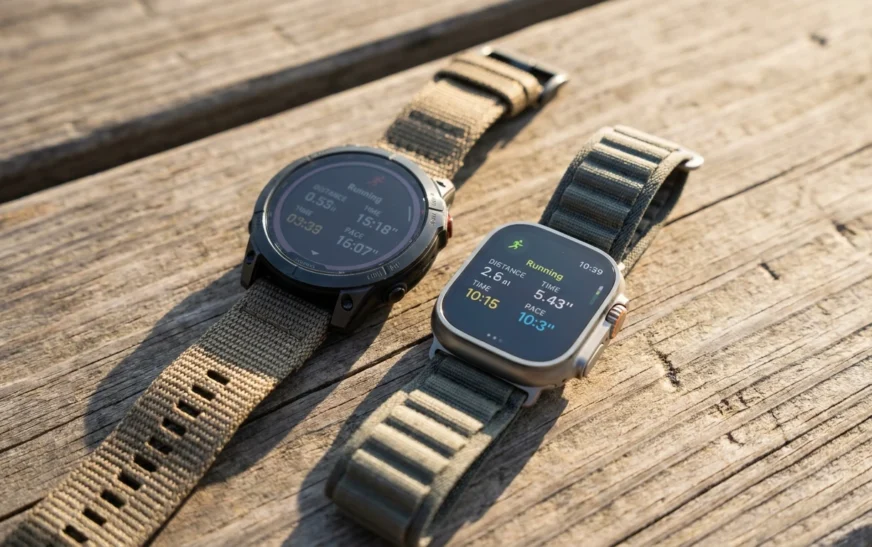
I’ve had a Garmin Fenix on one wrist and an Apple Watch Ultra on the other for stretches of testing that probably looked unhinged to anyone sitting across from me at a coffee shop. Two chargers, two apps open on my phone, two sets of notifications buzzing at slightly different times. It’s a ridiculous way to live, but it’s the only way to actually answer the garmin vs apple watch question honestly instead of parroting a spec sheet.
Here’s the short version before we go deep: Garmin wins if your life revolves around structured training, outdoor navigation, or a phone that isn’t an iPhone. Apple Watch wins if you live inside the Apple ecosystem and want one device that handles messages, payments, and health tracking without a second thought. Neither is objectively better. They’re built for different relationships with your wrist.
This isn’t a rehash of the usual comparison. I’m going to walk through where each device genuinely struggles, not just where it shines, and I’ll point out a few things most watch reviews gloss over entirely, like what happens to resale value, how the bands actually hold up, and why the answer changes depending on which specific model you’re comparing, not just the brand name.
Garmin vs Apple Watch at a Glance
Quick answer: Garmin is the better smartwatch for athletes who need multi-week battery life, precise GPS tracking, and deep training analytics like VO2 max and recovery time. Apple Watch is the better smart wearable for iPhone owners who want a full app ecosystem, cellular calling, Apple Pay, and daily health monitoring bundled into one screen.
| Category | Garmin | Apple Watch |
| Best for | Endurance training, outdoor navigation | Daily health, notifications, app ecosystem |
| Battery life | 5 days to 6+ weeks depending on model | 18-36 hours (Ultra 3 up to 3 days) |
| Phone compatibility | iOS and Android | iPhone only |
| GPS accuracy | Multi-band GNSS on higher models, very consistent | Dual-frequency on Ultra models, strong but battery-hungry |
| Training depth | VO2 max, training load, race predictors, recovery time | Workout summaries, training load is newer and less granular |
| Smart features | Basic notifications, Garmin Pay on some models | Full app store, cellular calls, Apple Pay, Siri |
| Starting price (useful model) | ~$250 (Forerunner/Vivoactive line) | ~$399 (Series 10) |
Design and Build Quality: Two Very Different Philosophies
Pick up a Garmin Fenix and an Apple Watch Series 10 side by side and the difference isn’t subtle. The Fenix feels like a tool. Chunky bezel, physical buttons you can operate with gloves on, a case that shrugs off a fall onto rocky trail. The Series 10 feels like jewelry that happens to be smart. Thinner, lighter, a touchscreen-first interface that assumes you’re tapping it in a coffee shop, not scrambling over scree at 9,000 feet.
Neither approach is wrong. It depends on where the watch actually spends its life. I’ve cracked a Series 10 screen protector on a doorframe doing something embarrassingly mundane. I’ve never worried about that with a Garmin Instinct, which is built to a military stress-test standard. If you’re rough on gear, or you work outdoors, that durability gap matters more than any spec sheet number.
Band compatibility is where things get interesting too. Garmin uses a mix of proprietary quick-release pins depending on the model, while Apple’s band ecosystem is enormous and standardized across the whole lineup. If you’re the type who swaps a strap based on outfit or activity the way some people swap a Wear OS smartwatch band, Apple makes that a lot less of a hunt.
Health and Fitness Tracking Depth
This is where the real philosophical split shows up. Apple Watch is a health device that also tracks workouts. Garmin is a training device that also tracks health. That one sentence explains almost every disagreement people have in this comparison.
Running and Endurance Metrics
Garmin’s Forerunner and Fenix lines track close to 80 distinct running and cycling metrics on the higher-end models: ground contact time, vertical oscillation, running power, grade-adjusted pace, lactate threshold, functional threshold power. Apple’s Series 10 covers roughly two dozen activity types with more generalized output. For someone building a race-specific training block, Garmin’s extra context stops being clutter and starts being the whole point. For someone who runs three times a week to stay sane, Apple’s simpler summary is arguably more useful because you’ll actually look at it.
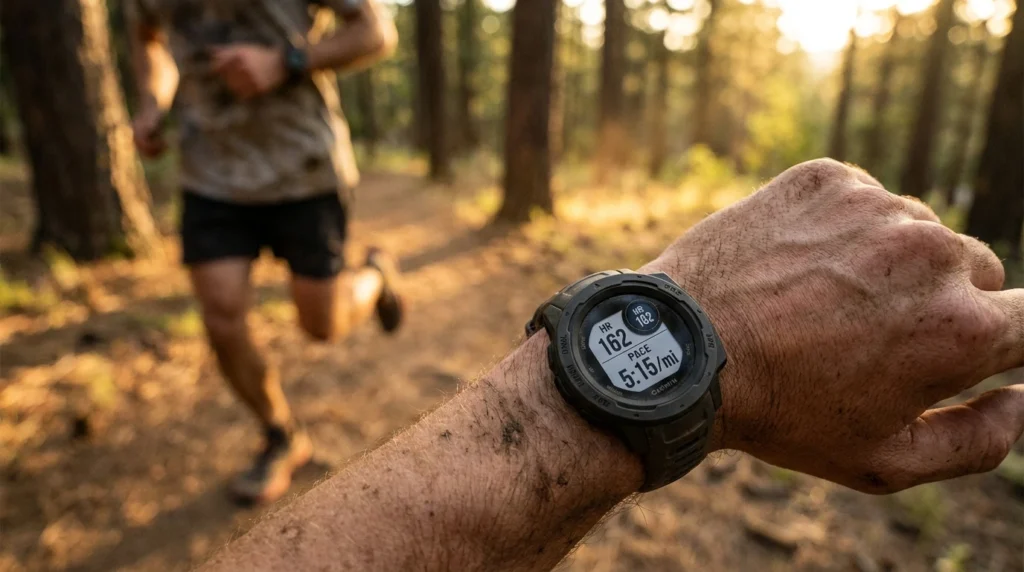
Marathoners and ultra runners lean Garmin almost without exception. The Forerunner 965 and Fenix 8 remain the standard for race-day reliability because the battery lasts through an ultra and the pacing tools are purpose-built for that exact scenario. Apple has closed ground with training load features in watchOS 11 and 12, but it’s still a first- or second-generation product compared to Garmin’s decade of iteration on the same problem.
Heart Rate, Blood Oxygen, and ECG
Both platforms now run essentially the same sensor category: optical heart rate, SpO2, accelerometer, gyroscope, compass, altimeter. Garmin uses its Elevate v5 sensor on 2023-and-newer models; Apple uses its own fourth-generation optical sensor plus a dedicated ECG chip that’s cleared for atrial fibrillation detection in the US. If ECG matters to you specifically, Apple has the edge, since Garmin’s ECG rollout has been slower and more limited by region and model.
Accuracy on both brands changes with motion type, wrist fit, tattoos, and how much the watch shifts during a hard effort. That’s a detail most spec-sheet comparisons skip entirely. A great sensor on a loose band produces noisy data no matter which logo is on the case. If you’re chasing precise numbers, fit the watch snug one notch tighter than feels comfortable during exercise, then loosen it back up afterward. It’s not glamorous advice, but it fixes more garmin vs apple watch heart-rate complaints than any firmware update I’ve seen.
Battery Life: Days Against Weeks
This is the single biggest, least negotiable difference between the two brands, and it’s the one that decides the argument for a lot of people before anything else even gets discussed.
- Apple Watch Series 10: roughly 18 hours of typical use, needs daily charging.
- Apple Watch Ultra 3: up to 42 hours normal use, around 3 days in low-power mode.
- Garmin Forerunner and Vivoactive line: 5 to 11 days smartwatch mode.
- Garmin Fenix 8 / Enduro line: 3 to 6+ weeks smartwatch mode, longer with solar charging in daylight.
Daily charging sounds like a minor inconvenience until you forget one night and wake up to a dead watch on the morning you actually wanted sleep data. I’ve done that more times than I’d like to admit with an Apple Watch. With a Garmin, charging becomes a once-a-week chore you barely think about, which matters enormously if you’re backpacking, traveling, or just someone who doesn’t want another gadget competing for a charger at 11 PM.
GPS Accuracy and Navigation
Garmin’s multi-band GNSS on higher-tier watches produces some of the most consistent GPS tracks in the industry, and it shows on technical trails with tree cover or urban canyons full of tall buildings. Apple closed a lot of the gap with dual-frequency GPS on the Ultra models, and in open-sky conditions the two are genuinely close now. Where Garmin still separates itself is offline mapping. Models like the Fenix and Epix let you load full topographic maps and navigate a route with turn-by-turn breadcrumb trails, entirely without a phone. Apple Watch relies more heavily on a paired iPhone for detailed mapping, which becomes a real limitation the moment you’re out of signal range on a remote trail.
Smart Features and Ecosystem
Before comparing anything else, there’s one fact most comparison articles bury near the end when it should come first: Apple Watch only pairs with an iPhone. Garmin pairs with both iOS and Android. If you carry a Samsung Galaxy, a Google Pixel, or any other Android phone, Apple Watch isn’t actually on the table, no matter how good the health features look in a review. That single compatibility rule eliminates half the debate for a huge portion of shoppers before specs even matter.
Android vs iPhone Compatibility
If you’re on Android and shopping for something with a fuller notification and app experience than Garmin offers, it’s worth looking sideways at a Samsung Galaxy Watch comparison instead, since Wear OS closes a lot of the smart-feature gap that Garmin leaves open on the Android side. That’s a genuinely different three-way decision than the one this article is centered on, but it’s the honest answer for Android owners who read this far expecting Apple to be an option.
On the Apple side, the app ecosystem is simply bigger. Third-party apps, complications, a real App Store, native cellular calling and texting on LTE models, Apple Pay at checkout without pulling out your phone, Siri on your wrist. Garmin has narrowed this gap with Garmin Pay and a Connect IQ app store, but it’s a noticeably smaller, less polished library. If daily smart-device convenience is what you’re actually optimizing for, Apple wins this category outright, no real contest.
Sleep Tracking and Recovery Metrics
Both watches now track sleep stages, respiration rate, and overnight heart rate variability, but they present that data very differently. Garmin bundles sleep into a broader Body Battery energy score that tries to tell you, in one number, whether today is a hard-training day or a rest day. Apple’s sleep data lives inside the Health app with less synthesis and more raw numbers for you to interpret yourself.
If sleep and recovery are actually your primary reason for buying a wearable rather than a side benefit, it’s worth comparing both against a dedicated recovery-first device. A Whoop vs Apple Watch breakdown is a more useful reference point there than Garmin is, since Whoop and Garmin’s Body Battery are solving the same recovery-scoring problem from different angles, and Apple Watch is playing catch-up to both.
Display and Screen Technology
Apple’s display is, frankly, gorgeous. Bright, color-accurate OLED that looks equally good indoors and in direct sun on the newer models. Garmin’s cheaper watches still use transflective MIP displays that look flat and utilitarian by comparison, though the AMOLED options on the Venu, Epix, and 965/265 lines have genuinely closed that gap and now look competitive in normal lighting. The trade-off is battery: Garmin’s MIP screens sip power, which is a big part of why those multi-week battery figures are even possible. AMOLED on any brand, including Apple, drains faster.
Software, App Support, and Long-Term Updates
Apple has a clear advantage in software longevity. Watch OS updates typically support a model for 5 to 6 years, with major feature additions arriving annually. Garmin’s update cadence is less predictable and varies a lot by product line; flagship Fenix and Forerunner watches get years of firmware improvements, while budget models can stagnate faster. If you want a device that keeps gaining capability well after you buy it, Apple’s update discipline is the more dependable bet.
One thing almost nobody mentions: resale value. Garmin watches, especially the Fenix and Forerunner lines, tend to hold value better on the used market because the hardware doesn’t feel dated the way a two-generation-old Apple Watch can. If you like to sell and upgrade every couple of years, that’s a real dollar difference worth factoring in alongside the garmin vs apple watch price tag on day one.
Price and Value by Tier
Entry-level Garmin (Vivoactive, base Forerunner) starts around $200 to $300 and already includes solid GPS and multi-day battery. Entry Apple Watch (SE) starts around $250 but drops ECG and always-on display. Mid-tier gets more interesting: a $500 to $600 Garmin Forerunner 965 competes against a $429 Apple Watch Series 10, and at that price point the decision really is about training depth versus daily convenience, not raw quality. At the top, the Garmin Fenix 8 and Apple Watch Ultra 3 both land near $800 to $1,000, and by that price both are excellent, so the phone in your pocket becomes the deciding factor more than anything on the wrist.
Who Should Buy a Garmin
- You run, cycle, swim, or train with any structure and actually look at the numbers afterward.
- You use an Android phone.
- You spend real time outdoors, off-grid, or somewhere charging isn’t guaranteed.
- You want a watch that survives being dropped, dunked, or scraped against rock.
- You’d rather charge once a week than once a day.
Who Should Buy an Apple Watch
- You already own an iPhone and want everything synced without friction.
- You want cellular calls, texts, and Apple Pay from your wrist without your phone nearby.
- Daily health monitoring matters more to you than marathon-level training analytics.
- You care about display quality and want the watch to look sleek in non-athletic settings.
- You’re fine charging nightly in exchange for a bigger app and accessory ecosystem.
Durability, Water Resistance, and Everyday Abuse
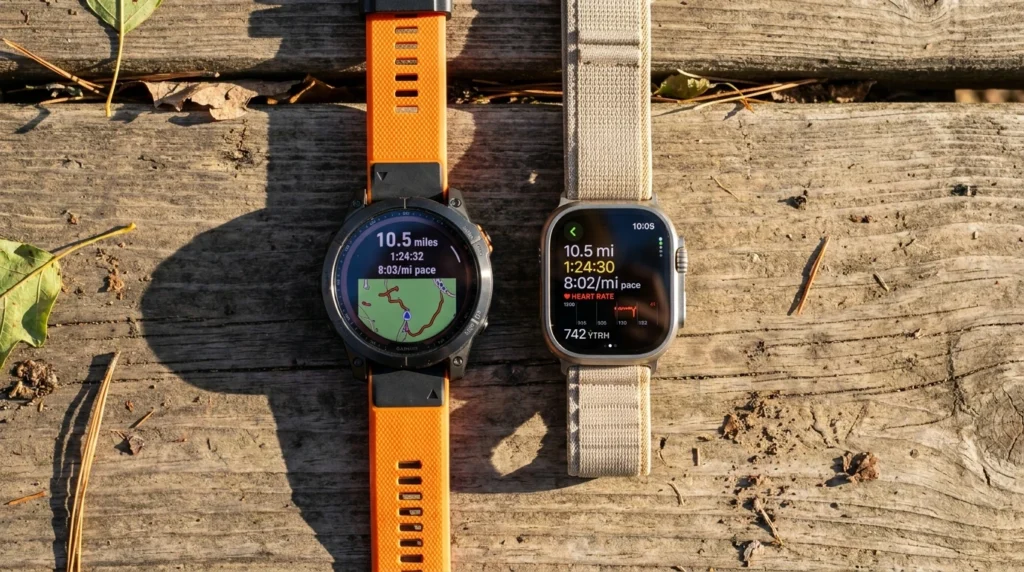
Most comparisons treat durability as a footnote. It shouldn’t be. Garmin’s Instinct and Fenix lines are built and tested to MIL-STD-810 standards, covering thermal shock, vibration, and impact resistance that goes well beyond a casual drop test. Apple Watch Ultra models meet a similar military-standard bar, but the standard Series line does not, and its sapphire crystal, while scratch-resistant, is more prone to shattering on a hard direct impact than Garmin’s fiber-reinforced polymer cases. Water resistance is close to a wash: both brands rate their higher-end models for swimming and snorkeling, though Garmin’s dive-certified watches (Descent series) go meaningfully deeper than anything Apple currently offers, which matters if scuba is part of your life and not just casual swimming.
Garmin vs Apple Watch: Frequently Asked Questions
Is Garmin more accurate than Apple Watch for GPS?
On higher-end models, yes, slightly. Garmin’s multi-band GNSS chips produce more consistent tracks in tree cover and dense urban areas. Apple’s dual-frequency GPS on Ultra models has narrowed the gap significantly, and in open-sky conditions the two are close to equal.
Can I use a Garmin watch with an iPhone?
Yes. Garmin watches pair with both iOS and Android through the Garmin Connect app, though a few deep iOS-only features like Siri shortcuts obviously stay exclusive to Apple’s own hardware.
Does Apple Watch work with Android phones?
No. Apple Watch requires an iPhone to set up and function. This is the single biggest deciding factor in the garmin vs apple watch decision for Android users, and it isn’t negotiable through any workaround.
Which is better for weight loss, Garmin or Apple Watch?
Both track calories, steps, and activity minutes accurately enough to support a weight-loss routine. Garmin’s Body Battery and training load features help pace workout intensity better; Apple’s Activity Rings and Fitness+ integration make daily consistency easier to maintain. Neither watch replaces a real nutrition plan.
Is Garmin worth it if I don’t run or hike seriously?
Probably not the flagship models. If you’re not training with structure, a mid-range Garmin Vivoactive or an Apple Watch SE will cover daily health tracking without paying for sensors and metrics you’ll never open.
How long do Garmin and Apple Watch batteries actually last after two years of use?
Both lose meaningful battery capacity by year two, typically 15 to 20 percent, similar to any lithium-ion device. Garmin’s longer baseline battery life means that degradation is less noticeable day to day than it is on an Apple Watch that already needed nightly charging when new.
The Bottom Line
Neither brand is chasing the other’s job anymore, and that’s why this comparison keeps getting harder to answer with a single winner. Garmin builds for the person who treats training data like a coach’s notebook and wants a battery that doesn’t beg for attention. Apple builds for the person who wants one device to run their whole digital life, health included, without switching apps or phones. Match the watch to how you actually live, not to which brand name sounds more impressive at the gym, and you’ll end up happy with either one. Buy for the wrong reason, and even the best hardware on your wrist won’t fix it.
Still weighing wrist real estate against a smart ring? The Oura Ring vs Galaxy Ring comparison and our look at the Ultrahuman Ring are worth a read if a screen on your wrist isn’t actually a requirement for you.

Continue Reading on CripsyWire
For more honest tech matchups, browse our full reviews and comparisons library. AI tool reviews live in AI tools and agents, phone reviews in smartphones, and wearable reviews in wearables. Before you buy, our step-by-step guides may help with setup decisions. The CripsyWire homepage highlights what is newest, all under our Tech coverage.