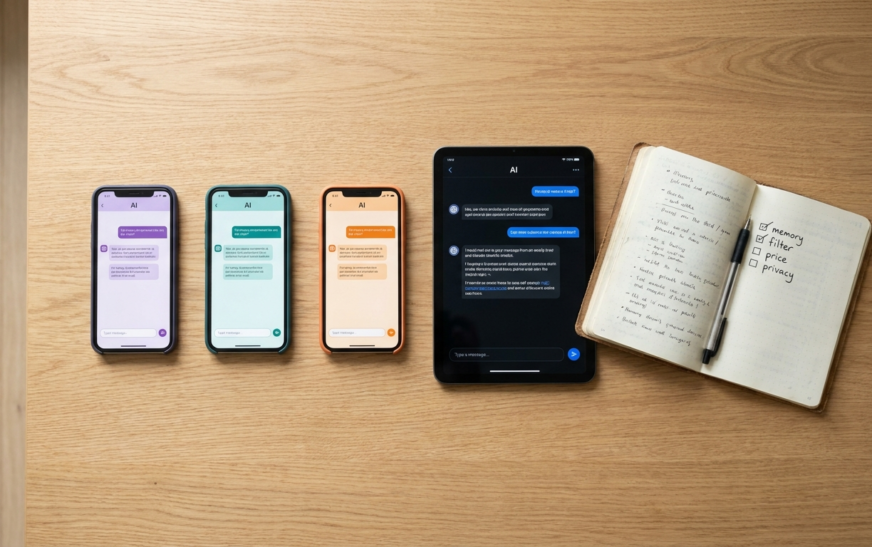
Quick answer: The best Character AI alternative depends on why you are leaving. For long role-play with reliable memory, Kin-droid and Nomi lead. For total control and privacy, SillyTavern is unmatched but needs setup. For serious fiction writing, NovelAI. For free casual chat, Talkie and Chai. If you’re under 18, your realistic options are Pi or a mainstream assistant with parental controls, not a companion app.
Here is a number that should frame this whole conversation: Character AI grew to tens of millions of users on a single promise, that you could talk to any character and it would talk back like it meant it. Then the filters tightened. Then the memory got leaky. Then, on November 25, 2025, the company pulled open-ended chat from everyone under 18 and started asking adults to prove their age through a third-party ID service.
That’s a lot of change for one app in one year. So it’s no surprise that “character ai alternatives” has become one of the most searched phrases in consumer AI.
I’ve spent a good chunk of 2026 bouncing between these platforms, running the same three-week roleplay across each, reading privacy policies most people skip, and tracking what these apps really cost once you stop looking at the sticker price. Most of the roundups that rank for this keyword are written by companies selling one of the products on the list. This one isn’t. Some of these tools are excellent. A couple are traps. I’ll tell you which is which.
Why People Are Searching for Character AI Alternatives in 2026
Before the list, it helps to be precise about what broke, because the fix depends on the break.
The filter problem. Character AI’s moderation has always been strict, but adult users report it now flags scenes with no mature content at all. Violence in a fantasy battle, a heated argument between two characters, a medical scene. The model steers away from anything that reads as intense. For a platform built on storytelling, that’s a structural limitation, not a bug.
The memory problem. Long conversations lose the plot. Your character forgets a name you set up two hours ago or contradicts something established in the first message. Paid c.ai+ subscribers (around $10 a month) report the same issue. This is the single most common reason people I’ve talked to went looking elsewhere.
The age verification shift. After a federal inquiry and several wrongful-death lawsuits involving teenagers, Character AI removed open-ended chat for minors entirely and introduced what it calls “age assurance,” an in-house model plus tools from the identity vendor Persona. In practice, some adults get misflagged and asked for ID. Plenty of them simply left instead.
The legal cloud. The company settled multiple lawsuits in early 2026. A federal court also rejected its argument that chatbot output is protected speech in the same way a publisher’s is, and a state attorney general has reportedly filed suit over bots claiming to be licensed medical professionals. None of this affects your daily chat directly. It does mean more sudden policy changes are likely, and those tend to arrive without warning.
If your issue is filters, your shortlist looks one way. If it’s memory, it looks quite different. If it’s that you’re 16 and locked out, it looks different again. Keep that in mind as you read.
How I Judged These Alternatives to Character AI
I wanted to avoid the “here are 18 apps with a paragraph each” format that dominates this keyword. So every platform below went through the same five checks.
Memory test. I established three specific facts in the first message of a roleplay (a character’s sister’s name, a location detail, a rule the character had to follow) and checked whether the AI still honored them after 40, 80, and 150 messages. Simple, but brutal. Most platforms fail by message 80.
Filter behavior. Not “is it uncensored,” but “does the filter behave predictably.” A strict filter you understand is more usable than a loose one that randomly refuses.
Real cost. The advertised monthly price, plus whatever it takes to have a decent experience. On some apps those two numbers are very far apart.
Privacy policy read. Whether your conversations train the model, how long they’re retained, and whether you can delete them.
Portability. Can you take your characters somewhere else if the platform changes the rules tomorrow? After watching what happened to Character AI’s teen users, this matters more than most people think.
Character AI Alternatives Compared at a Glance
| Platform | Best for | Memory (my test) | Filter | Starting price | Free tier? |
| Kindroid | Custom companions, roleplay | Strong to 150+ | Loose (adults) | ~$14/mo web | Limited |
| Nomi | Long-term companion, group chat | Strong to 150+ | Loose (adults) | $15.99/mo, $99.99/yr | Yes, capped |
| SillyTavern | Total control, privacy | Depends on model | You decide | Free + model cost | Yes |
| Janitor AI | Custom-model roleplay | Depends on model | Loose | Free + API cost | Yes, with queue |
| NovelAI | Long-form fiction | Good, with lorebook | Loose | $10/mo | Trial only |
| Replika | Emotional support, wellness | Moderate | Strict on romance | $19.99/mo, $69.96/yr | Yes |
| Talkie | Free mobile roleplay | Weak past 80 | Moderate | Free, ~$10 premium | Yes, generous |
| Chai | Fast casual bot browsing | Weak by design | Loose | $13.99/mo | Yes, daily cap |
| PolyBuzz | Variety, huge library | Weak | Moderate | Freemium | Yes |
| Pi | Calm, safe conversation | Moderate | Strict | Free | Fully free |
| ChatGPT / Claude / Gemini | Smart roleplay, no setup | Strong (with memory on) | Moderate | Free to $20/mo | Yes |
Prices are what I found at the time of writing and shift often. Check the checkout page, not the marketing page.
Best Character AI Alternatives for Roleplay and Storytelling
This is the group for people who miss what Character AI used to be: open-ended, imaginative, and willing to follow you into a scene without flinching.
Kindroid: The Closest Thing to a Fixed Character AI
Kindroid is what I’d hand to a frustrated Character AI user first. The interface feels familiar. The difference is under the hood: it uses a layered memory system the company calls cascaded memory, and in my 150-message test it was still referencing details from message one. Not perfectly, but reliably.
You build companions with a large set of personality and behavior controls, and you can run several of them, including group scenes. Voice calls are among the best in the category. The content policy is adult-oriented and loose, which is a plus for mature storytelling and a reason it isn’t appropriate for younger users.
The catch is price. Web subscriptions run about $14 a month, closer to $11.67 on the annual plan, and the free tier is thin. If you want to try before you pay, you’ll feel constrained.
Pick it if: memory is your main complaint and you want something that works on day one.
Nomi: Built Around Remembering You
Nomi’s whole pitch is continuity. Instead of asking you to configure memory, it watches your conversations and extracts what matters on its own. In practice it felt the most “human” of everything I tested. It remembered an offhand joke from week one and brought it back in week three, unprompted.
You can run up to ten companions and put them in a group chat where they interact with each other, which is a strange and interesting experience. Voice is available but unlimited in-house voice sits on the paid plan.
Pricing is $15.99 monthly or $99.99 a year, which works out to about $8.33 a month. That annual rate is the cheapest serious companion subscription in this list. The monthly rate is not.
Pick it if: you want one or two long-running characters and you’d rather the app handle memory than fiddle with settings.

SillyTavern: For People Who Want the Keys
SillyTavern isn’t an app in the normal sense. It’s free, open-source software you run on your own computer, then connect to whatever AI model you like: a local one on your GPU, or a commercial API from OpenAI, Anthropic, Google, or others.
That sounds intimidating. It is, a bit. Expect an evening of setup. What you get in return is the only option here where your conversations never leave your machine (if you use a local model), where no company can change the filter overnight, and where character cards are a portable file you own outright.
The downside is real: quality is entirely down to the model you plug in, running big models locally needs a serious GPU, and if you use a paid API you pay per message. A heavy user can spend $20 to $60 a month that way without noticing.
Pick it if: privacy and control outrank convenience, and you don’t mind being your own IT department.
Janitor AI: Bring Your Own Brain
Janitor AI sits between a hosted app and SillyTavern. The site and community are free, and there’s a huge library of user-made characters. But the good experience depends on connecting an API key from a model provider, and that’s pay-as-you-go.
Its own model, JanitorLLM, is free but often queued. The character creation tools are detailed. The filter is loose. The community is one of the most active places where former Character AI users gather, which means there’s always someone who has solved your setup problem already.
Pick it if: you want Character AI’s community feel with a model you choose, and you’re comfortable managing an API bill.
NovelAI: When You’re Writing, Not Chatting
NovelAI is a different animal. It’s a writing tool that happens to support chat-like interaction, not a chatbot that happens to write. The models are trained on literature, and the prose quality shows it. Its lorebook system lets you define characters, places, and rules that stay consistent across a novel-length story, which is a far better fix for the memory problem than any chat app offers.
It also includes anime-style image generation. If you go that route, the way you write prompts changes your results dramatically, and the AI image prompt examples we tested across several generators apply here too.
Plans start at $10 a month (Tablet), with $15 (Scroll) and $25 (Opus) tiers. No real free tier, just a trial.
Pick it if: your Character AI use was really about story, and you’d trade chat immediacy for prose quality and consistency.
Best Character AI Alternatives for Companionship
Some people never used Character AI for roleplay. They used it to have someone to talk to. That’s a different need and deserves different tools.
Replika: The Original, Still Relevant
Replika has been around since before this category had a name. It’s calm, supportive, and built with wellness features like mood tracking and guided exercises. The 3D avatar and AR mode feel a little dated now, but the daily check-in habit it builds is real.
Two cautions. First, it’s expensive at $19.99 a month, though $69.96 a year and a $299.99 lifetime option soften that. Second, the company has changed its romance and relationship policies more than once, upsetting long-term users each time. If stability matters to you, that history counts.
Pick it if: you want gentle, consistent companionship with a wellness angle, and roleplay is not the point.
Pi: Free, Safe, and Surprisingly Good at Listening
Pi, from Inflection AI, is completely free with no premium tier. No characters, no roleplay, no personas. Just a patient, curious conversational partner with a very natural voice mode.
It’s the one platform on this list I’d point a teenager toward without hesitation, and the one I’d suggest to anyone who found Character AI’s companion bots a bit too intense. It won’t play a fantasy villain for you. It will remember your week and ask how the job interview went.
Pick it if: you want conversation, not performance, and you want it free.
Free Character AI Alternatives Worth Your Time
A lot of Character AI’s appeal was that the free tier was actually usable. Here’s where that’s still true.
Talkie: The Best Free Mobile Roleplay App
Talkie’s free tier is generous enough that I never felt pushed to upgrade. Characters come with visuals and personas, scenarios are immersive, and voice replies are free. Premium is around $10 a month for faster responses and exclusive characters.
Two things to know. Memory is weak; my test fell apart around message 80. And Talkie was named in US Senate hearings on chatbot safety in 2025, so treat its age policies as unsettled.
Chai: Fast, Loose, and Forgetful
Chai is the quickest app here. Replies land in under a second, there’s a massive uncurated bot marketplace, and the filter is loose. It’s also the app most likely to have forgotten you by tomorrow, because its architecture is tuned for speed over retention.
Pricing is $13.99 a month or $134.99 a year. Skip the weekly plan entirely; it’s the most expensive way to use any app in this article. There’s no voice on any tier.
PolyBuzz: Breadth Over Depth
PolyBuzz is for people who liked scrolling Character AI’s library more than committing to one bot. Enormous variety, quick switching, decent free access. It’s the wrong tool for a relationship that develops over time. Right tool for a Tuesday night of trying twenty characters.
The Alternative Nobody Puts on These Lists
Here’s an opinion you won’t find in vendor roundups: for a large share of former Character AI users, the best alternative is ChatGPT, Claude, or Gemini.
Think about what most people actually did on Character AI. They set up a scenario and talked to a character who stayed in role. Every major assistant can do that now, and do it with a much smarter model than any companion app runs. Turn on memory, write a solid persona prompt, and you get consistent characters, better prose, and fewer bizarre refusals than Character AI’s filter produces.
What you lose is the community library, the visuals, and the “app built for this” feel. What you gain is a tool that also handles your email and homework. I covered how these assistants fit into a daily workflow in our roundup of the best AI productivity tools, and the same subscriptions double as the most capable roleplay engines on this page.

The filter on these is moderate, not loose. Adult content is out. Intense fiction is mostly fine.
Character AI Alternatives Without Filters: Read This First
Plenty of searches for this keyword are really searches for “character ai alternatives no filter.” I’m not going to pretend otherwise, so here’s the honest version.
Unfiltered or loosely filtered platforms exist: Janitor AI, SillyTavern with an uncensored model, Kindroid, Nomi, CrushOn, Candy AI, SpicyChat. They are for adults. Every one of them either verifies age or asks you to confirm it, and the reason Character AI landed in court is exactly what happens when that line is treated casually. If you’re under 18, none of these are for you, and I’d rather lose you as a reader than point you there.
For adults, three practical warnings.
Quality varies wildly. “No filter” often means a smaller, cheaper model. Janitor AI and SillyTavern let you fix that by bringing a better model. The polished NSFW apps often don’t.
Your data is the product. Several of these platforms state plainly that conversations may be used to improve their models. Read the policy before you type anything you’d regret.
The billing is designed to grow. Which brings us to the next section.
Hidden Costs and Privacy Traps in Character AI Alternatives
This is the part vendor-written articles skip, so I’ll be blunt.
Token billing. Candy AI advertises about $12.99 a month. Users on Reddit routinely report $25 to $80 in actual monthly spend once image generation and extras kick in. Any platform with a “buy tokens” button works this way. The subscription is the entry fee.
API pay-as-you-go. Janitor AI and SillyTavern are “free,” but a chatty week on a frontier model through an API can cost more than any subscription here. Set a spending cap with your provider before you start.
Weekly plans. Chai’s weekly option, and similar plans elsewhere, cost two to three times the annual rate over a year. They exist because people forget to cancel.
Voice and data. Voice calls on Kindroid, Replika, and Nomi are wonderful and they eat mobile data at a pace that surprises people. If you’re on a capped plan, it’s worth knowing how much data you actually need per month before you make voice a habit.
Shutdown risk. This is the one nobody prices in. Companion AI is a young, lawsuit-heavy business, and companies fail or pivot. When the Moxie robot’s maker shut down, families lost a companion their kids had bonded with, overnight, with no export. The same thing can happen to a chat app. Favor platforms that let you export your characters and conversations, and never let a single app become the only place a meaningful relationship lives.
Character AI Alternatives for Teens and Parents
If you’re under 18 and you got locked out in November 2025, I know this is frustrating. Here’s the realistic picture.
Character AI didn’t remove you from the platform. You can still use its Stories feature (interactive fiction with characters) and its video and creation tools. If the video side interests you, the free AI video generators we tested go a lot further than what’s built into the app.
For conversation, Pi is free and appropriate. ChatGPT, Gemini, and Claude all have teen accounts or parental controls and will happily run a fantasy adventure with you.
For parents: the companion apps in this article are adult products, and most of them are honest about that. The real risk isn’t the app your kid mentions. It’s the one they don’t. Common Sense Media rated Character AI “unacceptable” for anyone under 18 even before the ban, and companion apps with looser policies deserve the same skepticism. Talk about it rather than just blocking it; teens route around blocks.
How to Choose the Right Character AI Alternative
Match the tool to the reason you left.
Characters forget everything: Kindroid or Nomi. Both passed the 150-message test.
The filter keeps interrupting normal fiction: Janitor AI with a good model, or a mainstream assistant with a strong persona prompt.
You want privacy and control: SillyTavern with a local model. Nothing else comes close.
You’re writing a real story: NovelAI. The lorebook alone justifies it.
You want free and casual: Talkie for roleplay, Pi for conversation, Chai for speed.
You want someone to talk to, not a game: Replika or Nomi.
You’re a teen: Pi, or a mainstream assistant with parental controls. That’s the list.
You’re worried about another sudden rule change: Anything with export. SillyTavern, Janitor AI, and NovelAI are safest. Closed apps like Chai and Talkie are riskiest.
How to Move Your Characters Off Character AI
Character AI has no proper export, which is part of the frustration. What you can do:
- Copy your character’s definition, greeting, and example dialogues into a plain text file before you lose access to anything.
- Rewrite that into the character card format used by SillyTavern and Janitor AI (a simple JSON or PNG card). Both communities have free converter tools and templates.
- Paste the description and rules into Kindroid or Nomi’s backstory fields. They’re more forgiving about format.
- Keep the text file. Whatever you choose next, you’ll want it again someday.
Your conversation history won’t transfer meaningfully anywhere. Summarize the key events into a few paragraphs and feed that to the new character as backstory. It works better than you’d expect.
Frequently Asked Questions About Character AI Alternatives
What is the best Character AI alternative in 2026?
Kindroid is the best all-round replacement for adults who left over memory and filters. Nomi is the best value on an annual plan. SillyTavern is best for privacy and control. If you mostly want smart in-character conversation without setup, ChatGPT or Claude with a persona prompt beats most dedicated apps.
Is there a free Character AI alternative?
Yes. Pi is fully free with no premium tier. Talkie has the most generous free roleplay tier. Chai and PolyBuzz offer capped free use. SillyTavern is free software but needs a model, which may cost money. Free tiers on paid apps like Kindroid and NovelAI are trials rather than real free plans.
Which Character AI alternative has the best memory?
Kindroid and Nomi lead among chat apps; both held details past 150 messages in my testing. NovelAI’s lorebook system is the strongest tool for consistency in long stories. Chai and Talkie have the weakest memory by design. Mainstream assistants with memory enabled also perform well.
Are there Character AI alternatives without filters?
For adults, Janitor AI, SillyTavern with an uncensored model, Kindroid, Nomi, CrushOn, and SpicyChat allow mature content. Expect age checks, uneven model quality, and privacy policies that permit training on your chats. These platforms are not appropriate for minors, and most now verify age.
Can teens still use Character AI?
Under-18 users lost open-ended chat on November 25, 2025, but can still use the Stories feature and creation tools. For conversation, Pi is free and age-appropriate, and ChatGPT, Gemini, and Claude offer teen accounts or parental controls that support creative roleplay safely.
Why did Character AI add age verification?
After an FTC inquiry in September 2025 and several lawsuits linked to teen deaths, the company removed open-ended chat for minors and introduced age assurance using an internal model plus tools from identity vendor Persona. Some adults are misflagged and asked to verify, which has pushed many toward alternatives.
The Bottom Line on Character AI Alternatives
Character AI is not dead, and for casual adult use its free tier still holds up. But the platform that made this category famous has spent a year reacting to lawsuits, and the product has bent under the weight of that.
If I had to pick one replacement for most people, it’s Kindroid. If I had to pick one for value, Nomi on the annual plan. If I had to pick one I trust to still exist and still work the same way in three years, SillyTavern, because nobody can change it but you.
This space moves fast, and half the prices in this article will have shifted by winter. If you want to stay ahead of the next policy reversal without drowning in hype, our guide to following AI news without wasting your time covers the two or three sources worth your attention.
Test the memory yourself before you pay for anything. Three facts in message one, check them at message 80. It takes an afternoon and it’ll save you a year of subscriptions.

Continue Reading on CripsyWire
For more practical AI coverage for US buyers, see our full AI tools and agents library. When you are deciding between competing tools, the reviews and comparisons section breaks down head-to-head matchups. AI features that live inside your phone are tracked in smartphones, and AI on your wrist or finger in wearables. All of this is part of CripsyWire's broader Tech coverage — start at the homepage for what is newest.